
The Adventures of Fat Albert and the Cosby Kids (or Fat Albert) and Good Times: Black Again (or Good Times) share a number of commonalities. They’re both animated series that explore Black urban life. They both use comedy to address social realism. They both engage in Black storytelling.
And, unlike many other animated series about African-Americans (e.g., The Boondocks; The Proud Family; The PJs), they both include a billiard episode. Fat Albert aired the episode “Double or Nothing” in which Rudy learns a valuable lesson about winning big when he is tricked into gambling by a pool shark. Good Times premiered with the episode “Meet the Evans of New”, in which Reggie Evans gambles in billiards so he can win enough money to pay the heating bill in his apartment.
But, those similarities pale in comparison to how wildly different these two series are. Let’s just say Fat Albert’s Philadelphia and Reggie Evan’s Chicago may as well be a million miles apart.
“Double or Nothing”
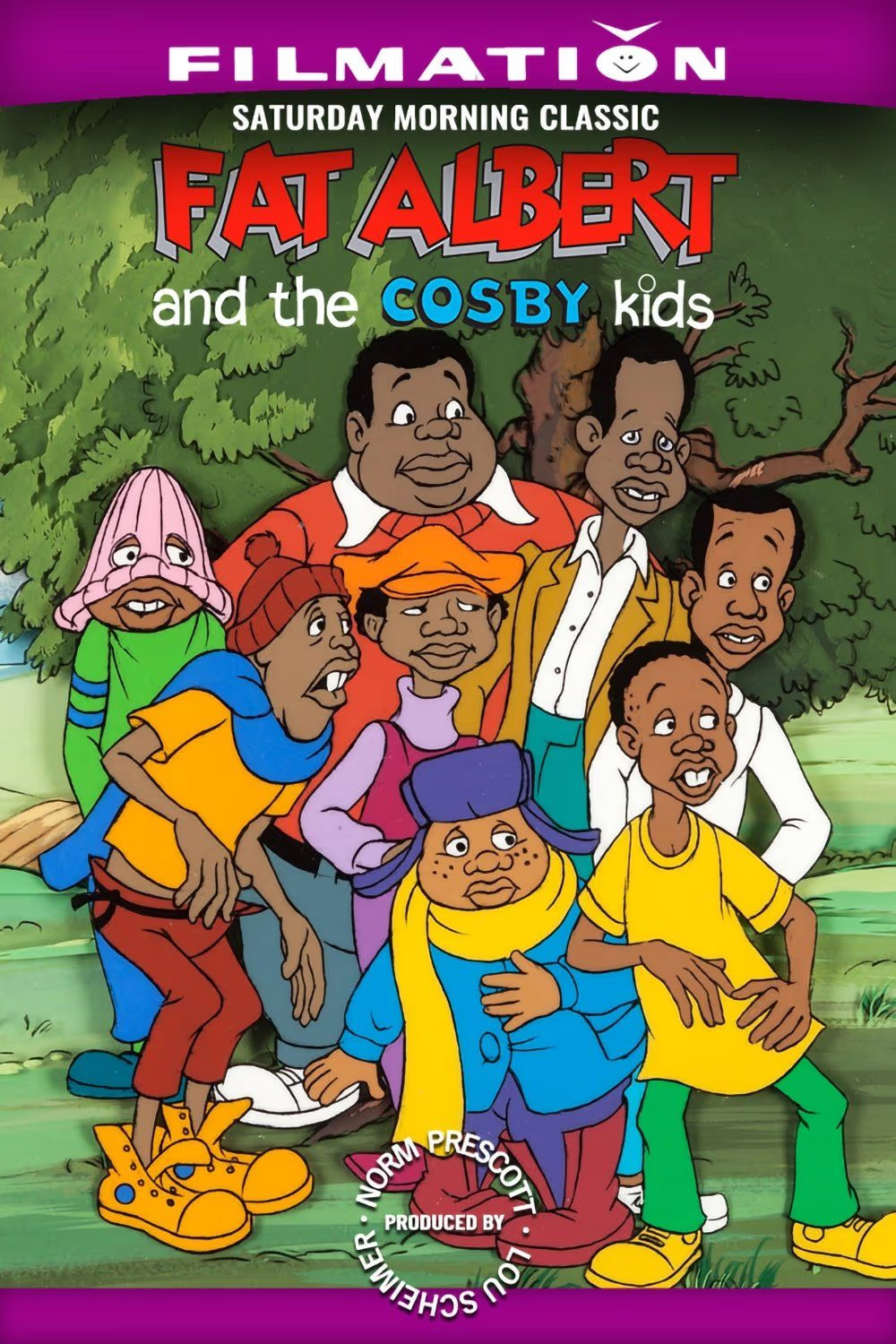 Fat Albert is an educational animated television series created, produced, and hosted (with live action interstitials and bookends) by comedian Bill Cosby. The series ran from 1972 to 1985, long before Cosby became synonymous with celebrity sexual assault. (He was convicted in 2018.) The show was inspired by Cosby’s remembrances of growing up in Philadelphia. It also reflected the intersection of both Cosby’s penchant for observational comedy, with recollections of his childhood, and his educational training. (Cosby received his Doctorate in Education in 1976 and did his dissertation on integrating the visual media of Fat Albert into Elementary School Curriculum.)
In the “Double or Nothing” episode from the series’ final season, Rudy Davis, the smooth talking, cocksure member of Cosby’s Junkyard Gang, is befriended by Arnie, who admires Rudy’s billiards skills and wants help improving his game. Eager to impress, Rudy gives Arnie some lessons and then takes him for some money. But, Rudy is too blind and greedy to recognize that Arnie is a pool shark. Rudy quickly loses back the money, and then loses the Cosby Kids’ money, too, when he tries to go ‘double or nothing.’ Still convinced it’s only a streak of bad luck, Rudy is even prepared to wager his special watch, but fortunately Fat Albert intervenes, reveals the ploy, and sends Arnie scrambling.
 The billiards storyline is pretty standard fare. What makes “Double or Nothing” interesting are the mini homilies Cosby delivers throughout the episode. He declares, “Rudy is not a very good loser. Of course, if he wants to keep on gambling, he better be, because losing is what gambling is all about.” He adds, “That’s the way gambling is. There’s no way to be a winner,” dismisses it as “for dopes,” and concludes that it is “not smart” but “downright stupid….” He leaves no wiggle room about the moral turpitude of gambling. Fat Albert is similarly decisive, saying,
“Gambling is for losers, and I’m not going to help you [Rudy] lose any more.”
The “Double or Nothing” episode is available to watch for free with ads on DailyMotion.
“Meet the Evans of New”
 You may remember meeting the original Evans family – James, Florida, Michael, Willona, and J.J (Mr. “Dy-no-mite!”) – when Good Times aired in the 1970s or reran in syndication. The show tackled complex and challenging issues about growing up in the Cabrini-Green housing projects of inner city Chicago.
Well, in 2024, an executive production team that included Norman Lear (who produced the original Good Times), Seth McFarlane (of Family Guy fame), and NBA phenom Steph Curry launched the animated Good Times: Back Again on Netflix, and it was a spectacular failure. Canceled after one season, the series was condemned by critics, audiences and multiple civil rights organizations as a “racist cartoon” that trolled in negative, crass and obscene portrayals of African-Americans.
“Meet the Evans of New” opens with the Evans family learning their heat has been turned off. After failing to raise the extra cash through his taxi cab driving day job, Reggie explains to his son Junior that to “take care of his family in a respectable way,” they must gamble in billiards. Using his grandfather’s cue stick, Reggie quickly beats most of the patrons, boasting, “Pool is in my genes and once I sink this 8-ball all your cash will be too [in my jeans].” He quickly amasses a small fortune, further schooling his son that pool halls are for “shit-talking”…it’s a place where men can “talk by themselves and can’t get into trouble.” But, before Reggie can sink the final shot against Minnesota Matt, who deigned to call him “the c-word…COWARD!,” he has to forfeit the game to rescue his youngest son.
 Aside from presenting gambling at pool in a more virtuous light, this scene probably doesn’t offer the starkest contrast between Good Times and Fat Albert. But, if you thought that pool scene marked the apex of crudeness, the remaining 20 minutes will disabuse you of that notion. They include: Junior waking from a possible wet dream on the couch; Reggie standing naked in front of his daughter; Junior wishing his “Dad’s sudsy bits can go back to normal [from the shrinkage]”; chicken buckets being used as lamp shades; babies dealing crack; a trio of babies (Baby, Lil’ Baby, and Baby Baby) shooting guns at other other babies; Beverly phoning “Not Whitey, but the True Almighty” Black Jesus for favors; Beverly visibly lactating; Beverly using her lactating breasts as a makeshift GPS to locate their kidnapped child; Dalvin doing a “key bump of formula”; a white woman wishing she had bought a Cambodian baby (instead of a black one) for adoption because “those babies are way more grateful”; Dalvin seeing a woman in a revealing top and requesting some milk; and a full-blown attack on spam, “a pink racist meat designed in a lab by a pink racist.”
All 10 episodes of Good Times are available to stream on Netflix.