Top 15 Billiards Album Covers

According to Google Search Console, one of the most common queries that leads people to my blog is billiards songs. Perhaps they’re a fan of the lyrics to Rod Stewart’s “Maggie May,” or fondly remember the video for George Thorogood’s “Bad to the Bone.” Then, I hit them with my Top 10 Billiards Songs and Video list, and it’s a whole another level of billiards music mania.

Billiards album cover Huey Lewis and the News (1984)But, if the lyrics and videos take you down one pool pocket, then the design of the album covers will steer you down a very different one. With the exception of Huey Lewis & the News’ third album, Sports, featuring an innocuous barroom pool table in the bottom left corner of the cover, and consisting of four top-ten hits (e.g., “Heart and Soul,” “Heart of Rock and Roll”), most covers featuring billiards are likely to be unfamiliar. Indeed, most of these bands, which span 14 genres across 11 countries over 50 years, are likely to be unfamiliar. Nonetheless, the portrayal of billiards in pop culture – whether in film, music, art, comics, advertising, or some combination – continues to reveal the richness of the sport and its global appeal. I therefore present my Top 15 Billiards Album Covers. (If you want to really go geek, take a peek at my Billiard Album Covers Pinterest page to see the other 125 that I ruled out.)

  1. Wilson Pickett: Pickett in the Pocket

Billiards album cover of Wilson Pickett (1974)Funk/soul/R&B singer and songwriter Wilson Pickett was a prolific music man with more than 50 songs that made the R&B charts. Pickett in the Pocket, his 1974 release for RCA, doesn’t feature any of his famous standards, such as “In the Midnight Hour” or “Funky Broadway,” though the album’s lesser-known “Take Your Pleasure Where You Find It” is considered a mammoth funk hit. But, the album cover reeks of cool, from the alliterative, pool-themed album name, to the photo of Pickett, wearing a satin red tailored, single-breasted jacket, while he patiently waits his turn at the table, with two fine ladies adorning each side of him.  Perhaps, he’s so relaxed because he has a two ball lead with solids? Or, as the back cover suggests, maybe it’s because he’ll be giving one-on-one lessons to one of the women after the game.

  1. Benny Holst / Jytte Pilloni / Katrine Jensenius / Delta Blues Band:  Så Længe Mit Hjerte Slår (En Nat Med John Mogensen)

Billiards album cover of Benny Holst (1985, Denmark)Yeah, that’s a mouthful. This 1985 rock-and-blues release from Denmark features studio recordings from the cabaret “Så længe mit hjerte slår.” For the life of me, I can’t figure out the band or album’s connection to billiards, or why the blonde feels compelled to sit on the table. Nonetheless, this cover makes the cut because of its focus on Keglebillard med huller (or Skittle Pool). In this billiards variant, players score points by knocking over the pins or by sinking balls in pockets according to local rules. And if pin billiards is now your jam, check out the Italian billiards film Io, Chiara e lo Scuro (The Pool Hustlers) that includes the nine-pin game goriziana at its center.

  1. Novo Fasili: Tvoje I Moje Godine

Billiards album cover of Novi Fosili (1985, Yugoslavia)For 30 years, the Croatian pop group Novo Fasili has been getting fans to shake their hips with their music style that combines ballad, Schlager, and Europop. By the 1980s, they were the most popular band to emerge from the former Yugoslavia. Like the previous album cover, the Tvoje I Moje Godine LP features band members sitting on the billiards table, but I can overlook such stupidity given the clever use of the billiards balls to spell the band’s initials “NF,” a lexical feat not captured on any other album cover I reviewed.  Now the only question is how did the table wind up with 23 billiards balls? 

  1. Bennewitz Quartet: Haydn, Mozart, Dittersdorf & Vanhal: An Evening in Vienna 1784

Billiards album cover of Bennewitz Qurtet (2024, Czech Republic)While it’s hardly visually interesting, the album cover for the Bennewitz Quartet’s tribute to the “Viennese Classical” circle of composers remains noteworthy for several reasons. First, it’s the only classical music LP cover I discovered that features billiards. Second, it’s one of the few album covers that focuses on carom billiards (with its pocketless table); another that didn’t make the list is the cover to the 1989 album Hotel Štístko Blues from the Czech blues band ASPM.  Finally, it’s a tip of the cue stick to Mozart, who unlike the other three composers, was a noted billiards aficionado who played the sport regularly and even owned a billiards table in his apartment in Vienna.

11. Feed Me:  High Street Creeps

Billiards album cover of Feed Me (2019)In the world of Electronic Dance Music (EDM), visual branding is very powerful. Think of Deadmau5’s mouse head or Marshmello’s giant white marshmallow helmet. Feed Me (aka Jonathan Gooch) is no exception. The former graphic designer created his trademark green monster as his visual embodiment. Now, what’s a bit harder to explain is why this green monster is playing a game of snooker with Gooch on the cover of his 2019 release High Street Creeps. Gooch has said in interviews that he grew up in England surrounded by pub culture, where snooker is commonplace, but I’m pretty sure the rule of one foot on the ground still applies. Sorry, Green Monster.

  1. Dolla Bill: “Old Schoolin’”  |. Nightblaze: “State of Grace”

Billiards album cover of Nightblaze (2025, Italy, song)Billiards album cover of Dolla Bill (2018, song)Billiards and sex have been bed partners for a long time. (See my blog post, “Rated B for Billiards: Top 10 Billiards Bedroom Scenes.”) So, it’s hardly surprising that sex, or at least hot women, would feature prominently on some covers. Tying for 10th place are two EP covers that have little in common other than the lovelies at the tables. In 2018, the North Carolina rapper Dolla Bill released his single “Old Schoolin’” with its fat bass pulse, flashes of electric piano…and a corseted woman lying prone on a billiard table while her stiletto heel naughtily lifts up the back of her dress. Fast forward to just a few weeks ago, and the Italian melodic rock band Nightblaze released “State of Grace,” the first single from their upcoming new album. Supposedly it’s a reimagining of their signature sound, but I’m still a bit bedazzled by the buxom beauty in the barroom who probably holds a pool cue as well as she holds that smoking semi-automatic.

  1.  The Intellectuals: Half-A-Live

Billiards album cover of The Intellectuals (1986, Denmark)The Intellectuals are a garage punk/rock band from Denmark who adopted a vintage pulp aesthetic for their 1986 album Half-A-Live. The LP cover leans into retro cartoon imagery popular with the punk genre (e.g., The Cramps, Crypt Records). In this case, the cover features a sailor and a roughneck playing carom billiards, while a bartender looks on. Absurdity abounds, from the juxtaposition of the band’s name with the cartoon characters, to the surreal, distorted table that sends the balls flying.  That table would probably fit well in this collection of Top 7 Billiards Tables Not For Sale

  1. Victor Fantastic Orchestra: Off Vocal Selection Shinji Tanimura / Takao Horiuchi Works

Billiards album cover of Victor Fantastic Orchestra (1986, Japan)If you’re a fan of J-Pop, you may sway to the Victor Fantastic Orchestra, a Japanese instrumental ensemble that plays orchestral renditions of classic J-Pop songs. But, you don’t have to love the genre to groove to the great cover of their 1986 album, Off Vocal Selection. Incorporating bold shapes and lines and a palette that riffs on the color of traditional pool table cloth, the album cover is positively retro-futuristic. This is what it means for pool to be hipster cool. It’s what Tubbs and Crockett would look like playing billiards in an episode of the spinoff Tokyo Vice.

  1. Brainstory: Sounds Good. |. Rez Doggz: Underdoggz

Billiards album cover of Brainstory (2024)Billiards album cover of Rez Doggz (2018, Canada)Animals playing pool is nothing new. Think of the Mr. Ed episode, “Ed the Pool Player.” Or, my blog post, “Welcome to the Billiards Zoo.” But, canine-headed humanoids? That’s a first. Except when it comes to album covers, where cynocephali are apparently not so unique. Brainstory, the psychedelic soul trio from Los Angeles, released Sounds Good in 2024. Even with the red cloth pool table, the album cover’s bar room is unmemorable, except, lo and behold, there are three pool playing patrons with dog heads. That idea may be as crazy as a rabid Rottweiler, yet six years earlier, Rez Doggz, a group of Mi’kmaq Hip-Hop artists from the First Nation reserve of Gesgapegiag, released their album Underdoggz, which similarly featured a pack of weredogs shooting stick and having a grand old time at the local watering hole.

  1. Nationaleatern: Rockormen

Billiards album cover of Nationaleatern (1979, Sweden)Recorded during a series of live performances in 1978 from the Swedish progressive rock band Nationleatern, Rockormen, which translates to “The Rock Snake,” features on the cover a billiards table with some surreal serpentine spectators and an arrangement of billiards balls with faces on them. It feels ghastly and uncomfortable. The faces may be based on real political targets, much as the band’s music often had political themes. (A similar use of representing political figures as billiards balls first appeared in a 1942 war poster, and then again on the 2013 magazine cover of India Today – Tamil. See the award Best Political Use of Imagery on a Magazine Cover.)

  1. Zekk: “Platinum Gacha”

Billiards album cover of Zekk (2019, South Korea, song)The future is 9-ball, at least for the twenty-something South Korean EDM DJ, Zekk, who made it the focus of the cover to his 2019 single, “Platinum Gacha.”  The anime illustration, foregrounding a spectacularly-fonted 9-ball, suggests a dystopia, where guards with robotic, stormtrooper-like heads act as billiards match overseers and hover dangerously close to the players. It’s not quite the futuristic billiards world Lex Marinos visualized in Hard Knuckle, though the player looks like she’d be comfortable in Bai Xinyu’s 2019 ultramodern billiards drama Metal Billiards.

  1. Jamie J. Marquez: Moon Striker  |  Eloy: Performance

Billiards album cover of Jaime Marquez (2014, Spain)Billiards album cover of Eloy (1983, Germany)Space is the place, at least according to Spanish guitarist Jamie J. Marquez and German prog rockers Eloy. On the cover of his 2014 solo album Moon Striker, Marquez takes us on an extraterrestrial journey, where a three-eyed alien, with nice form and a solid bridge, takes aim at the Earth (ball) in an interstellar game of carom billiards. Back in the Milky Way (maybe?), Eloy’s 1983 album Performance shows on the cover a human in a spacesuit playing billiards with glow-in-the-dark cue sticks and balls stamped with mathematical symbols. There hasn’t been this much planetary pool since Paul McCartney and the Wings went astro-minimal on the cover of their 1975 album, Venus and Mars.

  1. Butaotome: Billiards

Billiards album cover of Butaotome (2013, Japan)Across the top of the cover, in bold katakana, is written a title that translates to “Billiards.” Of course, Butaotome’s 2017 album was going to secure a top spot on this list. The band, a product of the country’s independently produced doujin music scene, embraces the visuality of billiards, even if there’s no direct linkage to the music or musicians. Floating billiard balls surround a woman in a red kimono descending from an escalator. The bright colors evoke Japanese ‘60s pop art, though there is also an anime influence. The modern setting, perhaps a shopping mall, also feels surreal, as the linearity of the mechanical escalator intersects with the randomness of the weightless balls.      

  1. Richard Elliot: Ricochet

Billiards album cover of Richard Elliot (2003)Smooth jazz makes my skin crawl, but I’m happy to give saxophonist Richard Elliot a second listen, simply because of the cover for his 2003 album Ricochet.  The illustration shows a vibrant group of people gathered around pool tables to play or watch. The picture is crawling with motion and energy. While Hollis King is credited as the art director for the album, the actual illustrator is unidentified. But, looking at the stylized figures, with their elongated limbs, I’d bet my Olhausen that the artist was heavily influenced by Ernie Barnes, the iconic artist who is most famous for his painting “Sugar Shack,” which was the backdrop for the credits of the sitcom Good Times. Barnes was enamored with billiards; in fact, he did a whole series of paintings that occurred in pool halls, such as Main Street Pool Hall and Pool Player. I’m sure he would have loved Ricochet, too.

  1. Black Label Society: Shot to Hell

Billiards album cover of Black Label Society (2006)Zakk Wylde, the long-time guitarist for Ozzy Osbourne, formed his band Black Label Society in 1998. On the cover of their seventh studio album, Shot to Hell (2006), they dabbled with paged imagery, as many heavy metal bands tend to do, but this time with light-hearted humor. The cover features a trio of nuns playing billiards. The first is focused intently on her shot, aiming the cueball at an eightball emblazoned with a skull on it; the other two are wistfully praying, perhaps to the Good Lord of the Baize. It’s sacrilege, of course, but with the nun’s upturned grin and the vibrant halo of colors surrounding the monastic trinity, I’m inclined to think this shot is going in. By the way, if sisters shooting stick is your salvation, then watch the “Armando and the Pool Table” episode of The Flying Nun, or purchase The Original 2021 Nuns Having Fun wall calendar. 

******

So, there’s my list. I’m sure I made some enemies with my omissions. I had to say no to some intimidating folks (e.g., Shandy, “Bish Bosh Bash”)…and to some not-so-intimidating folks (e.g., Elizabeth Barraclough, Hi). That’s the nature of the job. What would you have included on your list? Most important, the next time you’re shopping for albums – wait, does anyone shop for albums? – keep your eyes open for similar great Billiards Album Covers. 
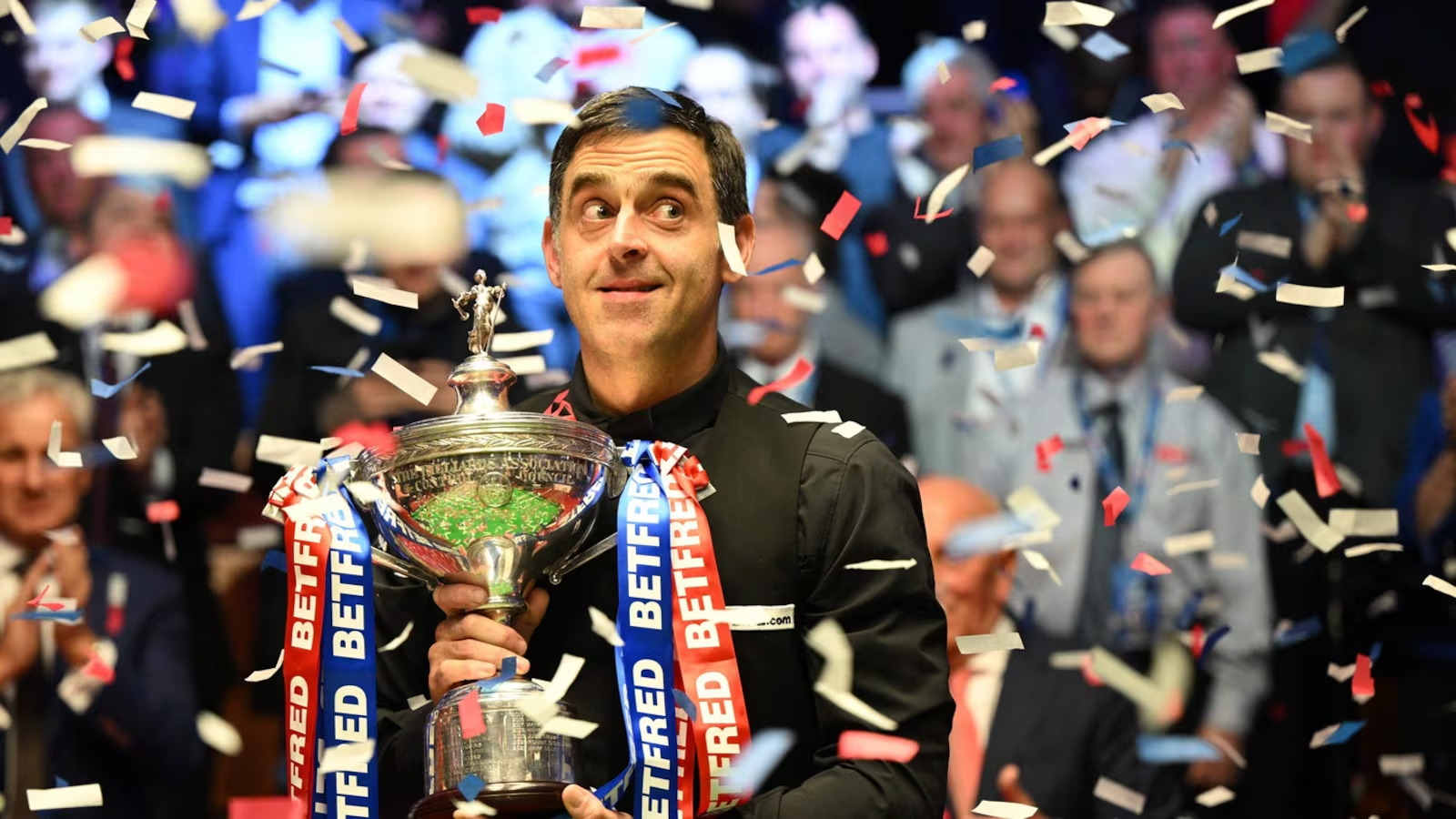
Ronnie O’Sullivan: Seventh Heaven

I have uncovered a blogging blind spot.

While I’ve posted about billiards players, from Jeanette Lee to Alex HIggins, from Willie Hoppe to Willie Misconi, from Cisero Murphy to Wilson Jones, I’ve noticed a glaring omission.

Not only is this player the focus of two separate documentaries and (loosely) one parody movie, but he also has traveled across the ocean for a documentary mini-series on pool hustlers, headlined his own TV show, co-authored three crime novels, and been involved in multiple video games. 

Yet, in 13 years of blogging, I’ve never written about him until now.

Seventh HeavenTo “The Rocket” Ronnie O’Sullivan, I say I’m sorry. You will be the focus of a lot more blog entries coming soon.

But, now that I’ve appropriately apologized, I’m tasked with reviewing Ronnie O’Sullivan: Seventh Heaven, the first major documentary to profile the seven-time World Snooker Champion, and it’s not too pretty.  

Produced by Eurosport and aired in 2022, Seventh Heaven is a one-on-one interview between O’Sullivan and Alan McManus, a retired professional snooker player, who is now a Eurosport pundit. Chronicling O’Sullivan’s life, primarily from his first World Championship win in 2001 against John Higgins to his seventh win in 2022 against Judd Trump, Seventh Heaven blurs the line between documentary and hagiography. Enraptured with O’Sullivan’s career and accomplishments, McManus gushes and glows with admiration and adulation for the Rocket. His feats and records are magnificent; his faults and shortcomings are minimized, if not ignored. Indeed, this is the story of St. Ronnie ascending the pearly gates. 

To be clear, O’Sullivan’s accomplishments are beyond incredible. His skills on the table, which are wonderfully clipped throughout the film as each World Championship win is packaged to perfection, are jaw-dropping. His 147 maximum break at the 1997 World Championship is a Guinness record in competitive play. He has achieved more than 1300 century breaks in his career. He has also won a record eight Masters titles and a record eight UK Championship titles for a total of 23 Triple Crown titles, the most achieved by any player. 

For those who follow the sport, O’Sullivan’s superhuman skill is not news. And, indeed there is joy in watching Seventh Heaven as a highlight reel. But, how much more interesting would this documentary have been if it had adequately dressed O’Sullivan’s darker side, such as his drug and alcohol abuse, his experienced depression, or his controversial comments that have led to him getting disciplined multiple times?

RonnieThankfully, there are a handful of times when McManus presses pause on the canonizing, such as when O’Sullivan discusses the loss of his father, his “backbone,” when a “part of [him] disappeared…and [he] lost his mojo.” Or, O’Sullivan briefly speaks about his panic attacks in 2000 that led to his first “snooker depression” against John Higgins. McManus even tsk-tsks O’Sullivan for disrespecting Alan Robidoux at the 1996 World Championship when he started to play him left-handed.

But, these moments are fleeting. Too much of Seventh Heaven is a paean to the Saint of Snooker. It’s a greatest hits of World Championship footage that is otherwise overcrowded by surface-level homilies and genuine reflections that don’t exactly rock the baize. 

If you’re a snooker fanatic, Seventh Heaven is probably canonical viewing; for the rest of us, let’s hope Ronnie O’Sullivan: The Edge of Everything, the documentary from Studio 99 that aired one year later, proves to be a more compelling watch.

Night To Be Gone

Tell me if this sounds familiar:

A guy walks into a pool hall, plays some games for money, and promptly loses. With a little luck, he wins on an “impossible” shot and then doubles his earnings by again making the same impossible shot. Feeling cocksure, he seeks out the best known player in town for a much bigger pot.  He goes on a roll, winning multiple games, but then gets psychologically battered and ultimately loses everything. Determined to regain his stature, he tries to make some quick buck hustling. It goes well for a while, until he hustles the wrong person and gets his arms fractured. A woman rehabilitates him, loves him, and helps him regain his confidence. He returns to finally beat the best known player, but his victory comes with a very painful price.

Night to be GoneOf course, I’m summarizing The Hustler.  Except I’m not. (Perhaps, the fractured arms rather than broken thumbs was the giveaway). I’m actually describing Night To Be Gone, an English-language billiards movie from Loren David Marsh that first released in Germany in January 2024, and is now available to watch on Amazon Prime.

Night To Be Gone is the story of Omer (Alpha Omer Cissé), a young West African refugee with a difficult family history, and Carine (Sylvaine Faligant), a recovering heroin addict from Marseille. They are itinerant grifters who both bring a lot of metaphoric baggage to the baize. Pool hustling is a path to fast cash. They arrive in Berlin so they can ultimately challenge The Sultan, a notorious and mysterious pool hustler to an all-night showdown of 10-ball with a minimum pot of 10,000 Euros. Each game is 1,000 Euros, and the match is not over until the money runs out or both players decide to quit.  Not surprisingly, they get hustled by The Sultan, who preys on their egos and erodes their cool veneer with racist and suggestive taunts. They lose all their money, forcing them to re-evaluate their get-rich-quick plans and ultimately their relationship with one another. 

Let me start with the favorable, as there are a handful of elements in Night To be Gone that are impressive – and distinct from The Hustler. The boldest and most interesting decision is that Omer is a dark-skinned, outsider from West Africa. He is an alien, a cypher to everyone he meets. But, this allows Omer to engage in some very intentional social engineering. Pool hustling is already a form of psychological manipulation. Omer compounds it by assuming racial identities that further this psychological influence. (This is both ironic and interesting, given the Sultan’s “African Prince” jeers contributed to Omer’s initial unraveling.) Among the conservative Bavarian businessmen, Omer is a welfare recipient. Playing against the liberals, he is a poor African whose village burned down. He is a drug dealer in one game, a bebopping hipster in another. Ever the racial chameleon, Omer engages people in underestimating him, which becomes their weakness, at least until it backfires on Omer when two Bauerntrampel don’t appreciate being hustled. 

Night to Be Gone.1Night To Be Gone is also a beautifully shot film. With its atmospheric black-and-white photography by Vlad Margulis and Florian Wurzer, and its eerie electronic scoring by Paul Brody, the film evokes a noirish 1940s aesthetic. Further contributing to this style is the movie’s pacing, selection of settings, and unsettling camera techniques. It works especially well for the filming of the billiards shots. Nothing feels rushed or manic; the shots are not contrived. It’s a game played for an audience of no one.

Unfortunately, these positives get overshadowed by billiards movie déjà vu, that gnawing sense we’ve seen this exact movie before. Night To Be Gone doesn’t feel like a tribute to The Hustler, certainly not the way the recently-reviewed Mr Doom felt like an ode to The Color of Money.  Rather, Night To be Gone feels like it’s trying to be The Hustler. As such, there is no suspense, no uncertainty, no question what will happen or how it will end. 

Arguably, Night To Be Gone is better classified as a remake of The Hustler. The British director Mark Murphy says, “a successful remake requires a delicate balance. It must simultaneously respect the original, bring something new to the table and feature effective casting. When these elements coalesce, the end product is a film that pays tribute to its predecessor while confidently standing on its own.” 

In this case, the “something new” is race – not just the casting of Omer, but the use of race as it pertains to hustling. Such terrain has been covered in other con artist/hustling movies – e.g., White Men Can’t Jump; Six Degrees of Separation; The Distinguished Gentleman – but never in billiards.

This feels like an accurate take on Night To Be Gone, except the director Marsh disputed it, claiming The Hustler is “an inspiration,” nothing more. If it’s not a remake, why does it feel like one? If it is a remake, why not lean into it?

Ultimately, it probably doesn’t matter. This cinematic conjecture is the milieu of film critics who can work themselves into a tizzy parsing meaning and pontificating to an audience of no one, when the real question is whether the film is entertaining. And, on that topic, Night To Be Gone holds its own. 

Early Billiards Sketch Comedies

Two years ago, I published a blog post entitled “British Sketch Comedy in the Golden Age of Snooker.”  The post began with a review of the uproarious 1973 “Pot Black” sketch from The Benny Hill Show. At the time of my publication, it was the only billiard sketch prior to 1980 that I had watched.

But, since then, my curation of billiard sketch comedies has expanded considerably and surfaced numerous jewels from 1930 to 1979. While some of the humor is now dated, these sketches and scenes represent a half-century of billiards inserting itself into mainstream culture and becoming a part of our popular vernacular. 

Brats (1930)

Any definitive list of early billiards sketches should kick off with the brilliance of Stan Laurel and Oliver Hardy, a duo that paved the way with their childish nature, physical exaggerations, and perfect timing for everyone from Lou Costello and Jerry Lewis to Peter Sellers and Jim Carrey. Brats is a 1930 short film in which Stan and Ollie take a break from their children by playing a game of pool. A mixup involving marshmallows and pool cue chalk leads both players to have issues that then become heated arguments, leading to an armoire breaking and pool felt ripping. The full film is available to watch here. Enjoy, and then experience its influence on modern billiards comedy, such as this pool-playing scene between Kramer and Fran Costanza from “The Doll” episode of Seinfeld.

Harry Tate – “Billiards” (1934)

Along with “Fishing” and “Motoring,” “Billiards” was one of several sketches centered on fads and trends that made the British music hall performer Harry Tate famous. Each sketch presented him as a mustachioed, blustering incompetent whose good intentions only contribute to the surrounding chaos. In “Billiards,” a game played for 10 pounds becomes a magnet for absurdity and calamity, as some balls appear stuck together, a drunk temporarily takes over the table, a man in an apron steps on the table to take measurements, and a high break leads to the ceiling collapsing and the wager getting called off.  The full sketch is available to watch on YouTube, though we can thank British Pathé for their film preservation efforts.

I’ll Never Heil Again (1941)

Curly, Larry, and Moe – aka The Three Stooges – made 190 short films for Columbia Pictures, each with their trademark style of physical, farce, and slapstick comedy. In I’ll Never Heil Again, the Stooges are military commanders who have taken over the country of Moronica. In a scheme to usurp their power, Princess Gilda replaces the 13-ball on the billiards table with an explosive replica, hoping the next shot will lead to their detonative death. But, the plan backfires as the new ball causes all sorts of unintended consequences on the table, with the cue ball never able to find its mark. Not surprisingly, the extended scene’s humor lies less in the supernatural shot-making and more in the Stooges’ waggery and banter.  Favorite line from the scene is Moe accusing Curly of “using too much English,” and Curly replies, “Never speak that word in this house!.” The full episode is here, with the billiards starting at 7:20.

The Red Skelton Show – “Bums Rush” (1952)

The remainder of the 1940s proved barren for billiards, but in the early 1950s, billiards reemerged on the comedic circuit, first starting with “The Sultan” episode of The Red Skelton Show. The “Bums Rush” sketch (which starts at 17:48 here) features the inaugural appearance of Skelton’s hobo clown character, Freddie the Freeloader. There’s no pool played, as all the action is situated outside a nameless pool hall, after Freddie gets ejected by the owner for pickpocketing several billiards balls.  Most of the sketch involves sight gags (e.g., Skelton diving head first into a trash can) or zinging one-liners (e.g., “I was born very poor…I didn’t even have a father or a mother.”) that would induce Dad-joke groans today. The sketch ends with Freddie outwitting the owner and running back into the pool hall, only to exit again, this time drenched, having experienced first-hand that the “pool” refers to a swimming pool. Ba dum tss!

The Abbott and Costello Show – “Las Vegas” (1953)

Bud Abbott and Lou Costello cemented their comedic immortality in the early 1940s with their radio sketch, “Who’ On First?,” that displayed their trademark ratatat wordplay, misunderstandings, memorable catchphrases, and impeccable timing. A decade plus later, they pivoted from baseball to billiards in the “Las Vegas” television episode, where Lou Costello competes in a hotel pool game. His opponent, Julius Caesar, keeps suggesting spectacularly-sized wagers that cause Costello to – literally – lose his cue stick. It’s a sight gag that wouldn’t work today, but under the physical contortionism of Costello, it’s perfect. And, when the side-betting gets subsumed by a conversation about horse racing terminology, in which Costello mistakes a horse who can run well in the mud (a mudder) as ‘mother’ and the food that is fed to a horse (its fodder) as ‘father,’ well, now we’re in the Billiards Comedy Hall of Fame.  The scene, which starts at 18:30, is available here.

The Colgate Comedy Hour – “Pool Hall” with Martin and Lewis (1955)

While “Pool Hall” may be best remembered for Dean Martin and Jerry Lewis’ heartfelt rendition of the popular standard “Side by Side,” it also offers a very entertaining billiard sketch that is classic Martin and Lewis interplay and humor.  Inside a nameless pool hall, Dino is preparing to make his final shot, when a rain-drenched Jerry enters and unwittingly proceeds to make a mess of the game. Ever the innocent man-child, Jerry accidentally interferes with shots, pours water on the table, and gets chalk powder everywhere. Straight-man Dino can barely hold it together, subtly fuming (while in character) and almost cracking up (out of character, as entertained by Lewis as the audience is). The full episode is available to watch here. “Pool Hall” was among the last sketches from The Colgate Comedy Hour before the series changed its name to The Colgate Variety Hour to reflect a move away from pure comedy.

Take a Good Look (1960)

From 1959-1961, ABC aired the game show Take a Good Look created by and starring comedian Ernie Kovacs. An odd show in which a panel of celebrities attempt to guess a secret about a seemingly ordinary person brought onstage, the clever spark was the short comedy sketches that vaguely revealed hints to the guest’s identity.  Such is the case in this sketch where Frankenstein (Kovacs) and Dracula (Bobby Lauher) compete in a game of billiards. Dracula talks a big game and shows off his knowledge of spin to Vampiress, but it’s Frankenstein who turns out to be the real pool shark. He pockets 14 of 15 balls on the break. The last one bounces out of the overstuffed pocket only then to be crushed by a monster’s hand that emerges from the table.

A Shot in the Dark (1964)

It only took one year for Peter Sellers to follow his side-splitting performance in The Pink Panther with its sequel, A Shot in the Dark.  Reprising his role as Inspector Jacques Clouseau, Sellers doubles-down on the character’s ineptitude, pompous personality, and exaggerated French accent. This time, those traits are on glorious display as he competes in a game of three-cushion billiards against the millionaire Monsieur Benjamin Ballon (George Sanders). Sellers is a master of sight gags; nobody can quite make a mess of a billiards cue stick stand like he can, and his attempts to play with a curved cue stick remain brilliant 60 years later. But, it’s his genteel observation – “I appear to have grazed your billiard table” – after slashing the baize with his cue stick that makes this scene positively memorable.

Turn-On (1969)

Cancelled before the first episode aired on the West Coast, Turn-On was the ahead-of-its-time brainchild of George Schlatter, producer of Rowan & Martin’s Laugh In. The conceptual TV show was packed full of short clips, rapid movements, and controversial topics. But, after a horrified programmer at WEWS in Cleveland shut off the show on live television, stating the remainder of the program would “not be seen this evening…or ever,” the lights were permanently turned off for Turn-On.  Those banned episodes have since surfaced on YouTube, and scattered among the non-linear sketches, multimedia assaults, and nonsensical nonsequiturs, are random clips – just a few seconds each – of a well-endowed woman shooting pool and making the balls obediently march in all sorts of directions. (An example is at 0:46 in the first episode.) Variations of this sketch (?) appear throughout the short-lived series. Hey, it was 1969 – what better time in billiards history to Turn-On, tune in, drop out, and pocket a shot.

The Tommy Cooper Hour  – “Tommy Cooper’s Christmas” (1973)

Today, the 6’4” fez-wearing Welsh comedian and magician Tommy Cooper may be best remembered for suffering a fatal heart attack on live TV, but in the mid-1970s, he was one of the most recognized entertainers in the world, due to his popular TV shows. The Christmas episode of the short-lived The Tommy Cooper Hour features the “Make or Break” sketch, which is intended to pit two Scottish snooker players against one another. However, there is a mix-up, and Thomas Cooper, amateur golf champion, shows up, instead of Terrence Cooper, amateur snooker champion. The sketch mocks the formality of snooker and its peculiar lexicon and rituals, and then draws comparisons between snooker and golf. (“Snooker is a game with balls and a sort of stick.” “That’s golf,” replies Cooper.) Such jokes elicit a grimace, maybe a chuckle, and then a half-gasp after Cooper magically balances two billiard balls on the tip of a cue stick. But, the skit ends on a high note when the real retired world snooker champion Joe Davis shows up (in all his Tartan glory) and proceeds to play the sport as if it’s golf by standing on the baize and swinging at the balls. The full episode is here. The sketch starts at 24:16.

The Carol Burnett Show – “1908 World Championship Match” (1978)

With 70 Emmy nominations and 25 Emmy wins, The Carol Burnett Show helped cement Carol Burnett as a comedian supernova. Buried within the variety show’s 279 episodes is a brief billiards sketch that unfortunately does not feature the eponymous star. As the name suggests, “1908 World Championship Match” is a competition between two players, TCBS regular Ken Conway and special guest Ken Berry. With its sepia filter and vaudeville music, the sketch harkens to the silent film era and re-introduces the physical antics of earlier sketches referenced in this post. Conway and Berry never actually play pool; the attempt to determine who should shoot first (this was before lagging for break became a norm) goes awry as Conway keeps accusing Berry of cheating. Tempers flare, and soon the players are antagonizing one another with an escalating assortment of dirty tricks. The sketch is amusing, though the real prize is watching Berry’s effortless acrobatics as he somesalts off the billiards table or into a crowd of onlookers. The sketch is available to watch here.

Laugh-In (1978)

Unfortunately, the original Rowan & Martin’s Laugh-In, a countercultural landmark in sketch comedy, does not feature any billiards; however, Laugh-In, the short-lived revival series from the late-’70s does, and it’s pretty unfunny. It seems the series’ producer, George Schlatter, opted to fish in the well of his cancelled show Turn-On and recycle the random billiards snippets. Throughout the February 1, 1978 episode are a running series of 5-second clips (i.e., 05:17, 19:29, 35:55, 42:45) with Ben Powers attempting to play pool, and the balls thwarting his efforts by splitting apart, popping out of pockets, and getting stuck on his cue stick. It’s just bad. There is nothing risque or amusing. The episode was at least somewhat saved by a young unknown cast member named Robin Williams (before he blew up on Mork & Mindy), the singing of Tina Turner, and special guest Jimmy Stewart.

As the 1970s faded into memory, the Me Decade would usher in a whole new set of billiard sketches, including The Muppet Show – “Cross Country Billiards” (1980), Not the Nine O’Clock News – “Smith and Jones: Snooker Tournament” (1981), and The Cannon & Ball Show – “Invisible Snooker” (1982), but that’s a topic for a different day’s blog post.

Mr Doom: Behind the 8 Ball

Every pool hustling movie lives in the shadow of The Hustler and its sequel The Color of Money, the modern apotheosis of the genre, which is ironic given the film was released almost 40 years ago. Most of these films are cinematic wannabes, kowtowing to TCOM without much originality or innovation. 

Mr Doom.1Certainly, that was the reaction within the billiardsphere earlier this month when it was announced that Robert DeNiro and Jenna Ortega would star in Shutout, a forthcoming movie about a seasoned hustler guiding a talented young player in the world of high-stakes pool. To quote Billiards_Watch from the AZ Billiards Forum, “That’s the most played out script and looks to be another Hollywood recycle…This is The Color of Money remade except it’s rebranded with another title.” 

So, director Leif Johnson is walking the plank a bit with his new billiards movie, Mr Doom: Behind the 8 Ball. Released on Amazon this past March, Mr Doom doesn’t try to hide its lineage; on the contrary, the film embraces it, starting with the title, which is an overt reference to the name of Vince’s Balabushka cue in TCOM. The film’s marketing is even more explicit, referring to Mr Doom as “reimagining The Color of Money in a small-town setting.” 

While the idolatry is on full display, Mr Doom ultimately carves out original ground and a touching story about the unlikely friendship between the film’s two main characters, Charlie and Jack, that both harkens to the relationship between Fast Eddie and Vince and still feels distinctly different.

Mr Doom.v4Charlie (Danny Parsons) is the Fast Eddie of this pairing. Emitting a smoothness somewhere between Jason Statham and Idris Elba, Charlie is a seasoned hustler, who sees an opportunity to score big if he can tame Jack (Danny Sutcliffe), a self-destructive sot who is surprisingly adept with a cue stick. Jack is the movie’s Vince, except he looks like a Northern English Wavy Gravy; a hippie version of “Bobby Elvis” Munson from Sons of Anarchy; a drunken mix of Captain Lou Albano and The Dude from The Big Lebowski.  Except the megawatt smile and the arm candy named Carmen have been replaced with a rats nest of a food-caked beard and a front-seat handjob from a hooker.

Initially, Charlie and Jack seem like they’re from different worlds. Disgusted by Jack’s boorishness and vulgarity, Charlie hustles him, taking advantage of Jack’s inebriation while pretending to also drink. (There is also a drunken spinoff of Vince’s “Werewolves of London” chest-thumping scene from TCOM.) Having humiliated Jack, Charlie then attempts to harness him, putting him in his debt while teaching him how to hustle pool. Echoes of TCOM abound.

But, the movie turns an emotional corner as we realize beneath Charlie’s cool exterior is his own wreckage of ruined relationships; similarly, behind Jack’s ogrish veneer are pockets of warmth and loyalty to something other than a vodka bottle. As their two backstories collide into one another, a fragile tie starts to unite them and ultimately cements itself in a final 9-ball match against a former partner of Charlie’s. 

Interspersed throughout Mr Doom is a hefty dose of blackball (English 8-ball) and 9-ball, which is interesting, given the tendency of most British billiards films to focus exclusively on snooker. (Perhaps, a bit more puzzling is the decision to film with a spotted cue ball.) While the games aren’t novel, the filming of the games is fast-paced and dynamic, a style intended to emulate that of Edgar Wright, according to Mr. Johnson

I’d be challenged to call Mr Doom groundbreaking or even a great movie. But, for those that enjoy entertaining characters, a well-crafted story, and a fresh take on a familiar film, then Mr Doom is worth the watch.

ChuckleVision – “Big Break”

I’ll give the viscount credit. He’s got a lot of patience.

Consider: mud is tracked all over his Persian rug; his early Bronze Age sculpture gets broken; his Carrara marble cherub statue is stolen then damaged; the foundation of his mansion partially collapses; his Rembrandt painting is used as a serving tray; and he is deluded into thinking his pet fish was fried and served for lunch.

But, all of that pales into comparison to the real horror committed by Barry and Paul Chuckle, the two  brothers who have been contracted to install the viscount’s new snooker table .

That’s the premise of the “Big Break” episode of ChuckleVision, a British children’s comedy series that ran for 292 episodes from 1987 to 2009. It starred real-life brothers, Barry and Paul Elliott, as the Chuckle brothers, a pair of endearing half-wits who often get into laughable trouble due to Paul’s oversized confidence and Barry’s attempts to clean up his mess.  “Big Break,” presumably named after the popular Big Break snooker game show, aired in 2007.(1) The full episode is available to watch here.

For children watching this episode, there are some obvious lessons. Don’t serve food on a Rembrandt. Don’t serve food from Barney’s Chippy to “a bunch of posh people.” But, the snooker care lessons may be a little more obfuscated, so let’s dig in.

For starters, you really don’t need to worry about two dunderheads absconding with your snooker table. It’s just too heavy. Given the viscount’s social standing, he presumably ordered the installation of a full-size 12’x6’ snooker table. Even if the Chuckle brothers mistakenly built it on the patio rather than in the basement, they could never undo the mistake by moving it by themselves, as it weighs approximately 2,755 pounds. 

Now, admittedly, the table does look rather small, so perhaps the viscount cheaped out and bought a six- or seven-foot table. Even at that size, the table would weigh 375-450 pounds, much too much for Paul and his pipsqueak brother to carry.

Even if one could move a fully assembled snooker table,  never try to move it down stairs without taking it apart. Barry surfaces unharmed when the table he’s carrying down the stairs falls. But, in practice, even a small table would have a gravitational acceleration of 9.8 m/s² (assuming a 10-foot vertical drop), which would release 6000 joules of energy – the equivalent of a severe car accident or a significant blunt trauma event.

ChuckleVisionBut, somehow the Chuckle brothers do get the fully installed table into the basement, only to put it in a room with insufficient space around the table to properly set up shots. At a minimum, this table requires a 15’x12’ sized room; instead the table is stuck in a tight storage room. It’s no wonder Paul damages the walls attempting to pot a ball. 

The large hole in the wall introduces a new problem, which is compounded by the mansion’s collapsing foundation. The table is now exposed to outside temperatures.  But, indoor tables, made of hardwoods, felt, and other delicate materials that are prone to damage, require a controlled indoor environment with a constant temperature and low humidity levels. No one is playing world professional snooker on this table. It doesn’t require a 21 degree Celsius playing surface, but surely greater temperature control is necessary.

Finally, wherever you install your table, don’t put it directly under a fish tank. Water can cause stains, warping and, worse, mildew. Even our lamebrain contractors know that, as it’s only when the tank’s water starts pouring out of the ceiling onto the table does Barry suggest to the viscount an alternative to playing snooker: “How about some pool?”

*****

  1. “Big Break” was not the first ChuckleVision episode to reference snooker. As early as the season one (1987) “Sport” episode, the brothers were reporting on the sport.

Extraction, USA

Extraction 1Here’s the good news: aside from the similar title, there’s no confusing the low-budget, quasi-billiards movie Extraction, USA with the $65 million Chris Hemsworth one-man-army action movie Extraction. In fact, the sum of the “action” in Extraction USA is a man getting beaned in the head with a billiard ball. 

Here’s the bad news: if you thought Extraction was a painful watch (and I’m not referring to all the literal pain Hemsworth afflicts on the Bangladeshi hooligans and drug lords), then you’re in for a difficult 90 minutes with Extraction, USA.

Directed by Mike Yonts and released on Tubi last November, Extraction, USA tells the story of Marni (Leanne Johnson), a single mother, and Steph (Marlee Carpenter), a mysterious drifter, who initially connect by hustling pool and then form a romantic relationship that is tested through the discovery of an underground drug ring. Underpinning all their sharking and derring-do is an urgent need to escape Extraction, the metonymic town named for the industry that supports it, and start a new life far, far away.

The industry, whether it’s fracking or something comparable, contaminates the air and water, creating an urban stink and making the city borderline unlivable and mostly impoverished. The typical lament is that there are a “few extraction millionaires and the rest of us fighting over the scraps.” Against this polluted backdrop, it’s no wonder that Leanne hustles pool for a few extra dollars so she can keep her son in school and avoid having him become a “muck kid.” 

Extraction, USAThen, along comes Steph, a platinum-haired gypsy, whose sojourn somehow has led her to the Time Out Lounge in middle-of-nowhere Extraction, and it’s love at first break. The chemistry dials up to 11 quickly, and pretty soon our sapphic duo are living together, telling lies to Marni’s uber-gullible son, sneaking into deep-pocket pool games, and eventually planning a heist to steal some drugs that “are like rocket fuel for the mucks” to get them to work harder.

Plotwise, it’s preposterous, but nothing is as absurd as the pool-training and pool-playing sprinkled throughout the first half of the film. After learning that Leanne is the best player in town, Steph trounces her and then becomes her Fast Eddie coach, showing her how to make… wait for it… straight-on shots. It’s Pool For Dummies, with high fives abounding after the simplest of shots. In case the nod to The Color of Money was missed, Leanne quotes Paul Newman’s character on two different occasions: “money won is twice as sweet as money earned.”

The games involving hustling are nominally more interesting, solely because of “quake rules” (i.e., if there is a tremor caused by a local extraction and the balls move, they’re played wherever they land). But, those games are filmed unimaginatively, with a sole jump shot breaking the monotony.  (I don’t know how much Tammy “Lefty61935” Anderson, the credited “billiards trainer” earned for this film, but she was overpaid.)

It’s not that Extraction, USA lacks heart or grit. The makers of the film said it was “one of the toughest tasks any of us ever attempted. Like most indie film crews, we put in some long days and endured all sorts of uncertainty about locations, vehicles, and funding.” 

But, shoestring budgets can yield great films. Look at Rocky or Mad Max or Halloween.(1) So, that’s a challenge to conquer, but not the underlying issue.

Extraction 2Rather, it’s the film’s desire to be a little of everything that ultimately turns it into a mishmash of nothing.  Per the makers, “On one level the film is about crime and action, but if you look a little deeper, it says some interesting things about income inequality, the environment, and men and women in the workplace.” 

Therein lies the problem. Extraction, USA triples-down on its multitude of identities. Go to the movie’s website, and the three themes (or “flavors”) – heist, romance, dramedy – are highlighted, each with its own movie poster.

In the zeal to genre-bend and create a movie that is intended to appeal to multiple types of viewers, Extraction USA fumbles through its competing storylines, short changing any real dramatic tension or character evolution.  And by making billiards seminal to the story’s arc, without investing in making the billiards remotely realistic or interesting, the movie completely fizzles, leaving just the stench of extraction in the air.
—————————

  1. Rocky (1976) was made for $1 million and brought in $225 million worldwide. The franchise has grossed $1.9 billion. Mad Max (1979) cost $300,000 and hauled in $100 million. Halloween (1978) was created for $300,000 and raked in over $70 million worldwide. (source: Collider.com)

Whole Lotta Hustle

The Hustler (novel)In 1961, when 20th Century Fox released The Hustler, Robert Rossen not only made history by directing the gold standard of billiards movies, but also forever popularized the hustler avocation and its association with pool. Though the term “hustler” had been used by road players throughout the twentieth century, and was also the title of Walter Tevis’ first novel, from which The Hustler was adapted two years later, it was Rossen’s movie that permanently injected the hustler into billiards pop culture.

Over the last 63 years, the “hustler” appellation has appeared in more than two dozen billiards movie and television episode titles, ranging from short films (e.g, The Hustle) to international films (e.g., Io, Chiara e lo Scuro, aka The Pool Hustlers); from sketch comedies (e.g., “The Hustler of Money”) to documentaries (e.g., Raising the Hustler); from games shows (e.g., Minnesota Fats Hustles the Pros) to reality shows (e.g., The Hustlers).

The films and shows below are all members of that titular tribe of “hustlers,” tipping their cultural hat to Rossen’s original masterpiece. They all have a whole lotta hustle, even if, unfortunately, most don’t have that much else about which to boast.

MADtv – “The Hustler” (1999)

MadTVNever able to fully compete with Saturday Night Live, the sketch comedy show MADtv nonetheless developed a cult following for its lowbrow humor and hot takes on celebrity culture. During the show’s fourth season, comic big man Will Sasso donned the pinstripes and assumed the Minnesota Fats role in the four-minute “The Hustler” sketch.

Essentially, a fat man walks into a pool hall and attempts to convince a local patron that he’s no hustler, just “passing the hours playing the game I love.” He offers to play a game for $5, and he loses. For $20, he loses again. The gag is that he keeps upping the amount and losing, eventually paying out one million dollars. But, when it’s time to complete the hustle and rein in his patsy, his opponent leaves with all the cash. It’s a cute concept, but the predictable joke falls flat quickly. For a far funnier take on The Hustler, watch The New Show with its identically named sketch, “The Hustler.”

Malcom & Eddie – “Do the K.C. Hustle” (1996)

During the 1990s renaissance of black sitcoms, Malcolm & Eddie may not have made anyone’s top five list. Nonetheless, there was far worse watching than this UPN series which paired the responsible and cocksure Malcolm (Malcolm Jamal-Warner, following up his wild success on The Cosby Show) with the fast-talking and frenetic Eddie (Eddie Griffin), who together open a sports bar called McGee’s.

The “Do the K.C. Hustle” episode focuses on a billiards rematch between Malcolm and his old college friend Preston Alexander, now a self-assured millionaire. Preston pokes Malcolm’s ego, getting him to wager $5,000 on a game; only after the deal is sealed does Preston perform some incredible pool shots and Maclom realizes he’s been hustled. 

The episode veers in some strange directions involving lingerie and an oversized masseuse, but it’s the wonderful cameo of Richard Pryor as Coach Uncle Bucky that saves the day. Appearing on a power-operated mobility scooter due to his multiple sclerosis, Pryor’s voice is shaky, but his comedic delivery remains spot-on. Though Pryor doesn’t pick up the cue, he doles out good enough advice that Malcolm has the confidence to (1) play without wearing women’s underwear (!!); and (2) make a beautiful multi-ball, multi-rail trick shot to end the game and win the $5,000.  

Special kudos to Chef Anton, the episode’s billiards technical advisor, who became the first two-time United States Trick Shot Champion of Pool.

Out of the Blue – “The Hustler”  (1979)

With only eight total episodes airing, Out of the Blue is a sitcom trainwreck. The deeply unfunny series starred Jimmy Brogan as Random, an angel-in-training who is assigned to live with (and act as guardian angel for) a suburban Chicago family. (How anyone thought this premise could be humorous is mystifying, but then again, Touched by an Angel ran for almost a decade.) 

In “The Hustler,” the Richards family needs to come up with an extra $20 to buy their aunt a sweater. Older son Chris thinks he can make it playing pool, but is quickly hustled.  Random cringingly explains, “He let you win a few times. That’s how a hustler sets you up. You’re known as a pigeon. You flew right into his coop.” Lesson learned, Random then gives the hustler a taste of his own medicine, performing the famous six ball butterfly trick shot and quipping, “You’ve heard of Minnesota Fats? They call me Pearly Gates Slim.” (For a more original and funnier permutation of billiards legend Minnesota Fats’ name, watch the Aurora Skittle Pool commercial (1970), featuring comedian Don Adams as “Wisconsin Skinny.”)

I might be more forgiving of this dreck were it not for the deplorable lack of billiards realism. In the first game, Chris’ opponent calls the ball in the corner pocket and then hits it into the side. The cue ball then magically moves to a different part of the table and many of the balls formerly on the table are now mysteriously pocketed. The second game is even worse, as the butterfly shot clears the table, though only six balls went in. The full episode is available to watch below.

Small Time Hustle (2011)

Some time between 1961 and 2011, “hustle” must have become so vulgarized as to have lost its meaning, or else I’m not understanding Rian Lehman’s short film, Small Time Hustle. This wearying film features a couple of small town locals playing pool, sometimes winning money and sometimes losing money. Everyone looks bored, the pool playing is repetitive (as is the music), and there’s no hustle, just a cashier who proves to be a better shot than his opponents. The saving grace is a colorful final 9-ball shot in which the eight ball is first pocketed, and then the ball’s backspin pockets the 9-ball in the opposite side pocket.

Takes Two to Hustle (2014)

Takes Two to HustleJohnny Bastoni and Ace Maserati are respectively the billiards hotshot wildman and his protective gorilla sidekick, who make money hustling pool and earning street cred. In fact, they’re such local legends that one fan is seeking to make a documentary about them. At least, that’s the premise of Alberto D’Onofrio’s Canadian short film Takes Two to Hustle

Except, in mere minutes, all plausibility is thrown out the window. The only hustle we see Ace make is winning $100 and proclaiming “this is the life!” As for the “crazy motherfucker Bastoni who is scared of nothing and can shred you to pieces,” he comes across as intimidating as a middle school science teacher.  The urban folklore seems a far cry from the pathetic reality of these two “heroes of the street.” Remind me why anyone would want to watch a documentary about them?

The Hustler (2013)

The HustlerCatalan screenwriter David Bertran made waves in 2017 with his short film Coming to Terms that won 45 Awards and was officially selected in 103 film festivals. His first short film, The Hustler is far less well-known, and unfortunately seems unavailable to locate or watch.  According to IMDB, the movie is about when “a real estate millionaire, his trophy wife and a hustler engage in a game of pool, things do not always go according to the plan.” If you have any information about this movie or the whereabouts of the people involved in its creation, please contact me directly.

The Real Hustler (2017)

Even less is known about Felipe Lopez’ short film The Real Hustler, which promises, “Pool is a hustlers’ game. One can be the hustler, but someone has to be the mark.”  If you have any information about this movie or the whereabouts of the people involved in its creation, please contact me directly.
The Hustle (TBD)

Lest you conclude the hustler’s heyday has run its course, there was a casting call eight months ago in Houston, Texas for The Hustle, a short film that “follows the story of Jake, a confident, seasoned pool hustler who believes he’s unbeatable. One night, he struts into a pool hall, exuding confidence and charm, and quickly hustles a couple of overconfident guys. However, his night takes an unexpected turn when he meets Rebecca, a seemingly casual player who is more than meets the eye.”

And, just in case you’re not convinced that the billiards hustler has become as ubiquitous in pop culture as the criminal mastermind, the charming outlaw, and the ice queen, I leave you with the trailer for Custer Hustler, a pool movie that was never actually made.


Break (2024)

Break (2024).v2After watching Break, Will Wernick’s tedious and hackneyed film that released earlier this year, I asked ChatGPT to create the most cliched billiards movie possible. The similarities to Break were striking, but not surprising.

Break follows the story of Eli King, a twenty-something from Southfield, Michigan, who balances multiple jobs while caring for his family. His life takes a dramatic turn after a game of 8-ball with a local frat boy turns violent. He is suddenly thrust into Detroit’s billiards underbelly, where shady characters and doting old-timers spend their days and nights at the Loving Touch Pocket Billiards hall. There, he discovers his runaway father’s legacy as a pool legend. He embarks on a transformative journey, which will encompass highs and lows, love and violence, and, of course, the ultimate, winner-takes-all match of 9-ball against evil Jimmy, the man responsible for forcing his father to leave town.

ChatGPT pitched me the (fake) movie Cue of Destiny. “Small-town prodigy Jake Daniels reluctantly enters the high-stakes world of underground billiards to escape his dead-end life, guided by his estranged father, a disgraced pool hustler. Facing colorful rivals and his own insecurities, Jake must overcome impossible odds to take on Vincent “Viper” Kane, the man who destroyed his father’s career. With a heart-stopping final shot, Jake redeems his family’s name, wins the championship, and forges his own path as a legend in the making.”

Aside from the fact that Cue of Destiny is at least an original title, as opposed to Break, which may have cribbed its title from Sam Elkins’ superior billiards movie Break (2020), the two movies read like cinematic kissing cousins. Their shared DNA consists of every recycled billiards trope, two-dimensional character, and watered-down plot idea imaginable.

Break (2024)Taking the comparison a step further, I asked ChatGPT for some sample dialogue from Cue of Destiny. The billiards screenwriter in the ether replied,”Pool ain’t just about sinking balls, kid. It’s about controlling the table. Same as life—if you don’t own the table, someone else will own you.” 

As for Break, the three-person writing team scripted a similarly clichéd zinger, “Learn how to play the game or the game will play you…Keep your life clean, the game will work out.”

The shame is if you remove the derivative dialogue, the cardboard characters, and the atrocious acting from the lead (Darren Weiss, who is also the executive producer), you’re left with a film that genuinely seems to enjoy billiards, or at least, the filming of billiards. 

A variety of camera angles and filming techniques were used to capture the motion of the balls and the beauty of pocketing shots. There are some great bank shots, some well-crafted shot sequences, and a particularly sweet double bank shot with just the right amount of English. 

We know director Will Wernick likes billiards, or at least terrorizing people in upside down pool halls, as evidenced in his 2017 horror flick Escape Room. But, more likely, credit goes to cinematographer Akis Konstantakopoulos and editor Daniel Gibb, as well as billiards coaches (and presumably technical advisors) Steve Sherman and Spencer Ladin. (According to an interview with Weiss, Ladin also spent about three hours a day, three days a week for three months teaching Weiss how to shoot billiards.) Sportsman Family Billiards in Englewood, Los Angeles, also proved a great locale as the venue standing-in for Loving Touch Pocket Billiards.

Other callouts go to actress Braedyn Burner, who makes the most of her flimsy character Millie, the overnight love interest of Eli, and veteran actor Jeff Kober, who plays evil Jimmy. Kober is an Emmy-winning actor (General Hospital), who played a number of unredeemable and far more memorable characters in shows such as Sons of Anarchy, The Walking Dead, and Out of Bounds. He’s the C-list headliner for Break, much like Rutger Hauer was the marquis (and more recognizable) name that helped the other Break (2020) stand out from the billiards pack.

Unfortunately, neither a few good actors, nor an affinity for billiards, can save this otherwise miserable movie from the billiards trash-heap. To quote ChatGPT one more time, “I guess some tables just aren’t meant to be won.” The same is true for billiards movies.

Break is available to stream on Amazon Prime. You can watch the trailer below.

City Hunter – “Mokkori Is the Best Medicine: A Pool Shot to a Pretty Hustler’s Heart”

People learn billiards for many reasons: recreational enjoyment, social connections, love of competition, skills development. For expert marksman and underground private eye Ryo Saeba, the protagonist of the anime series City Hunter, the answer is simple: to score some ass.

Screenshot 2024 12 01 at 9.22.01 PMSure, in the 1988 episode “Mokkori Is the Best Medicine: A Pool Shot to a Pretty Hustler’s Heart” there’s the nobler underlying cause of helping Yuri protect her family’s pool bar, The Stardust, from being taken over by the gangster Ginji. But deep down, for Ryo, whose mind bugs out and eyes bulge out around beautiful women, it’s always about one thing: Mokkori!

Mokkori is a Japanese phrase akin to the English cartoonish noise “Boi-oing!” to describe an erection. For horndog Ryo, it can refer to boobs, butt, legs; if you can ogle it, it’s Mokkori time. Some crime fighters (Batman) are led by their vow for justice, others (Superman) by their moral compass. Ryo is led by the cue stick in his pants.

Screenshot 2024 12 01 at 9.23.47 PMEven skeevier, it’s not just the case of a Peeping Ryo; this guy can’t help acting on his lecherous libido. He literally engineers situations where he can attempt to grope women, peer under their dresses, or stare at their cleavage. 

If this all sounds a little WTFish, consider that City Hunter is no niche softcore, fly-by-night brainchild of some horny pervert who watched too much late-night Skinemax. To the contrary, City Hunter is the brainchild of writer and illustrator Tsukasa Hojo, who first introduced the famous Japanese detective in a manga magazine in 1985. The magazine has since sold more than 50 million copies, appealing to both men and women. 

It also spawned the anime series that ran from 1987-1991, around the same time that Baywatch was globally swiveling heads and turning the wearers of red bathing suits into international eye candy as part of a cultural zeitgeist. 

In fact, the CIty Hunter series was so popular that it was subsequently adapted in 1993 into a Hong Kong thriller with Jackie Chan, then remade into a 2018 French film, and just this year, released on Netflix as a Japanese action film. 

All of which is to say analyzing the premise and popularity of City Hunter may leave the uninitiated scratching their heads. I’ve read online that it’s precisely because Ryo’s objectifying antics always fail, and he is further punished by his partner Kari, who clobbers him with her famous 100-ton hammer, that his appeal has endured. He operates in the world of over-the-top harmlessness.

Consider the “Mokkori Is the Best Medicine” episode, which opens with a booby-trapped billiards table maiming the Stardust Pool Bar owner after he attempts to make a difficult bank shot. Ryo initially refuses to take the case, claiming that pool halls lack “girls in high cut bathing suits” (perhaps confusing pool with a swimming pool), but quickly pivots when his partner convinces him some women will be topless by the pool.

Screenshot 2024 12 01 at 9.26.32 PMWhile there are no topless women present, Ryo goes gaga when he spies the owner’s daughter Yuri, who is the “ultimate Mokkori hustler babe.” He accepts the case under the condition Yuri will teach him billiards, which is Ryu’s way of sneaking peeks while she demonstrates breaks, masse, and other assorted shots. Fortunately, Yuri is no tenderfoot, and she quickly neuters Ryo’s carnal instincts with some well placed cue jabs and ricochet shots.

Once Ryu’s game is officially rebuffed, “Mokkori Is the Best Medicine” turns into a more traditional billiards episode of the unassuming woman competing against the evil gangster to save her pool hall and her family’s reputation. Think of this as the anime version of Second Chance or Wandering Ginza Butterfly

After the gangster’s scare tactics fail to intimidate Yuri into giving up the bar, he challenges her to a 20-rack match of 8-ball. Unbeknownst to Yuri, the table is electromagnetically rigged, which allows for the cue ball’s speed and direction to be remotely controlled by the gangster’s lackey. But, such cheating is no match for Ryo’s watchful eye, deductive prowess, and fists of fury. And, in a real twist ending, he not only foils the gangster’s plan, but motivates Yuri to make the high-pressure winning shot by squeezing her ass and promising her some post-match Mokkori.

I couldn’t make this up if I tried.

“Mokkori Is the Best Medicine”  is available to rent on CrunchyRoll.