Tag Archives: billiards movie

Snooker Man

Perhaps as a subconscious tribute to the late Rob Reiner, director of This Is Spinal Tap, the greatest mockumentary ever made, I am kicking off 2026 with a review of the 2024 UK film Snooker Man, which won’t be entering the pantheon of great mockumentaries any time soon.

Snooker ManThat’s not to say the premise isn’t clever:  Johnny “Snooker Man” Bonnar, the 17th-rated lookalike for the great world snooker champion Ronnie O’Sullivan, stumbles into an avocation in miniature snooker and pursues a path to challenge the reigning champion Wolfgang in the World Championship of Miniature Snooker (WCMS).

Humorously, the genesis of this original film concept began with Snooker Man director Pete Casserly winning a “best adult short film award” at the Dorking Film Festival in 2020. Casserly’s film was about someone trying to audition for a role as Rodney Trotter, the lead of a musical version of the British sitcom Only Fools and Horses. In Casserly’s film, the lead actor, Nick Hayles, is said to look like Bruce Campbell, the star of Sam Raimi’s famous cult film Evil Dead. While it’s a decent resemblance, Casserly’s mother said Hayles looked much more like Ronnie O’Sullivan. And, so the germs of the mockumentary Snooker Man were born.

Snooker Man starts on a high note. The opening credits pay tribute to the James Bond movie Skyfall with the fluid graphics, dissolving and reassembling motifs, balletic characters, and super-imposed silhouettes (of a snooker player!). The title song “Snooker Man,” sung by Nekane, also harkens to Adele’s “Skyfall” in musical tone, though hardly in lyrics (“The ladies want him | The gentlemen want to be him | He’s a snooker man”).

But, it’s not too long before you not only realize the film has nothing to do with James Bond, aside from featuring a Daniel Craig impersonator who acts out scenes from Casino Royale, but also that the rest of the movie is not nearly as clever.

Nick Hayles

The 17th-rated Ronnie O’Sullivan lookalike

First, we are introduced to Johnny Bonarr (Nick Hayles) and his pitiable career starring in terrible movies, such as The Girl With Two Masks; To Kill a Princess; and Chihuahua Man. (Making this even more twisted is these clips are from real movies created by Casserly, who shared in an interview that by inserting these clips, “I kind of made fun of how terrible they were as an apology to the actors who unfortunately had to take part in them!”)

Ronnie Photo

The real Rocket Ronnie O’Sullivan

Johnny made these films with Barry Keane (Stephen Sheridan), an unaccomplished director who unsuccessfully aims to double for British stage thespian Toby Jones. When that fails, Keane launches Prestige Lookalikes, the UK’s lowest-rated lookalike agency, and hires Johnny to double as Ronnie O’Sullivan. He’s the 17th-ranked lookalike, which everyone agrees is pretty pathetic, given he’s impersonating the world’s #1 rated snooker player.

Johnny’s deteriorating career takes an unsuspecting u-turn, when he needs to emulate The Rocket by shooting on a 36” snooker table. His performance, or rather the fact there is a film crew on the premises capturing his cue strokes, enrages  the sport’s reigning foul-mouthed champion, Wolfgang, who challenges him to a future match. Soon, there is a new miniature snooker wunderkind making waves, and his name is Snooker Man, a player even capable of running a 147 break in under four minutes.

Now, I’m more than happy to watch a competitive match of a miniaturized sport, especially one that I love as much as billiards. And, miniature sports are not as outlandish as one might think. Fun fact: there are real, professional world championships of miniature golf, miniature soccer (i.e., foosball), table hockey, and Subbuteo table football. And, as the director Casserley notes in an interview, there are also world championships for everything from cup stacking to Rubik’s Cube solving to air guitar playing. So, is miniature snooker really such a stretch? 

Snooker Mani image1

Notice something missing from that table?

But, match after match after match starts to get downright dull, a far cry from the “nonstop thrill ride of ball potting action” that the WCMS marketing promises. A rogue’s gallery of opponents, including The Ambassador and Hong Kong’s reigning champ Queenie, does little to enliven the atmosphere. And the final match, pitting Snooker Man against Wolfgang, is predictable, unenjoyable, and unforgivable for not even having the right number of balls on the snooker table.

The movie’s post-credits, which include Snooker Man embarrassingly performing his new K-pop single “Baegman Janga (Millionaire J)” that reached 287th in the Korean music charts, only cement the film’s downward creative spiral from its opening credits.

Snooker Man is available to watch on Amazon Prime Video. For a limited time, it is also currently streaming for free on YouTube.

O Canada, Our Home of Three Billiards Short Films

No disrespect to Alex Pagulayan, Cliff Thornburn, or “Big Bill” Werbeniuk, but Canada is not often top-of-mind when one thinks about global billiards hot spots. So I always get a bit excited when I stumble across billiards movies from our neighbors to The North. 

Granted, there is very little actual billiards across these three Canadian short films – Pool, Face Cachée, and The Billiard Shot – but each nonetheless tips its toque to the sport, and therefore deserves review.

Pool

Canadian billiards film - PoolDirector Clayton Holmes makes every second count in his three-minute short film Pool from 2015, which is available to watch on Vimeo. As a countdown clock perilously ticks, our tattooed hero must sink every ball on a glass-topped pool table before it fills up with water and drowns the bikini-clad woman trapped beneath it. This may sound like Ian Fleming spyfare, but credit to Mr. Holmes who avoids any dialogue and uses our hero literally diving into the pool table to time shift and alert us that we’re in fact watching the imaginative mind of a shy tween, who only wants to gather up enough courage to talk to the young girl of his dreams stepping out of the swimming pool. 

Mr. Holmes shared with me that he was in VFX school and came up with the idea of a guy diving into a pool table.  “It took forever to finish the shot so I figured I would make a short film around it.  The visual effects were tricky but the hardest part of all was finding someone with a swimming pool in Vancouver.”

The Billiard Shot

Canadian billiards film - The Billiard ShotFast forward three years, and director EJ Levy releases The Billiard Shot at the end of 2018. Filmed in Calgary, Alberta, the three-minute film depicts “a mob boss who sends out a hit on the man who is suspected of killing his brother, and meets his own fate when confronted by the grieving brother of the murdered suspect.”

Shot in black-and-white, with minimal dialogue, and plenty of jarring camera angles and out-of-focus shots, the film stumbles in its attempt to mirror the eerie, melodic desperation of Bessie Smith’s “My Sweetie Went Away” that plays in the background. The billiards balls and break are part of the smoke-filled background, but serve no real purpose in supporting the film’s narrative or mood.

Face Cachée

Canadian billiards film - Face CacheeRounding out the trinity is Nicolas Lecavalier’s 2024 student film, Face Cachée, produced by O’Sullivan College in Montreal. Translated to “Hidden Faces,” the six-minute film is about a mysterious murder in Colonel Mustard’s basement that forces three friends to discover the killer. The possible suspects include Mademoiselle Scarlett, Professeur Plum, and Madame Pervenche, so you’re right to think it’s an alternate take on the popular board game Clue. The film is available to watch below.

Unfortunately, much like Jonathan Lynn’s 1985 eponymous movie, there’s very little billiards played in the film (and worse, there seems to be two 3-balls on the table), but it’s hard not to appreciate these students having a fun time making this literal whodunit. Personally, my favorite part of the film was the Saul Bass-style animated end sequence credits, with the abstract cut-out figures playing pool as the Shtriker Big Band rewards our ears with the song, “Play, Play, Play.” Smart decisions all around, just like Madame Pervenche’s winning pronouncement.

Mirrors in Triumph

Canadian billiards film - Mirrors in Triumph

Finally, if you can’t get enough from the Land of Maple Leaf, then buckle up in your Beaumont, and get ready for the feature-length film Mirrors in Triumph. The movie premiered in January 2025 at the Mayfair Theatre in Ottawa, Ontario. It played at some festivals, won some awards, and most likely will be moved to a fully public status on YouTube, according to its writer and director Era Era Films.

The movie’s genesis started a decade ago, when the director, an Ottawa native, spent the latter half of their high school career at The Orange Monkey pool hall. That planted the seed for the movie’s concept, which subsequently turned into a script. On a shoestring budget, filming began in mid-2022 and post-production continued through most of 2023. Described as an “unapologetically Canadian project,” the movie focuses on a billiards fanatic, who struggles to adjust to the ever changing world around him.

Learn more about the film here and watch the trailer below.  The director sent me a private link to the film, so I look forward to sharing my review in the near future.


Ronnie O’Sullivan: Seventh Heaven

I have uncovered a blogging blind spot.

While I’ve posted about billiards players, from Jeanette Lee to Alex HIggins, from Willie Hoppe to Willie Misconi, from Cisero Murphy to Wilson Jones, I’ve noticed a glaring omission.

Not only is this player the focus of two separate documentaries and (loosely) one parody movie, but he also has traveled across the ocean for a documentary mini-series on pool hustlers, headlined his own TV show, co-authored three crime novels, and been involved in multiple video games. 

Yet, in 13 years of blogging, I’ve never written about him until now.

Seventh HeavenTo “The Rocket” Ronnie O’Sullivan, I say I’m sorry. You will be the focus of a lot more blog entries coming soon.

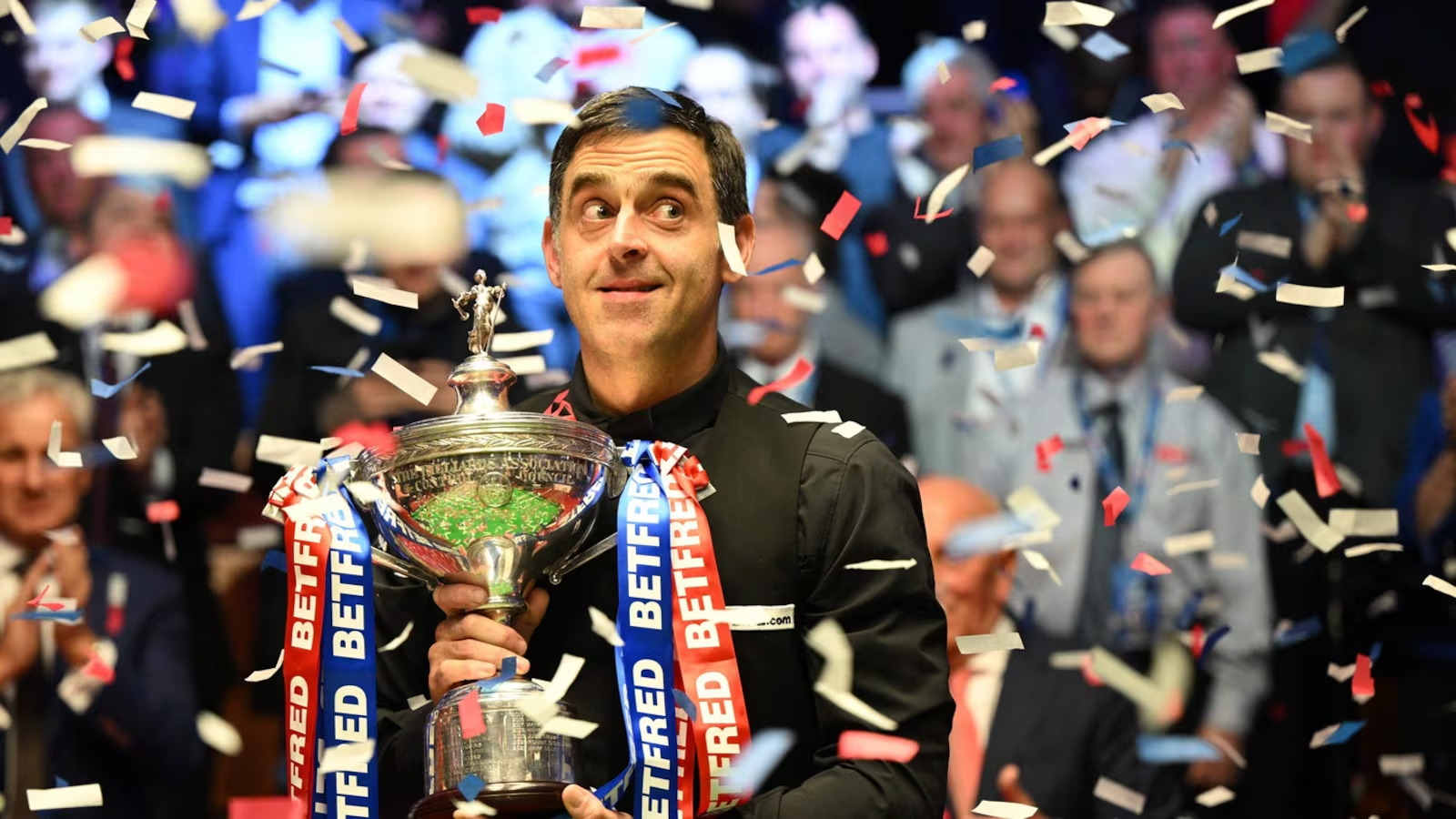
But, now that I’ve appropriately apologized, I’m tasked with reviewing Ronnie O’Sullivan: Seventh Heaven, the first major documentary to profile the seven-time World Snooker Champion, and it’s not too pretty.  

Produced by Eurosport and aired in 2022, Seventh Heaven is a one-on-one interview between O’Sullivan and Alan McManus, a retired professional snooker player, who is now a Eurosport pundit. Chronicling O’Sullivan’s life, primarily from his first World Championship win in 2001 against John Higgins to his seventh win in 2022 against Judd Trump, Seventh Heaven blurs the line between documentary and hagiography. Enraptured with O’Sullivan’s career and accomplishments, McManus gushes and glows with admiration and adulation for the Rocket. His feats and records are magnificent; his faults and shortcomings are minimized, if not ignored. Indeed, this is the story of St. Ronnie ascending the pearly gates. 

To be clear, O’Sullivan’s accomplishments are beyond incredible. His skills on the table, which are wonderfully clipped throughout the film as each World Championship win is packaged to perfection, are jaw-dropping. His 147 maximum break at the 1997 World Championship is a Guinness record in competitive play. He has achieved more than 1300 century breaks in his career. He has also won a record eight Masters titles and a record eight UK Championship titles for a total of 23 Triple Crown titles, the most achieved by any player. 

For those who follow the sport, O’Sullivan’s superhuman skill is not news. And, indeed there is joy in watching Seventh Heaven as a highlight reel. But, how much more interesting would this documentary have been if it had adequately dressed O’Sullivan’s darker side, such as his drug and alcohol abuse, his experienced depression, or his controversial comments that have led to him getting disciplined multiple times?

RonnieThankfully, there are a handful of times when McManus presses pause on the canonizing, such as when O’Sullivan discusses the loss of his father, his “backbone,” when a “part of [him] disappeared…and [he] lost his mojo.” Or, O’Sullivan briefly speaks about his panic attacks in 2000 that led to his first “snooker depression” against John Higgins. McManus even tsk-tsks O’Sullivan for disrespecting Alan Robidoux at the 1996 World Championship when he started to play him left-handed.

But, these moments are fleeting. Too much of Seventh Heaven is a paean to the Saint of Snooker. It’s a greatest hits of World Championship footage that is otherwise overcrowded by surface-level homilies and genuine reflections that don’t exactly rock the baize. 

If you’re a snooker fanatic, Seventh Heaven is probably canonical viewing; for the rest of us, let’s hope Ronnie O’Sullivan: The Edge of Everything, the documentary from Studio 99 that aired one year later, proves to be a more compelling watch.

Night To Be Gone

Tell me if this sounds familiar:

A guy walks into a pool hall, plays some games for money, and promptly loses. With a little luck, he wins on an “impossible” shot and then doubles his earnings by again making the same impossible shot. Feeling cocksure, he seeks out the best known player in town for a much bigger pot.  He goes on a roll, winning multiple games, but then gets psychologically battered and ultimately loses everything. Determined to regain his stature, he tries to make some quick buck hustling. It goes well for a while, until he hustles the wrong person and gets his arms fractured. A woman rehabilitates him, loves him, and helps him regain his confidence. He returns to finally beat the best known player, but his victory comes with a very painful price.

Night to be GoneOf course, I’m summarizing The Hustler.  Except I’m not. (Perhaps, the fractured arms rather than broken thumbs was the giveaway). I’m actually describing Night To Be Gone, an English-language billiards movie from Loren David Marsh that first released in Germany in January 2024, and is now available to watch on Amazon Prime.

Night To Be Gone is the story of Omer (Alpha Omer Cissé), a young West African refugee with a difficult family history, and Carine (Sylvaine Faligant), a recovering heroin addict from Marseille. They are itinerant grifters who both bring a lot of metaphoric baggage to the baize. Pool hustling is a path to fast cash. They arrive in Berlin so they can ultimately challenge The Sultan, a notorious and mysterious pool hustler to an all-night showdown of 10-ball with a minimum pot of 10,000 Euros. Each game is 1,000 Euros, and the match is not over until the money runs out or both players decide to quit.  Not surprisingly, they get hustled by The Sultan, who preys on their egos and erodes their cool veneer with racist and suggestive taunts. They lose all their money, forcing them to re-evaluate their get-rich-quick plans and ultimately their relationship with one another. 

Let me start with the favorable, as there are a handful of elements in Night To be Gone that are impressive – and distinct from The Hustler. The boldest and most interesting decision is that Omer is a dark-skinned, outsider from West Africa. He is an alien, a cypher to everyone he meets. But, this allows Omer to engage in some very intentional social engineering. Pool hustling is already a form of psychological manipulation. Omer compounds it by assuming racial identities that further this psychological influence. (This is both ironic and interesting, given the Sultan’s “African Prince” jeers contributed to Omer’s initial unraveling.) Among the conservative Bavarian businessmen, Omer is a welfare recipient. Playing against the liberals, he is a poor African whose village burned down. He is a drug dealer in one game, a bebopping hipster in another. Ever the racial chameleon, Omer engages people in underestimating him, which becomes their weakness, at least until it backfires on Omer when two Bauerntrampel don’t appreciate being hustled. 

Night to Be Gone.1Night To Be Gone is also a beautifully shot film. With its atmospheric black-and-white photography by Vlad Margulis and Florian Wurzer, and its eerie electronic scoring by Paul Brody, the film evokes a noirish 1940s aesthetic. Further contributing to this style is the movie’s pacing, selection of settings, and unsettling camera techniques. It works especially well for the filming of the billiards shots. Nothing feels rushed or manic; the shots are not contrived. It’s a game played for an audience of no one.

Unfortunately, these positives get overshadowed by billiards movie déjà vu, that gnawing sense we’ve seen this exact movie before. Night To Be Gone doesn’t feel like a tribute to The Hustler, certainly not the way the recently-reviewed Mr Doom felt like an ode to The Color of Money.  Rather, Night To be Gone feels like it’s trying to be The Hustler. As such, there is no suspense, no uncertainty, no question what will happen or how it will end. 

Arguably, Night To Be Gone is better classified as a remake of The Hustler. The British director Mark Murphy says, “a successful remake requires a delicate balance. It must simultaneously respect the original, bring something new to the table and feature effective casting. When these elements coalesce, the end product is a film that pays tribute to its predecessor while confidently standing on its own.” 

In this case, the “something new” is race – not just the casting of Omer, but the use of race as it pertains to hustling. Such terrain has been covered in other con artist/hustling movies – e.g., White Men Can’t Jump; Six Degrees of Separation; The Distinguished Gentleman – but never in billiards.

This feels like an accurate take on Night To Be Gone, except the director Marsh disputed it, claiming The Hustler is “an inspiration,” nothing more. If it’s not a remake, why does it feel like one? If it is a remake, why not lean into it?

Ultimately, it probably doesn’t matter. This cinematic conjecture is the milieu of film critics who can work themselves into a tizzy parsing meaning and pontificating to an audience of no one, when the real question is whether the film is entertaining. And, on that topic, Night To Be Gone holds its own. 

Mr Doom: Behind the 8 Ball

Every pool hustling movie lives in the shadow of The Hustler and its sequel The Color of Money, the modern apotheosis of the genre, which is ironic given the film was released almost 40 years ago. Most of these films are cinematic wannabes, kowtowing to TCOM without much originality or innovation. 

Mr Doom.1Certainly, that was the reaction within the billiardsphere earlier this month when it was announced that Robert DeNiro and Jenna Ortega would star in Shutout, a forthcoming movie about a seasoned hustler guiding a talented young player in the world of high-stakes pool. To quote Billiards_Watch from the AZ Billiards Forum, “That’s the most played out script and looks to be another Hollywood recycle…This is The Color of Money remade except it’s rebranded with another title.” 

So, director Leif Johnson is walking the plank a bit with his new billiards movie, Mr Doom: Behind the 8 Ball. Released on Amazon this past March, Mr Doom doesn’t try to hide its lineage; on the contrary, the film embraces it, starting with the title, which is an overt reference to the name of Vince’s Balabushka cue in TCOM. The film’s marketing is even more explicit, referring to Mr Doom as “reimagining The Color of Money in a small-town setting.” 

While the idolatry is on full display, Mr Doom ultimately carves out original ground and a touching story about the unlikely friendship between the film’s two main characters, Charlie and Jack, that both harkens to the relationship between Fast Eddie and Vince and still feels distinctly different.

Mr Doom.v4Charlie (Danny Parsons) is the Fast Eddie of this pairing. Emitting a smoothness somewhere between Jason Statham and Idris Elba, Charlie is a seasoned hustler, who sees an opportunity to score big if he can tame Jack (Danny Sutcliffe), a self-destructive sot who is surprisingly adept with a cue stick. Jack is the movie’s Vince, except he looks like a Northern English Wavy Gravy; a hippie version of “Bobby Elvis” Munson from Sons of Anarchy; a drunken mix of Captain Lou Albano and The Dude from The Big Lebowski.  Except the megawatt smile and the arm candy named Carmen have been replaced with a rats nest of a food-caked beard and a front-seat handjob from a hooker.

Initially, Charlie and Jack seem like they’re from different worlds. Disgusted by Jack’s boorishness and vulgarity, Charlie hustles him, taking advantage of Jack’s inebriation while pretending to also drink. (There is also a drunken spinoff of Vince’s “Werewolves of London” chest-thumping scene from TCOM.) Having humiliated Jack, Charlie then attempts to harness him, putting him in his debt while teaching him how to hustle pool. Echoes of TCOM abound.

But, the movie turns an emotional corner as we realize beneath Charlie’s cool exterior is his own wreckage of ruined relationships; similarly, behind Jack’s ogrish veneer are pockets of warmth and loyalty to something other than a vodka bottle. As their two backstories collide into one another, a fragile tie starts to unite them and ultimately cements itself in a final 9-ball match against a former partner of Charlie’s. 

Interspersed throughout Mr Doom is a hefty dose of blackball (English 8-ball) and 9-ball, which is interesting, given the tendency of most British billiards films to focus exclusively on snooker. (Perhaps, a bit more puzzling is the decision to film with a spotted cue ball.) While the games aren’t novel, the filming of the games is fast-paced and dynamic, a style intended to emulate that of Edgar Wright, according to Mr. Johnson

I’d be challenged to call Mr Doom groundbreaking or even a great movie. But, for those that enjoy entertaining characters, a well-crafted story, and a fresh take on a familiar film, then Mr Doom is worth the watch.

ChuckleVision – “Big Break”

I’ll give the viscount credit. He’s got a lot of patience.

Consider: mud is tracked all over his Persian rug; his early Bronze Age sculpture gets broken; his Carrara marble cherub statue is stolen then damaged; the foundation of his mansion partially collapses; his Rembrandt painting is used as a serving tray; and he is deluded into thinking his pet fish was fried and served for lunch.

But, all of that pales into comparison to the real horror committed by Barry and Paul Chuckle, the two  brothers who have been contracted to install the viscount’s new snooker table .

That’s the premise of the “Big Break” episode of ChuckleVision, a British children’s comedy series that ran for 292 episodes from 1987 to 2009. It starred real-life brothers, Barry and Paul Elliott, as the Chuckle brothers, a pair of endearing half-wits who often get into laughable trouble due to Paul’s oversized confidence and Barry’s attempts to clean up his mess.  “Big Break,” presumably named after the popular Big Break snooker game show, aired in 2007.(1) The full episode is available to watch here.

For children watching this episode, there are some obvious lessons. Don’t serve food on a Rembrandt. Don’t serve food from Barney’s Chippy to “a bunch of posh people.” But, the snooker care lessons may be a little more obfuscated, so let’s dig in.

For starters, you really don’t need to worry about two dunderheads absconding with your snooker table. It’s just too heavy. Given the viscount’s social standing, he presumably ordered the installation of a full-size 12’x6’ snooker table. Even if the Chuckle brothers mistakenly built it on the patio rather than in the basement, they could never undo the mistake by moving it by themselves, as it weighs approximately 2,755 pounds. 

Now, admittedly, the table does look rather small, so perhaps the viscount cheaped out and bought a six- or seven-foot table. Even at that size, the table would weigh 375-450 pounds, much too much for Paul and his pipsqueak brother to carry.

Even if one could move a fully assembled snooker table,  never try to move it down stairs without taking it apart. Barry surfaces unharmed when the table he’s carrying down the stairs falls. But, in practice, even a small table would have a gravitational acceleration of 9.8 m/s² (assuming a 10-foot vertical drop), which would release 6000 joules of energy – the equivalent of a severe car accident or a significant blunt trauma event.

ChuckleVisionBut, somehow the Chuckle brothers do get the fully installed table into the basement, only to put it in a room with insufficient space around the table to properly set up shots. At a minimum, this table requires a 15’x12’ sized room; instead the table is stuck in a tight storage room. It’s no wonder Paul damages the walls attempting to pot a ball. 

The large hole in the wall introduces a new problem, which is compounded by the mansion’s collapsing foundation. The table is now exposed to outside temperatures.  But, indoor tables, made of hardwoods, felt, and other delicate materials that are prone to damage, require a controlled indoor environment with a constant temperature and low humidity levels. No one is playing world professional snooker on this table. It doesn’t require a 21 degree Celsius playing surface, but surely greater temperature control is necessary.

Finally, wherever you install your table, don’t put it directly under a fish tank. Water can cause stains, warping and, worse, mildew. Even our lamebrain contractors know that, as it’s only when the tank’s water starts pouring out of the ceiling onto the table does Barry suggest to the viscount an alternative to playing snooker: “How about some pool?”

*****

  1. “Big Break” was not the first ChuckleVision episode to reference snooker. As early as the season one (1987) “Sport” episode, the brothers were reporting on the sport.

Extraction, USA

Extraction 1Here’s the good news: aside from the similar title, there’s no confusing the low-budget, quasi-billiards movie Extraction, USA with the $65 million Chris Hemsworth one-man-army action movie Extraction. In fact, the sum of the “action” in Extraction USA is a man getting beaned in the head with a billiard ball. 

Here’s the bad news: if you thought Extraction was a painful watch (and I’m not referring to all the literal pain Hemsworth afflicts on the Bangladeshi hooligans and drug lords), then you’re in for a difficult 90 minutes with Extraction, USA.

Directed by Mike Yonts and released on Tubi last November, Extraction, USA tells the story of Marni (Leanne Johnson), a single mother, and Steph (Marlee Carpenter), a mysterious drifter, who initially connect by hustling pool and then form a romantic relationship that is tested through the discovery of an underground drug ring. Underpinning all their sharking and derring-do is an urgent need to escape Extraction, the metonymic town named for the industry that supports it, and start a new life far, far away.

The industry, whether it’s fracking or something comparable, contaminates the air and water, creating an urban stink and making the city borderline unlivable and mostly impoverished. The typical lament is that there are a “few extraction millionaires and the rest of us fighting over the scraps.” Against this polluted backdrop, it’s no wonder that Leanne hustles pool for a few extra dollars so she can keep her son in school and avoid having him become a “muck kid.” 

Extraction, USAThen, along comes Steph, a platinum-haired gypsy, whose sojourn somehow has led her to the Time Out Lounge in middle-of-nowhere Extraction, and it’s love at first break. The chemistry dials up to 11 quickly, and pretty soon our sapphic duo are living together, telling lies to Marni’s uber-gullible son, sneaking into deep-pocket pool games, and eventually planning a heist to steal some drugs that “are like rocket fuel for the mucks” to get them to work harder.

Plotwise, it’s preposterous, but nothing is as absurd as the pool-training and pool-playing sprinkled throughout the first half of the film. After learning that Leanne is the best player in town, Steph trounces her and then becomes her Fast Eddie coach, showing her how to make… wait for it… straight-on shots. It’s Pool For Dummies, with high fives abounding after the simplest of shots. In case the nod to The Color of Money was missed, Leanne quotes Paul Newman’s character on two different occasions: “money won is twice as sweet as money earned.”

The games involving hustling are nominally more interesting, solely because of “quake rules” (i.e., if there is a tremor caused by a local extraction and the balls move, they’re played wherever they land). But, those games are filmed unimaginatively, with a sole jump shot breaking the monotony.  (I don’t know how much Tammy “Lefty61935” Anderson, the credited “billiards trainer” earned for this film, but she was overpaid.)

It’s not that Extraction, USA lacks heart or grit. The makers of the film said it was “one of the toughest tasks any of us ever attempted. Like most indie film crews, we put in some long days and endured all sorts of uncertainty about locations, vehicles, and funding.” 

But, shoestring budgets can yield great films. Look at Rocky or Mad Max or Halloween.(1) So, that’s a challenge to conquer, but not the underlying issue.

Extraction 2Rather, it’s the film’s desire to be a little of everything that ultimately turns it into a mishmash of nothing.  Per the makers, “On one level the film is about crime and action, but if you look a little deeper, it says some interesting things about income inequality, the environment, and men and women in the workplace.” 

Therein lies the problem. Extraction, USA triples-down on its multitude of identities. Go to the movie’s website, and the three themes (or “flavors”) – heist, romance, dramedy – are highlighted, each with its own movie poster.

In the zeal to genre-bend and create a movie that is intended to appeal to multiple types of viewers, Extraction USA fumbles through its competing storylines, short changing any real dramatic tension or character evolution.  And by making billiards seminal to the story’s arc, without investing in making the billiards remotely realistic or interesting, the movie completely fizzles, leaving just the stench of extraction in the air.
—————————

  1. Rocky (1976) was made for $1 million and brought in $225 million worldwide. The franchise has grossed $1.9 billion. Mad Max (1979) cost $300,000 and hauled in $100 million. Halloween (1978) was created for $300,000 and raked in over $70 million worldwide. (source: Collider.com)

Break (2024)

Break (2024).v2After watching Break, Will Wernick’s tedious and hackneyed film that released earlier this year, I asked ChatGPT to create the most cliched billiards movie possible. The similarities to Break were striking, but not surprising.

Break follows the story of Eli King, a twenty-something from Southfield, Michigan, who balances multiple jobs while caring for his family. His life takes a dramatic turn after a game of 8-ball with a local frat boy turns violent. He is suddenly thrust into Detroit’s billiards underbelly, where shady characters and doting old-timers spend their days and nights at the Loving Touch Pocket Billiards hall. There, he discovers his runaway father’s legacy as a pool legend. He embarks on a transformative journey, which will encompass highs and lows, love and violence, and, of course, the ultimate, winner-takes-all match of 9-ball against evil Jimmy, the man responsible for forcing his father to leave town.

ChatGPT pitched me the (fake) movie Cue of Destiny. “Small-town prodigy Jake Daniels reluctantly enters the high-stakes world of underground billiards to escape his dead-end life, guided by his estranged father, a disgraced pool hustler. Facing colorful rivals and his own insecurities, Jake must overcome impossible odds to take on Vincent “Viper” Kane, the man who destroyed his father’s career. With a heart-stopping final shot, Jake redeems his family’s name, wins the championship, and forges his own path as a legend in the making.”

Aside from the fact that Cue of Destiny is at least an original title, as opposed to Break, which may have cribbed its title from Sam Elkins’ superior billiards movie Break (2020), the two movies read like cinematic kissing cousins. Their shared DNA consists of every recycled billiards trope, two-dimensional character, and watered-down plot idea imaginable.

Break (2024)Taking the comparison a step further, I asked ChatGPT for some sample dialogue from Cue of Destiny. The billiards screenwriter in the ether replied,”Pool ain’t just about sinking balls, kid. It’s about controlling the table. Same as life—if you don’t own the table, someone else will own you.” 

As for Break, the three-person writing team scripted a similarly clichéd zinger, “Learn how to play the game or the game will play you…Keep your life clean, the game will work out.”

The shame is if you remove the derivative dialogue, the cardboard characters, and the atrocious acting from the lead (Darren Weiss, who is also the executive producer), you’re left with a film that genuinely seems to enjoy billiards, or at least, the filming of billiards. 

A variety of camera angles and filming techniques were used to capture the motion of the balls and the beauty of pocketing shots. There are some great bank shots, some well-crafted shot sequences, and a particularly sweet double bank shot with just the right amount of English. 

We know director Will Wernick likes billiards, or at least terrorizing people in upside down pool halls, as evidenced in his 2017 horror flick Escape Room. But, more likely, credit goes to cinematographer Akis Konstantakopoulos and editor Daniel Gibb, as well as billiards coaches (and presumably technical advisors) Steve Sherman and Spencer Ladin. (According to an interview with Weiss, Ladin also spent about three hours a day, three days a week for three months teaching Weiss how to shoot billiards.) Sportsman Family Billiards in Englewood, Los Angeles, also proved a great locale as the venue standing-in for Loving Touch Pocket Billiards.

Other callouts go to actress Braedyn Burner, who makes the most of her flimsy character Millie, the overnight love interest of Eli, and veteran actor Jeff Kober, who plays evil Jimmy. Kober is an Emmy-winning actor (General Hospital), who played a number of unredeemable and far more memorable characters in shows such as Sons of Anarchy, The Walking Dead, and Out of Bounds. He’s the C-list headliner for Break, much like Rutger Hauer was the marquis (and more recognizable) name that helped the other Break (2020) stand out from the billiards pack.

Unfortunately, neither a few good actors, nor an affinity for billiards, can save this otherwise miserable movie from the billiards trash-heap. To quote ChatGPT one more time, “I guess some tables just aren’t meant to be won.” The same is true for billiards movies.

Break is available to stream on Amazon Prime. You can watch the trailer below.

Be Careful of the #FakeBilliardsMovie Scam

The news is overflowing with headlines about scams. “Real estate scams are on the rise,” declares Fox News. “Rental scams are on the rise,” says Forbes.  “Investment scams,” “Employment scams,” and “Facebook scams” are all soaring.

And those are the obvious ones. We’re also seeing rises in “Homecoming mum scams,”Toll payment scams,” and, heaven forbid, “Pig butchering scams,” to name just a few news-grabbers.

Yet, somehow within this swamp of scams, scant attention has been given to a trend that I first highlighted in 2017, and again two years ago: the #FakeBilliardsMovie scam. It wears many guises, but beneath its mask of misinformation, the FakeBilliardsMovie is a cultural con artist, a cinematic charlatan, a billiards bilker. 

Look at this latest set of 15 visual sirens, but hold onto the rail and don’t get lured. Join the crusade and help me banish these bunco artists of the baize. (All summaries are courtesy of IMDB.)

Ard al Khof15. Land of Fear (original title: Ardh el-Khof)

For a fleeting moment, I felt like Howard Carter must have in 1922 when he discovered King Tut’s tomb. After years of searching, I had stumbled across Ardh el-Khof, the first Egyptian billiards movie known to man (or, at least, to me). But, this unearthing proved a hoax. Beneath the billiards artifice, this 1999 film is about a police officer who is assigned to a secret mission as an undercover drug dealer and slowly loses his identity. So, it’s not only a sham, but a ripoff of the exceptional Deep Cover. #FakeBilliardsMovie


On Time14. On Time

No doubt, Lilly Rikhter is multi-talented. Award-winning actress. Model. DJ. Thai boxer and powerlifter. Fitness bikini champion. But, even with all those accomplishments under her belt, and – let’s call it what it is – her assets on display, that’s not enough to give On Time a second look, especially when it shamelessly snookers you into thinking it’s a billiards film. On the contrary, this 2023 Spanish short film is about a woman framed for murder and her attempt to distance herself from the crime.  #FakeBilliardsMovie


Bitterroot13. Bitterroot

In southwestern Montana, between the Bitterroot Range and Sapphire Mountains, lies the Bitterroot Valley. This area is not only the primary shooting location for the TV series Yellowstone, but also ground zero for the eponymous Western Noir short film, currently in post-production. Bitterroot looks like it’s where time forgot to pass. Somewhere between that wagon wheel and the pool table a billiards movie awaits with a slow drawl and a mean draw…except apparently not. Rather, this film is about some local townsfolk who are split over how to handle the disappearance of a greedy businessman.  #FakeBilliardsMovie 

Cue Ball12. Cue Ball (original title: Pitok)

The blood-stained cue stick separating the cue ball from the other balls had me crossing fingers that the 2022 Iranian movie Cue Ball was some kind of Agatha Christie / Walter Tevis cinematic stepchild. The enigmatic characters seem unruffled by whatever horror transpired on this table. But, more likely, the billiards is a red herring. The movie, about a young man named Ala who carries a big wound from his past, appears to have nothing to do with billiards. The only “break” you’ll hear in this film is from characters “breaking” away from family traditions and overbearing relatives.  #FakeBilliardsMovie 

La frígida y la viciosa11. Frigid Fantasies (original title: La Frígida y La Viciosa)

Almost 50 years before 50 Shades of Grey had Anastasia Steele playing naughty S&M games with Christian Grey, Spanish director Carlos Aured was making his own risque, softcore movie filled with sexual games and experiments. Aured’s film is about an attractive woman who introduces a married couple to a new sexual life. Hard to imagine what kind of game entails shooting billiards balls at the nether regions of a woman tied supine to a table, but I’m pretty confident it’s not one of standard billiards variants.  #FakeBilliardsMovie


Naanum Rowdy Dhaan Naanum Rowdy Dhaan.v210. Naanum Rowdy Dhaan

The marketers of Naanum Rowdy Dhaan apparently couldn’t limit their lies to one poster; they doubled-down on their duplicities, spreading their half-truths across two posters.  This 2015 Indian Tamil-language romantic action comedy film couldn’t give two billiards balls about the sport, contrary to the posturing of the film’s stars Vijay Sethupathi and Nayanthara.  Oddly-held cue sticks notwithstanding, the movie is about the son of a police inspector, who becomes involved in illegal activities and falls in love with a deaf woman on a quest to get revenge against a ruthless gangster.  #FakeBilliardsMovie

Juke Joint9. Juke Joint

Between 1915 and the early 1950s, more than 500 “race films” were created and produced outside the Hollywood system for black audiences and featured black casts. Juke Joint is a 1947 Bert Goldberg race film. Like most of those 500+ films, this one was assumed lost. The good news is a print was found in a warehouse in 1983; the bad news is that its unearthing was accompanied by such a misleading lobby card. Never mind that the pictured table seems to be missing quite a few colored balls. The greater outrage is that the movie is not about billiards; it’s about a con artist and his dim-witted sidekick who hustle their way into a boarding house where they are entrusted to give “poise lessons” to an aspiring beauty queen named Honey Dew.  #FakeBilliardsMovie

Deux Soeurs8. Deux Soeurs

French Polynesia is known for its stunning beaches and resorts, not its film output.  Its island Tahiti has been the location for many films (e.g., Point Break, Soul Surfer, Mutiny on the Bounty), but the country of origin for a film? Not too often. That’s why I was initially giddy to discover Deux Souers, a French Polynesia short film released in 2022.  The poster suggests mystery, secrets, control, and of course, billiards. After all, the billiards table literally foregrounds the entire picture! Yet, the poster ultimately delivers only disappointment, as in, “I’m super disappointed that this movie, which has a character recounting her sister’s story, from her rebirth as a woman to the assault that will lead to her death, has absolutely zero to do with billiards.”  #FakeBilliardsMovie

Iya Aimodi7. Iya Aimodi

Eight thousand miles away from Hollywood a completely different, vibrant film industry exists within Nigeria. It’s called Nollywood, and it releases more than 2500 films per year. In 2023, one of those films was Iya Aimodi, and from the looks of the poster, it was about a whole different type of action happening on the billiards table.  Whether the nookie is real, the billiards is not, unfortunately. This Yoruban movie is about a woman who infiltrates the marriage of a young couple by posing as a maid so she can claim vengeance and justice for past wrongs. Yeah, that’s precisely what jumps out at me from this poster!?!  #FakeBilliardsMovie

Split The6. The Split

After filming the spectacular The Dirty Dozen in 1967, Jim Brown, Donald Sutherland, and Ernest Borgnine reunited one year later, along with Warren Oates, Jack Klugman, Julie Harris, and Gene Hackman, to film The Split. Based on a half-million dollar heist that goes sideways when the money disappears and the crew start blaming one another, the movie sounds fantastic…so why did the marketers need to taint it with this ridiculous lobby card? I’m not sure which is the greater crime: the stolen $500,000 or Jim Brown’s risible bridge. And for an extra 100 C-notes, please explain why there appear to be two 14-balls on the table.  #FakeBilliardsMovie

Squadra antiscippo5. Squadra Antiscippo

If I were to update my blog post, “Top 10 Billiards Brawls,” I might need to swap in Squadra Antiscippo, a 1976 Italian police drama, that appears to provide a healthy dose of pool pandemonium. Does that guy in the blue jeans really have a cue ball in his mouth? But, bedlam aside, this is not a billiards movie; it’s a film about an undercover cop who finds and arrests a series of purse snatchers until he discovers an American at the top of an evil ring of thieves.  #FakeBilliardsMovie

Vozrast Iyubvi4. Age of Love (original title: Возраст любви)

Lasting only four episodes, this 2016 Russian melodrama TV series focused on Igor and Olga, two unremarkable and unrelated individuals who have a chance encounter in a sanatorium, where each of them wanted to find peace from the bustle of everyday reality. Here, they awaken to a new world of happiness and unknown feelings, which seems to include a meet-cute where the man stereotypically shows the woman how to aim a shot in a game of Russian pyramid. I hope she becomes as good as Anastasia Luppova; otherwise I’m decrying this Russian ruse. #FakeBilliardsMovie

Yoon Yul ah's Three Cushion3. Yoon Yool-Ah’s Three Cushion

We’re knee-deep into global examples of movie marketers misleading audiences with their underhanded usage of billiards imagery. The panache of pool can beguile the best of us into watching anything: cheesy rom-coms, melodramatic morality tales, cop stories, Westerns, comic book capers, you name it. But, I think the 2019 South Korean film Yoon Yool-Ah’s Three Cushion takes the prize. Yep, it’s a Korean porno. So, the next time someone says, “Sex sells,” remember: “Billiards sells, too.” #FakeBilliardsMovie


Hermosa Justicia2. Hermosa Justicia

I don’t want to overreact to the poster of the 2023 Costa Rican film Hermosa Justicia. After all, this is the country of pura vida. Besides, billiards and leather-clad superheroines sounds like a great combination shot. But, this story of two costumed women uniting to take down the villainous Dr. Olman, who has recently escaped from prison, has as much to do with billiards as Catwoman had to do with good movie-making. It’s cinematic capriccio, a case of disguised identity, just like our two masked crusaders. #FakeBilliardsMovie

1. Bones | Big Bang Theory

Bones Tv SeriesBig Bang TheoryHere’s my rule: if you’re going to market a TV show with billiards, feature the sport in at least one episode. Maybe I can cut Bones some slack. The Fox series aired in 2005-2006 and only had 22 episodes. At least one scene featured FBI Agent Seeley Booth burning the midnight oil in a pool hall. But, there’s no forgiving The Big Bang Theory, that primetime juggernaut with 279 episodes and average viewership often north of 15 million. If a short film can be made about Isaac Asimov’s sci-fi story “The Billiard Ball,” and multiple TV shows can discuss the physics of pool, then surely Sheldon Cooper can pick up a cue stick just once and give the game a quantum physics makeover. #FakeBilliardsMovie

So, where do we go from here? Call the FTC to report false advertising? Reach out to Scambusters? I’ve read naked potholing can be an effective protest strategy (at least in Saskatchewan).  I’m admittedly a bit dejected from trying to denounce this dupery for the past seven years, but I have another idea: grab some popcorn and check out any of the 300+ legitimate billiards movies, TV shows, short films and web episodes

Swamper

In the moving industry, a swamper is slang for an unskilled laborer who assists in the loading and unloading of packed furniture, boxes, and other objects. Jay Thurlow, the protagonist of Philip Neumann’s 2021 Canadian movie Swamper, is a swamper, and it’s not pretty. 

SwamperFor every occasional generous gratuity he receives, he must also clean out the fecal matter left in the truck by homeless people; double-check his employer which tries to short-change him on his hourly pay; haul sofas up treacherous cliffs; accept verbal abuse from clients; and turn a blind eye to a murderous, ill-tempered partner.

And that’s just the tip of the cue stick when it comes to Jay’s bad luck and difficult life.

He must also deal with a dying mother, an unemployed alcoholic father, a violent landlord, and a demanding girlfriend. He gets fired, dumped, conned, beaten, and repeatedly threatened. On the positive, someone offers to purchase his eyeball for $20,000.

On top of, or perhaps as a result of, these woes and vices, Jay also has a billiards gambling problem. He’s a pool shark, who easily rattles; a hustler who can’t finish the hustle; a talent who can’t get out of his own way. He’s metaphorically running the table and still scratching on the 8-ball.

Apparently, being an indigenous teen from a broken family is hard, which seems to be core to the movie’s muddled message. But, within this miasma, there is optimism. Brandon Moon, who plays Jay, injects his character with an innocent and heartfelt pertinacity. He is repeatedly knocked down, but never knocked out.

This persistence is central to Jay’s pool game. Whether it’s 8-ball or 9-ball, one pocket against Manitoba Fats or straight pool (“Who the fuck plays straight pool anymore?”) against Ronnie the Rooster, billiards is Jay’s lifeline to a possibly better world.

We root for Jay, even if it’s just to get a momentary respite from his hapless existence. But, oddly, Swamper does not reward the audience, which is one of the film’s fundamental problems. The character arcs are horizontal lines with narratives that fade, rather than conclude. Enjoyable scenes are intermittently scattered throughout an otherwise unsatisfying and exhausting viewing experience.

As for the pool, there are some clear nods to The Hustler and The Color of Money, from the black-and-white filming to the fanboy obsession with specific cue sticks, such as a Kevin DeRoo versus a vintage Meucci, to the aforementioned fat man opponent. The pool-playing is authentic, but it lacks dramatic tension, especially during the culminating $10,000 8-Ball Tournament, which unfortunately makes Swamper a far cry from the genre’s giants it so obviously idolizes. 

Sadly, Swamper does have one thing in common with its billiard film predecessors. Just as The Hustler filmed at Ames Pool Hall (which closed five years after the film in 1966), and The Color of Money filmed at St. Paul’s Billiards (now closed), Swamper filmed at Guys & Dolls Billiards in Vancouver…and which is also now closed.

Swamper is not currently available to watch online. A huge thank you to Alex Quinn, actor and producer of Swamper, for sharing a private copy of the film with me to watch.