Category Archives: Billiards TV

The Billiards TV category is about television episodes that prominently feature billiards or have plots centered around billiards.

A Tale of Two Pool Halls: Fat Albert and Good Times

The Adventures of Fat Albert and the Cosby Kids (or Fat Albert) and Good Times: Black Again (or Good Times) share a number of commonalities. They’re both animated series that explore Black urban life. They both use comedy to address social realism. They both engage in Black storytelling. 

And, unlike many other animated series about African-Americans (e.g., The Boondocks; The Proud Family; The PJs), they both include a billiard episode. Fat Albert aired the episode “Double or Nothing” in which Rudy learns a valuable lesson about winning big when he is tricked into gambling by a pool shark. Good Times premiered with the episode “Meet the Evans of New”, in which Reggie Evans gambles in billiards so he can win enough money to pay the heating bill in his apartment.

But, those similarities pale in comparison to how wildly different these two series are. Let’s just say Fat Albert’s Philadelphia and Reggie Evan’s Chicago may as well be a million miles apart.

“Double or Nothing”
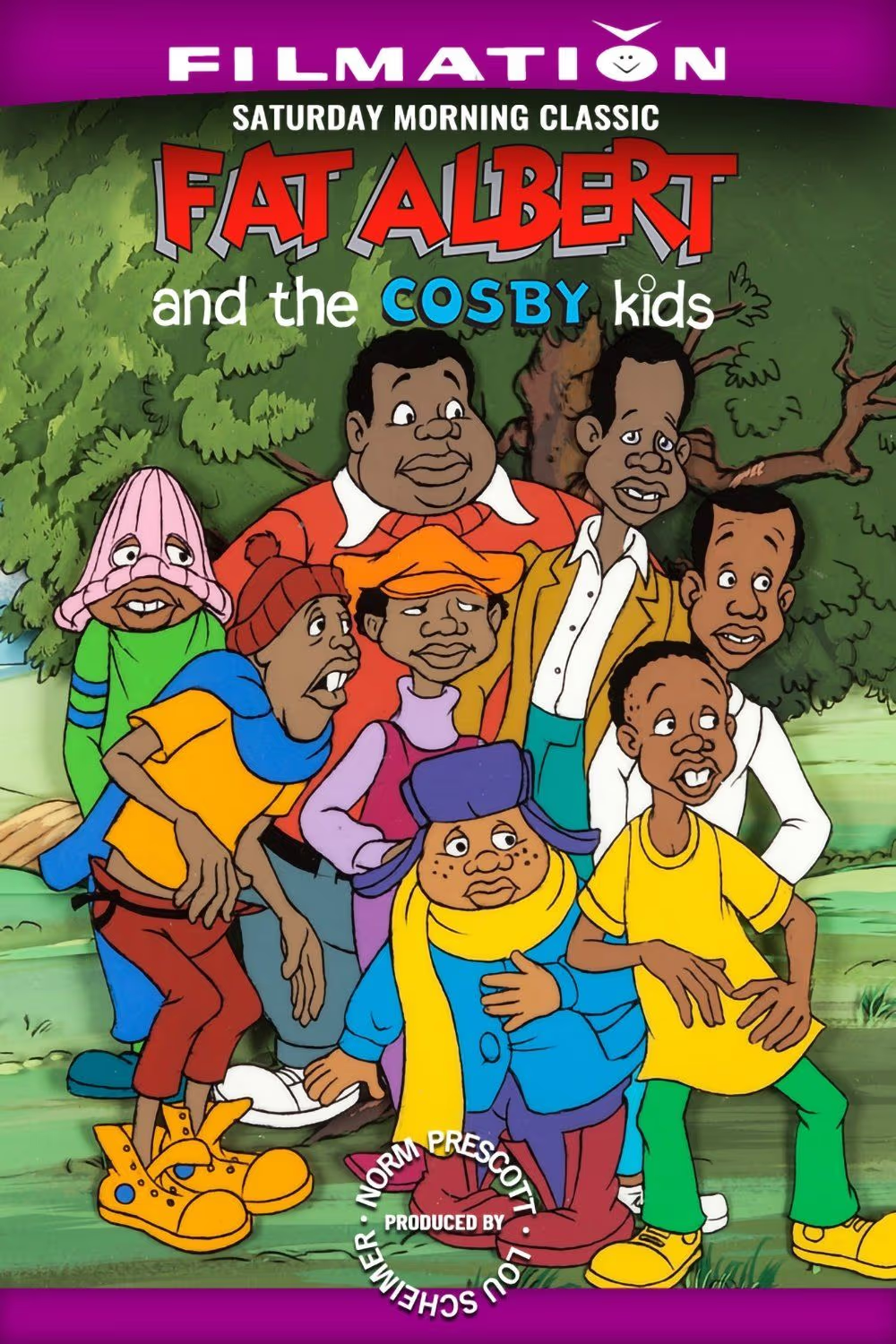
Fat Albert.2Fat Albert  is an educational animated television series created, produced, and hosted (with live action interstitials and bookends) by comedian Bill Cosby. The series ran from 1972 to 1985, long before Cosby became synonymous with celebrity sexual assault. (He was convicted in 2018.) The show was inspired by Cosby’s remembrances of growing up in Philadelphia. It also reflected the intersection of both Cosby’s penchant for observational comedy, with recollections of his childhood, and his educational training. (Cosby received his Doctorate in Education in 1976 and did his dissertation on integrating the visual media of Fat Albert into Elementary School Curriculum.)

In the “Double or Nothing” episode from the series’ final season, Rudy Davis, the smooth talking, cocksure member of Cosby’s Junkyard Gang, is befriended by Arnie, who admires  Rudy’s billiards skills and wants help improving his game. Eager to impress, Rudy gives Arnie some lessons and then takes him for some money. But, Rudy is too blind and greedy to recognize that Arnie is a pool shark.  Rudy quickly loses back the money, and then loses the Cosby Kids’ money, too, when he tries to go ‘double or nothing.’  Still convinced it’s only a streak of bad luck, Rudy is even prepared to wager his special watch, but fortunately Fat Albert intervenes, reveals the ploy, and sends Arnie scrambling.

Fat Albert.1The billiards storyline is pretty standard fare. What makes “Double or Nothing” interesting are the mini homilies Cosby delivers throughout the episode. He declares, “Rudy is not a very good loser. Of course, if he wants to keep on gambling, he better be, because losing is what gambling is all about.” He adds, “That’s the way gambling is. There’s no way to be a winner,” dismisses it as “for dopes,” and concludes that it is “not smart” but “downright stupid….” He leaves no wiggle room about the moral turpitude of gambling. Fat Albert is similarly decisive, saying,
“Gambling is for losers, and I’m not going to help you [Rudy] lose any more.”

The  “Double or Nothing” episode is available to watch for free with ads on DailyMotion.

“Meet the Evans of New”

Good Times.2You may remember meeting the original Evans family – James, Florida, Michael, Willona, and J.J (Mr. “Dy-no-mite!”) – when Good Times aired in the 1970s or reran in syndication. The show tackled complex and challenging issues about growing up in the Cabrini-Green housing projects of inner city Chicago.

Well, in 2024, an executive production team that included Norman Lear (who produced the original Good Times), Seth McFarlane (of Family Guy fame), and NBA phenom Steph Curry launched the animated Good Times: Back Again on Netflix, and it was a spectacular failure. Canceled after one season, the series was condemned by critics, audiences and multiple civil rights organizations as a “racist cartoon” that trolled in negative, crass and obscene portrayals of African-Americans.

“Meet the Evans of New” opens with the Evans family learning their heat has been turned off. After failing to raise the extra cash through his taxi cab driving day job, Reggie explains to his son Junior that to “take care of his family in a respectable way,” they must gamble in billiards. Using his grandfather’s cue stick, Reggie quickly beats most of the patrons, boasting, “Pool is in my genes and once I sink this 8-ball all your cash will be too [in my jeans].” He quickly amasses a small fortune, further schooling his son that pool halls are for “shit-talking”…it’s a place where men can “talk by themselves and can’t get into trouble.” But, before Reggie can sink the final shot against Minnesota Matt, who deigned to call him “the c-word…COWARD!,” he has to forfeit the game to rescue his youngest son.

Good Times.1Aside from presenting gambling at pool in a more virtuous light, this scene probably doesn’t offer the starkest contrast between Good Times and Fat Albert. But, if you thought that pool scene marked the apex of crudeness, the remaining 20 minutes will disabuse you of that notion. They include: Junior waking from a possible wet dream on the couch; Reggie standing naked in front of his daughter; Junior wishing his “Dad’s sudsy bits can go back to normal [from the shrinkage]”; chicken buckets being used as lamp shades; babies dealing crack; a trio of babies (Baby, Lil’ Baby, and Baby Baby) shooting guns at other other babies; Beverly phoning “Not Whitey, but the True Almighty” Black Jesus for favors; Beverly visibly lactating; Beverly using her lactating breasts as a makeshift GPS to locate their kidnapped child; Dalvin doing a “key bump of formula”; a white woman wishing she had bought a Cambodian baby (instead of a black one) for adoption because “those babies are way more grateful”; Dalvin seeing a woman in a revealing top and requesting some milk; and a full-blown attack on spam, “a pink racist meat designed in a lab by a pink racist.”

All 10 episodes of Good Times are available to stream on Netflix.

Room 104 – “Shark”

Room 104 - Shark episodeIn the 2018 second-season “Shark” episode of the HBO anthology series Room 104, there is a confrontation between two characters about their evolving relationship hustling pool. Ollie (James Earl), a skilled pool player, confronts his cousin and manager Franco (Mahershala Ali) about the value he brings to their partnership, especially as they consider pivoting from road hustling to legitimate tournaments. Questioning their 50/50 financial arrangement, Ollie asks, “I’m the one doing the playing, so what are you going to be doing?

Sensing his gig may be at risk, Franco delivers an acerbic diatribe in response:

I don’t think you realize how much f*cking hard work, skill, dedication, brain power goes into this operation I created for us here. Someone got to book the bus tickets, got to find the cheapest room to stay in town, got to find a pool hall that don’t know about us yet, got to sniff out the player in there that you can definitely beat to get things rolling, then I got to make sure I sniff out any other hustlers in there that got us beat, avoid them, set you up with just the right sucker whose got more money than skill, make the deal with him, or his motherf*cking, piece-of-sh*t ass manager, then distract said piece-of-sh*t manager with conversation while you’re playing, while still keeping my eye on the game so I know how much to bet the next round. And I do this sh*t over and over and over again, plus I got to keep this sh*t all positive because you up here questioning me all the time and acting all moody, like tonight. 

It’s a merciless moment, made all the more brilliant by Mr. Ali’s delivery. (It’s no wonder this gifted actor won back-to-back Oscars for Moonlight and Green Book. As one reviewer wrote, “Mahershala Ali could read the phone book and I would watch.”) 

But, it also feels slightly absurd, especially as a commentary on the historical relationship between pool players and their backers.

Room 104 - Shark episodeLet’s start with the most obvious problem. Except for the top players in the world, very few are going to have ‘business managers,’ especially someone who is going to collect 50% of the player’s earnings. Most pool players, even hustlers, are scraping by, and there’s not enough money to carry a manager.

Slightly more common is that a player will have a stakehorse, i.e., a backer who can put up the money to compete in tournaments or make sizable wagers that can have large payoffs. Conceptually, this is the dynamic in The Hustler between Eddie Felson and his stakehorse Bert Gordon. But, Franco is no Bert Gordon. Even after Ollie beats “that motherf*cker Larry dude…coming up in there with some dinosaur looking motherf*cking yellow ass crusty toenails poking through his sandals,” the duo only net $94 between them. 

Franco blames the paltry amount on the fact that they used to play in “ bigger cities in the bigger halls with the bigger idiots with the bigger wallets…But we played those places out already. So now we gotta hustle more, smaller venues, smaller paydays.” But whatever excuse one concocts, if they’re not clearing $100 in a night, Ollie needs a backer, not a manager.

A third arrangement is the partner model. Think back to the 1940s and 1950s, when players might work together playing private pool games for money. The famous road warriors  Don “The Cincinnati Kid” Willis and Luther “Wimpy” Lassiter epitomized this partnership. According to R.A. Dyer, author of Hustler Days:

Willis befriended Luther Lassiter in 1948 after beating Lassiter at nine-ball. Lassiter, who went on to become seven-time world champion, was perhaps America’s best nine-ball player; together, the two men formed “arguably the most formidable road team in American history”. As Willis said in 1977: “I broke Lassiter one night playing 9-ball in Elizabeth City, North Carolina. He suggested that we become road partners …. We split everything we made—sometimes as much as $5000 or $10,000 over a period of several days.” When hustling with Lassiter, Willis often went first, playing the lemon to set up a victim for Lassiter, who would then finish the opponent.

Even if the arrangement is not a joint player partnership, there is at least a mutual respect and understanding of the game. (Think of the relationship between Eddie Felson and Vincent Lauria in The Color of Money.) But, that’s not the case with Franco and Ollie. Franco’s rant continues:

I’m not just your manager, I’m your f*cking shrink, too. You need me to do all the sh*t I do, and take care of you, and the only thing you gotta f*cking do is go out and play with some sticks and balls when I tell you to, and with who I tell you to play with…that’s your whole f*cking job. I got a f*cking halfwit who plays with sticks and balls as a partner, and he’s telling me I ain’t worth my wait in the 50/50? What the f*ck you talking about it? That sounds like a big ol’ f*ck you to me. 

Room 104 - Shark episodeEven Bert Gordon, who called Fast Eddie “a born loser” to try to break his self-destructive tendencies, would never disrespect the game to the point of referring to his partner – or his investment – as a “halfwit who plays with sticks and balls.” 

Want to inject a bit of reality back into this Room 104 episode?  How about this response from Ollie: “Yeah, it is a big ol’ f*ck you. BYE!!”

The “Shark” episode of Room 104 is available to watch on HBOMax.

The Naked Truth – “Born To Be Wilde”

Steppenwolf’s 1968 counterculture anthem, “Born To Be Wild,” is about living life unafraid and on one’s own terms. It’s a fitting play on words for The Naked Truth episode, “Born To Be Wilde,” in which Nora Wilde decides to embrace her love of billiards and play the game her way.

Naked Truth - Born To Be WildeLasting only three seasons (1995-1998), the ABC-then-NBC sitcom The Naked Truth starred Téa Leoni, in her first lead role, as Pulitzer Prize nominated photographer Nora Wilde, who is forced to take a job at The Comet, a sleazy celebrity tabloid that requires her to work in demeaning situations. While the TV series opened with strong ratings, by the third season, it was in a downward spiral, and the last seven episodes were never aired. “Born To Be Wilde” is one of those episodes.

Whether the demise of The Naked Truth was warranted, I cannot say; I had never heard of the series, and I have no plans to watch any of the remaining 54 episodes. However, for 23 minutes, I was pretty entertained, largely because Ms. Leoni has solid comedic chops, and she throws herself into this episode’s original script.

In “Born To Be Wilde,” the tabloid team learns that the Shoot Billiards Not Bullets celebrity pool tournament is allegedly rigged to ensure the celebrities win. To break the story, Wilde’s partner, Jake, will compete in the tournament to where he can “get his ass whupped by some model who weighs less than a pool cue.”  Wilde’s role in the sting is less enjoyable. She is assigned the role of “chalk girl,” where she must “wander around the floor wearing a tight dress, a lovely smile, and chalk on a chain.”

Though Wilde pretends to know nothing about pool, and mocks Jake for naming his cue stick Old Mahogany Joe (“Why are men compelled to name anything that is longer than it is wide?”), it’s quickly revealed she has a passion for the sport. When Jake disappears to the restroom, she steps up to the pool table, longingly caresses the cue stick, and then threads a difficult shot through two balls.

At the tournament, dressed as Chalk Girl, Wilde is approached by her first celebrity, Diff’rent Strokes star Gary Coleman (playing completely against type), who lecherously says, “Hey there sweet thing, how about a little chalk for the old stick?” But, after a coquettish rebuff, Wilde still has no more information on the tournament scandal.

However, when Jake accidentally gives himself a black eye trying to mimic Tom Cruises’ cue stick twirls in The Color of Money, Wilde then professes her love for pool and seizes the cue to compete as his substitute. She explains, “Back in college, I’d wake up in the morning after a feverish night at the pool hall with balled up twenties in my pocket, and I had no idea how they got there, whose stick I had used, how many games I had played. All I knew was that I had won and I didn’t care how.”

Naked Truth - Born To Be WildeUnfettered, Wilde proceeds to demolish her celebrity opponents, first Mr. Coleman and then (an off-camera) Angela Lansbury.  With each game, her confidence rises and her tongue gets sharper, as in, “Now, now I’ll let Ms Lansbury have at least one shot… oops., I lied… guess it’s Loser She Wrote.”

As the tournament unravels, its organizer finally reveals her true colors and tells Wilde to “take a dive,” which is captured on tape. Having nailed the scandal, but also having lost the support of the crowd, Wilde acquiesces to losing her final match against country music star Trisha Yearwood. But, Ms. Yearwood’s taunts, including a left-field dig comparing chest sizes, pushes Wilde back into beast mode, and the match ends with the ladies billiard-brawling on the pool table.

While I wish there were more on-screen billiards in this episode, “Born To Be Wilde” packs it in with sassy dialogue, a couple of well-placed celebrity cameos, and an original concept. (Aside from Celebrity Billiards with Minnesota Fats, I’m pretty sure ‘celebrity billiards’ is unmined comedic territory.)

One of the final Naked Truth episodes that aired was “The Unsinkable Molly Brown,” a reference to Margaret “Molly” Brown, the socialite who survived the sinking of the Titanic. While The Naked Truth ultimately sank like a struck battleship, Ms Leoni fortunately proved to be the series’ Molly Brown. She subsequently has had a successful career in film and television, with lead roles in major big budget movies (i.e., Deep Impact, Jurassic Park III), and then years later in the CBS drama Madame Secretary. Alas, her famous cue stick caress was never reprised.

Early Billiards Sketch Comedies

Two years ago, I published a blog post entitled “British Sketch Comedy in the Golden Age of Snooker.”  The post began with a review of the uproarious 1973 “Pot Black” sketch from The Benny Hill Show. At the time of my publication, it was the only billiard sketch prior to 1980 that I had watched.

But, since then, my curation of billiard sketch comedies has expanded considerably and surfaced numerous jewels from 1930 to 1979. While some of the humor is now dated, these sketches and scenes represent a half-century of billiards inserting itself into mainstream culture and becoming a part of our popular vernacular. 

Brats (1930)

Any definitive list of early billiards sketches should kick off with the brilliance of Stan Laurel and Oliver Hardy, a duo that paved the way with their childish nature, physical exaggerations, and perfect timing for everyone from Lou Costello and Jerry Lewis to Peter Sellers and Jim Carrey. Brats is a 1930 short film in which Stan and Ollie take a break from their children by playing a game of pool. A mixup involving marshmallows and pool cue chalk leads both players to have issues that then become heated arguments, leading to an armoire breaking and pool felt ripping. The full film is available to watch here. Enjoy, and then experience its influence on modern billiards comedy, such as this pool-playing scene between Kramer and Fran Costanza from “The Doll” episode of Seinfeld.

Harry Tate – “Billiards” (1934)

Along with “Fishing” and “Motoring,” “Billiards” was one of several sketches centered on fads and trends that made the British music hall performer Harry Tate famous. Each sketch presented him as a mustachioed, blustering incompetent whose good intentions only contribute to the surrounding chaos. In “Billiards,” a game played for 10 pounds becomes a magnet for absurdity and calamity, as some balls appear stuck together, a drunk temporarily takes over the table, a man in an apron steps on the table to take measurements, and a high break leads to the ceiling collapsing and the wager getting called off.  The full sketch is available to watch on YouTube, though we can thank British Pathé for their film preservation efforts.

I’ll Never Heil Again (1941)

Curly, Larry, and Moe – aka The Three Stooges – made 190 short films for Columbia Pictures, each with their trademark style of physical, farce, and slapstick comedy. In I’ll Never Heil Again, the Stooges are military commanders who have taken over the country of Moronica. In a scheme to usurp their power, Princess Gilda replaces the 13-ball on the billiards table with an explosive replica, hoping the next shot will lead to their detonative death. But, the plan backfires as the new ball causes all sorts of unintended consequences on the table, with the cue ball never able to find its mark. Not surprisingly, the extended scene’s humor lies less in the supernatural shot-making and more in the Stooges’ waggery and banter.  Favorite line from the scene is Moe accusing Curly of “using too much English,” and Curly replies, “Never speak that word in this house!.” The full episode is here, with the billiards starting at 7:20.

The Red Skelton Show – “Bums Rush” (1952)

The remainder of the 1940s proved barren for billiards, but in the early 1950s, billiards reemerged on the comedic circuit, first starting with “The Sultan” episode of The Red Skelton Show. The “Bums Rush” sketch (which starts at 17:48 here) features the inaugural appearance of Skelton’s hobo clown character, Freddie the Freeloader. There’s no pool played, as all the action is situated outside a nameless pool hall, after Freddie gets ejected by the owner for pickpocketing several billiards balls.  Most of the sketch involves sight gags (e.g., Skelton diving head first into a trash can) or zinging one-liners (e.g., “I was born very poor…I didn’t even have a father or a mother.”) that would induce Dad-joke groans today. The sketch ends with Freddie outwitting the owner and running back into the pool hall, only to exit again, this time drenched, having experienced first-hand that the “pool” refers to a swimming pool. Ba dum tss!

The Abbott and Costello Show – “Las Vegas” (1953)

Bud Abbott and Lou Costello cemented their comedic immortality in the early 1940s with their radio sketch, “Who’ On First?,” that displayed their trademark ratatat wordplay, misunderstandings, memorable catchphrases, and impeccable timing. A decade plus later, they pivoted from baseball to billiards in the “Las Vegas” television episode, where Lou Costello competes in a hotel pool game. His opponent, Julius Caesar, keeps suggesting spectacularly-sized wagers that cause Costello to – literally – lose his cue stick. It’s a sight gag that wouldn’t work today, but under the physical contortionism of Costello, it’s perfect. And, when the side-betting gets subsumed by a conversation about horse racing terminology, in which Costello mistakes a horse who can run well in the mud (a mudder) as ‘mother’ and the food that is fed to a horse (its fodder) as ‘father,’ well, now we’re in the Billiards Comedy Hall of Fame.  The scene, which starts at 18:30, is available here.

The Colgate Comedy Hour – “Pool Hall” with Martin and Lewis (1955)

While “Pool Hall” may be best remembered for Dean Martin and Jerry Lewis’ heartfelt rendition of the popular standard “Side by Side,” it also offers a very entertaining billiard sketch that is classic Martin and Lewis interplay and humor.  Inside a nameless pool hall, Dino is preparing to make his final shot, when a rain-drenched Jerry enters and unwittingly proceeds to make a mess of the game. Ever the innocent man-child, Jerry accidentally interferes with shots, pours water on the table, and gets chalk powder everywhere. Straight-man Dino can barely hold it together, subtly fuming (while in character) and almost cracking up (out of character, as entertained by Lewis as the audience is). The full episode is available to watch here. “Pool Hall” was among the last sketches from The Colgate Comedy Hour before the series changed its name to The Colgate Variety Hour to reflect a move away from pure comedy.

Take a Good Look (1960)

From 1959-1961, ABC aired the game show Take a Good Look created by and starring comedian Ernie Kovacs. An odd show in which a panel of celebrities attempt to guess a secret about a seemingly ordinary person brought onstage, the clever spark was the short comedy sketches that vaguely revealed hints to the guest’s identity.  Such is the case in this sketch where Frankenstein (Kovacs) and Dracula (Bobby Lauher) compete in a game of billiards. Dracula talks a big game and shows off his knowledge of spin to Vampiress, but it’s Frankenstein who turns out to be the real pool shark. He pockets 14 of 15 balls on the break. The last one bounces out of the overstuffed pocket only then to be crushed by a monster’s hand that emerges from the table.

A Shot in the Dark (1964)

It only took one year for Peter Sellers to follow his side-splitting performance in The Pink Panther with its sequel, A Shot in the Dark.  Reprising his role as Inspector Jacques Clouseau, Sellers doubles-down on the character’s ineptitude, pompous personality, and exaggerated French accent. This time, those traits are on glorious display as he competes in a game of three-cushion billiards against the millionaire Monsieur Benjamin Ballon (George Sanders). Sellers is a master of sight gags; nobody can quite make a mess of a billiards cue stick stand like he can, and his attempts to play with a curved cue stick remain brilliant 60 years later. But, it’s his genteel observation – “I appear to have grazed your billiard table” – after slashing the baize with his cue stick that makes this scene positively memorable.

Turn-On (1969)

Cancelled before the first episode aired on the West Coast, Turn-On was the ahead-of-its-time brainchild of George Schlatter, producer of Rowan & Martin’s Laugh In. The conceptual TV show was packed full of short clips, rapid movements, and controversial topics. But, after a horrified programmer at WEWS in Cleveland shut off the show on live television, stating the remainder of the program would “not be seen this evening…or ever,” the lights were permanently turned off for Turn-On.  Those banned episodes have since surfaced on YouTube, and scattered among the non-linear sketches, multimedia assaults, and nonsensical nonsequiturs, are random clips – just a few seconds each – of a well-endowed woman shooting pool and making the balls obediently march in all sorts of directions. (An example is at 0:46 in the first episode.) Variations of this sketch (?) appear throughout the short-lived series. Hey, it was 1969 – what better time in billiards history to Turn-On, tune in, drop out, and pocket a shot.

The Tommy Cooper Hour  – “Tommy Cooper’s Christmas” (1973)

Today, the 6’4” fez-wearing Welsh comedian and magician Tommy Cooper may be best remembered for suffering a fatal heart attack on live TV, but in the mid-1970s, he was one of the most recognized entertainers in the world, due to his popular TV shows. The Christmas episode of the short-lived The Tommy Cooper Hour features the “Make or Break” sketch, which is intended to pit two Scottish snooker players against one another. However, there is a mix-up, and Thomas Cooper, amateur golf champion, shows up, instead of Terrence Cooper, amateur snooker champion. The sketch mocks the formality of snooker and its peculiar lexicon and rituals, and then draws comparisons between snooker and golf. (“Snooker is a game with balls and a sort of stick.” “That’s golf,” replies Cooper.) Such jokes elicit a grimace, maybe a chuckle, and then a half-gasp after Cooper magically balances two billiard balls on the tip of a cue stick. But, the skit ends on a high note when the real retired world snooker champion Joe Davis shows up (in all his Tartan glory) and proceeds to play the sport as if it’s golf by standing on the baize and swinging at the balls. The full episode is here. The sketch starts at 24:16.

The Carol Burnett Show – “1908 World Championship Match” (1978)

With 70 Emmy nominations and 25 Emmy wins, The Carol Burnett Show helped cement Carol Burnett as a comedian supernova. Buried within the variety show’s 279 episodes is a brief billiards sketch that unfortunately does not feature the eponymous star. As the name suggests, “1908 World Championship Match” is a competition between two players, TCBS regular Ken Conway and special guest Ken Berry. With its sepia filter and vaudeville music, the sketch harkens to the silent film era and re-introduces the physical antics of earlier sketches referenced in this post. Conway and Berry never actually play pool; the attempt to determine who should shoot first (this was before lagging for break became a norm) goes awry as Conway keeps accusing Berry of cheating. Tempers flare, and soon the players are antagonizing one another with an escalating assortment of dirty tricks. The sketch is amusing, though the real prize is watching Berry’s effortless acrobatics as he somesalts off the billiards table or into a crowd of onlookers. The sketch is available to watch here.

Laugh-In (1978)

Unfortunately, the original Rowan & Martin’s Laugh-In, a countercultural landmark in sketch comedy, does not feature any billiards; however, Laugh-In, the short-lived revival series from the late-’70s does, and it’s pretty unfunny. It seems the series’ producer, George Schlatter, opted to fish in the well of his cancelled show Turn-On and recycle the random billiards snippets. Throughout the February 1, 1978 episode are a running series of 5-second clips (i.e., 05:17, 19:29, 35:55, 42:45) with Ben Powers attempting to play pool, and the balls thwarting his efforts by splitting apart, popping out of pockets, and getting stuck on his cue stick. It’s just bad. There is nothing risque or amusing. The episode was at least somewhat saved by a young unknown cast member named Robin Williams (before he blew up on Mork & Mindy), the singing of Tina Turner, and special guest Jimmy Stewart.

As the 1970s faded into memory, the Me Decade would usher in a whole new set of billiard sketches, including The Muppet Show – “Cross Country Billiards” (1980), Not the Nine O’Clock News – “Smith and Jones: Snooker Tournament” (1981), and The Cannon & Ball Show – “Invisible Snooker” (1982), but that’s a topic for a different day’s blog post.

ChuckleVision – “Big Break”

I’ll give the viscount credit. He’s got a lot of patience.

Consider: mud is tracked all over his Persian rug; his early Bronze Age sculpture gets broken; his Carrara marble cherub statue is stolen then damaged; the foundation of his mansion partially collapses; his Rembrandt painting is used as a serving tray; and he is deluded into thinking his pet fish was fried and served for lunch.

But, all of that pales into comparison to the real horror committed by Barry and Paul Chuckle, the two  brothers who have been contracted to install the viscount’s new snooker table .

That’s the premise of the “Big Break” episode of ChuckleVision, a British children’s comedy series that ran for 292 episodes from 1987 to 2009. It starred real-life brothers, Barry and Paul Elliott, as the Chuckle brothers, a pair of endearing half-wits who often get into laughable trouble due to Paul’s oversized confidence and Barry’s attempts to clean up his mess.  “Big Break,” presumably named after the popular Big Break snooker game show, aired in 2007.(1) The full episode is available to watch here.

For children watching this episode, there are some obvious lessons. Don’t serve food on a Rembrandt. Don’t serve food from Barney’s Chippy to “a bunch of posh people.” But, the snooker care lessons may be a little more obfuscated, so let’s dig in.

For starters, you really don’t need to worry about two dunderheads absconding with your snooker table. It’s just too heavy. Given the viscount’s social standing, he presumably ordered the installation of a full-size 12’x6’ snooker table. Even if the Chuckle brothers mistakenly built it on the patio rather than in the basement, they could never undo the mistake by moving it by themselves, as it weighs approximately 2,755 pounds. 

Now, admittedly, the table does look rather small, so perhaps the viscount cheaped out and bought a six- or seven-foot table. Even at that size, the table would weigh 375-450 pounds, much too much for Paul and his pipsqueak brother to carry.

Even if one could move a fully assembled snooker table,  never try to move it down stairs without taking it apart. Barry surfaces unharmed when the table he’s carrying down the stairs falls. But, in practice, even a small table would have a gravitational acceleration of 9.8 m/s² (assuming a 10-foot vertical drop), which would release 6000 joules of energy – the equivalent of a severe car accident or a significant blunt trauma event.

ChuckleVisionBut, somehow the Chuckle brothers do get the fully installed table into the basement, only to put it in a room with insufficient space around the table to properly set up shots. At a minimum, this table requires a 15’x12’ sized room; instead the table is stuck in a tight storage room. It’s no wonder Paul damages the walls attempting to pot a ball. 

The large hole in the wall introduces a new problem, which is compounded by the mansion’s collapsing foundation. The table is now exposed to outside temperatures.  But, indoor tables, made of hardwoods, felt, and other delicate materials that are prone to damage, require a controlled indoor environment with a constant temperature and low humidity levels. No one is playing world professional snooker on this table. It doesn’t require a 21 degree Celsius playing surface, but surely greater temperature control is necessary.

Finally, wherever you install your table, don’t put it directly under a fish tank. Water can cause stains, warping and, worse, mildew. Even our lamebrain contractors know that, as it’s only when the tank’s water starts pouring out of the ceiling onto the table does Barry suggest to the viscount an alternative to playing snooker: “How about some pool?”

*****

  1. “Big Break” was not the first ChuckleVision episode to reference snooker. As early as the season one (1987) “Sport” episode, the brothers were reporting on the sport.

City Hunter – “Mokkori Is the Best Medicine: A Pool Shot to a Pretty Hustler’s Heart”

People learn billiards for many reasons: recreational enjoyment, social connections, love of competition, skills development. For expert marksman and underground private eye Ryo Saeba, the protagonist of the anime series City Hunter, the answer is simple: to score some ass.

Screenshot 2024 12 01 at 9.22.01 PMSure, in the 1988 episode “Mokkori Is the Best Medicine: A Pool Shot to a Pretty Hustler’s Heart” there’s the nobler underlying cause of helping Yuri protect her family’s pool bar, The Stardust, from being taken over by the gangster Ginji. But deep down, for Ryo, whose mind bugs out and eyes bulge out around beautiful women, it’s always about one thing: Mokkori!

Mokkori is a Japanese phrase akin to the English cartoonish noise “Boi-oing!” to describe an erection. For horndog Ryo, it can refer to boobs, butt, legs; if you can ogle it, it’s Mokkori time. Some crime fighters (Batman) are led by their vow for justice, others (Superman) by their moral compass. Ryo is led by the cue stick in his pants.

Screenshot 2024 12 01 at 9.23.47 PMEven skeevier, it’s not just the case of a Peeping Ryo; this guy can’t help acting on his lecherous libido. He literally engineers situations where he can attempt to grope women, peer under their dresses, or stare at their cleavage. 

If this all sounds a little WTFish, consider that City Hunter is no niche softcore, fly-by-night brainchild of some horny pervert who watched too much late-night Skinemax. To the contrary, City Hunter is the brainchild of writer and illustrator Tsukasa Hojo, who first introduced the famous Japanese detective in a manga magazine in 1985. The magazine has since sold more than 50 million copies, appealing to both men and women. 

It also spawned the anime series that ran from 1987-1991, around the same time that Baywatch was globally swiveling heads and turning the wearers of red bathing suits into international eye candy as part of a cultural zeitgeist. 

In fact, the CIty Hunter series was so popular that it was subsequently adapted in 1993 into a Hong Kong thriller with Jackie Chan, then remade into a 2018 French film, and just this year, released on Netflix as a Japanese action film. 

All of which is to say analyzing the premise and popularity of City Hunter may leave the uninitiated scratching their heads. I’ve read online that it’s precisely because Ryo’s objectifying antics always fail, and he is further punished by his partner Kari, who clobbers him with her famous 100-ton hammer, that his appeal has endured. He operates in the world of over-the-top harmlessness.

Consider the “Mokkori Is the Best Medicine” episode, which opens with a booby-trapped billiards table maiming the Stardust Pool Bar owner after he attempts to make a difficult bank shot. Ryo initially refuses to take the case, claiming that pool halls lack “girls in high cut bathing suits” (perhaps confusing pool with a swimming pool), but quickly pivots when his partner convinces him some women will be topless by the pool.

Screenshot 2024 12 01 at 9.26.32 PMWhile there are no topless women present, Ryo goes gaga when he spies the owner’s daughter Yuri, who is the “ultimate Mokkori hustler babe.” He accepts the case under the condition Yuri will teach him billiards, which is Ryu’s way of sneaking peeks while she demonstrates breaks, masse, and other assorted shots. Fortunately, Yuri is no tenderfoot, and she quickly neuters Ryo’s carnal instincts with some well placed cue jabs and ricochet shots.

Once Ryu’s game is officially rebuffed, “Mokkori Is the Best Medicine” turns into a more traditional billiards episode of the unassuming woman competing against the evil gangster to save her pool hall and her family’s reputation. Think of this as the anime version of Second Chance or Wandering Ginza Butterfly

After the gangster’s scare tactics fail to intimidate Yuri into giving up the bar, he challenges her to a 20-rack match of 8-ball. Unbeknownst to Yuri, the table is electromagnetically rigged, which allows for the cue ball’s speed and direction to be remotely controlled by the gangster’s lackey. But, such cheating is no match for Ryo’s watchful eye, deductive prowess, and fists of fury. And, in a real twist ending, he not only foils the gangster’s plan, but motivates Yuri to make the high-pressure winning shot by squeezing her ass and promising her some post-match Mokkori.

I couldn’t make this up if I tried.

“Mokkori Is the Best Medicine”  is available to rent on CrunchyRoll.

Super Gran – “Supergran Snookered”

grandma snooker shirtGo online and search for ‘grandmothers playing billiards (or snooker).’ Aside from an article about Grandma Fatma, Turkey’s oldest snooker fan, or a Maltese nonagenarian who likes Stephen Hendry, the pickings are slim.  Yet, the concept has a certain hip factor, as evidenced by the variety of available merch emblazoned with slogans such as, “Some Grandmas Play Bingo; Real Grandmas Play Pool,” “Never Underestimate the Power of a Grandma Who Plays Pool,” and my favorite, “My Grandma Will Break Your Balls.”

In fact, the concept’s popular appeal can be traced back at least to May 1987, during the second season of the British children’s television show SuperGran. In the “Supergran Snookered” episode, our favorite superpowered grandmother, Granny Smith (Gudrun Ure) demonstrates that aside from being able to jump tremendous heights and hear distressed communications from a long distance, she also shoots a mean game of snooker.The episode is available to watch below.

For the unfamiliar, SuperGran, which was based on a series of children’s books by Forrest Wilson, is about an elderly grandma who accidentally acquires superpowers when she is hit by a magic ray. In the guise of Super Gran, she protects the residents of the fictional town of Chiselton from villains such as Roderick ‘Scunner’ Campbell (Iain Cuthbertson) and his gang, the Muscles.

In “Supergran Snookered,” Campbell fortuitously realizes that the local overweight Cat Burglar, initially dismissed and denigrated as a “myopic mass of multitudinous flab” or a “quivering colossal crumb” is a snooker prodigy. Armed with his new secret weapon, the ever-scheming Campbell becomes a snooker promoter. As the narrator shares, “By the end of that day, Scunner Campbell was walking on air. Yes you could keep your Joe Johnsons, your Hurricane Higgins and your Whirlwind Whites, the next snooker sensation just had to be Fat Cat Burglar.”

SupergranAs snooker fever envelopes Chiseltown, Campbell sets up the Chiseltown Snooker Championship, which ultimately draws the attention of Mr. McBigg, a resident gangster, who wagers 50,000 pounds (approximately $135,000 USD today).  The match is supposed to feature Cat Burglar against McBigg’s stakehorse, Hot Shot Houlihan. But, complications ensue, leading to McBigg playing SuperGran, a last-minute substitute for Cat Burglar.  Though McBigg initially disparages her as “the Tartan twit that jumps through walls,” he quickly becomes mum, as SuperGran runs 147 points for a perfect break. 

The light-hearted episode allows SuperGran to showcase a variety of her enhanced skills, including accelerated cartwheeling, bicycle stunt riding, and superhuman strength. But, of course, it’s her snooker that really shines. 

While the actual filming of the snooker is terrible (i.e., all potted balls, no set-ups, no continuous shots), the scene’s saving grace is none other than the real Willie Thorne, who watches from the stands, patiently awaiting his “few pointers” from SuperGran.


25,000 Miles of Billiards Sketch Comedies

At least since 1948, when Milton Berle first hosted Texaco Star Theater, television has aired sketch comedy shows. Over the years, and propelled by the success of sketch comedy titans such as Saturday Night Live and Monty Python’s Flying Circus, hundreds of shows have followed.  

Van Hammersly

“Van Hammersly” – Mr. Show

While they’re concentrated in certain geographic markets, such as the United States, Canada, and the United Kingdom, sketch comedy shows are a global television genre. Early progenitors arose in the Netherlands (Van Kooten en De Bie) and Mexico (Los Supergenios de la Mesa Cuadrada); more recent incarnations are everywhere, including Malaysia (Senario), Philippines (Lokomoko), Brazil (Hermes & Renato), and Indonesia (Extravaganza).

Given the global popularity of sketch comedy, it was only a hop, skip, and a jump to explore its intersection with another global phenomenon: billiards, of course.  The sampling below is hardly the genre’s best (e.g., “The Hustler of Money” or “Van Hammersly” from Mr. Show) or comprehensive (as I have intentionally omitted England, since I recently wrote about British sketch comedy during snooker’s golden era), but it does represent 25,000 miles of billiards sketch comedies from around the world. Chalk up and enjoy!

Key & Peele – “Pussy on the Chain Wax” (USA)

Circled around an in-home billiards table, four friends begin a game of pool with the opening break. As Jordan Peele’s character lines up to take his shot, Keegan-Michael Key’s character recounts a recent fight he got into. There’s some friendly disputing of the facts, to which Key clarifies that he put the “pussy on the chain wax.” Two of the friends echo their support with laughs, hand slaps, and shoulder bumps. But, Jordan’s character is more suspect – not of the fight details, but of the authenticity of his friend’s phrase. Is “pussy on the chain wax” even a “thing”?1

This 2013 segment from the series’ third season is pitch-perfect, gut-busting fun. In this case, the phrase is absurd. Peele’s linguistic challenge is logical; he even Googles the phrase to find no matches. But, as the background piano fades in, Key shares his true plight: “I lost my job. My girlfriend left me…I just wanted to have a little fund with my friends today” and can’t understand why the origin of the phrase matters. Caught off guard by the rawness of his friend’s emotions, Peele unwinds his crusade without skipping a beat and joins in the brotastic bonhomie. Cue the choir: it’s time to put the “pussy on the chain wax!”  The sketch is available to watch here.

Pussy on the Chain Wax

SCTV – “Melonville Snooker Championship” (Canada)

Second City Television, a Canadian sketch comedy series which ran from 1976 to 1984, featured an all-star cast of rising Canucks, including John Candy, Eugene Levy, Rick Moranis, and Catherine O’hara.  Many of the sketches were side-splittingly funny; unfortunately, the 1978 segment “Melonville Snooker Championship” was not one of them. 


The sketch focuses on a snooker championship, pitting Lenny “Golden Arm” Bouchard (John Candy) against “The Greek Hustler” Alki Stereopolis (Joe Flaherty), at Dwayne & Tino’s Bowling and Billiards bar.2 Both players are a far cry from the formal, polished gentlemen of English snooker.  But, the real grater is announcer Lou Jaffe (Eugene Levy), whose nasal, singsongy voice and random exclamations continue to interrupt the match and ultimately lead to fisticuffs between the two players. 

Full Frontal – “Parko’s Good Sports: Snooker” (Australia)

On the positive, Full Frontal, the Australian sketch comedy series that ran from 1993 to 1997, introduced us to Eric Bana, who eventually stepped away from the funnyman role to headline Hollywood blockbusters, such as Troy, Hulk, and Munich.

But Full Frontal also included the the incredibly unhumorous segment “Parko’s Good Sports: Snooker,” which has our Good Sports host interviewing Milo Kerrigan, a punch-drunk ex-boxer (played by Shaun Micallef) about snooker, a “quiet game requiring a delicate touch and a lot of finesse.” The gag is that Milo is hardly delicate (or coherent). He garbles and babbles; he hits balls off the table and wears the rack on his head; he launches his cue stick into the wall – twice. The one thing he doesn’t do is act remotely funny, which makes me hard-pressed to understand why he was one of Full Frontal’s most popular characters. 

Comedy Central Stand-Up, Asia! – “Mini Billiards” (Singapore)

With a big heart and a small billiards table, the “Mini Billiards” sketch from Comedy Central Stand-Up, Asia! has just enough humor and originality to keep viewers smiling and engaged. The sketch pits GB Labrador, a Pinoy stand-up comedian, against Eliot Chang, an NY-based comedian, in a game of billiards that is played on a desktop table less than a foot long. 

Capitalizing on the popularity of billiards in the Philippines, Mr. Labrador embraces his nationality and declares, “Billiards is our game.” The two comedians then alternate taking shots, which seems much harder for Mr. Chang, who is “not used to small balls.” 

The players’ quips are rather feeble (especially when Mr. Chang invokes Harry Potter), but the editors score humor points with some clever sound and visual effects. And, Mr. Labrador gets in a good laugh when he rebuffs Mr. Chang’s plea for mercy by telling him that he “already has a wealthy country.” 

Chewin’ the Fat: “Ford and Greg on the Couch” (Scotland)

Chewin’ the Fat was a Scottish sketch comedy series that aired 30 episodes of guffaws between 1999 and 2002. In the season’s first episode, one of the segments takes us behind the scenes of the Snooker Semi-Finals at the Crucible to view some of the “lighter moments that have made this tournament so entertaining.”

Yet another sketch lampooning the formality of snooker, this wordless episode is a pastiche of boys behaving badly set to a ragtime soundtrack. The players drop their drawers, pick their wedgies, pick their noses, dance on tables, chalk their faces, give one another piggybacks, mock, jeer, cackle, and act like asses. 

Perhaps the Scots had grown bored with snooker. Their national champion, Stephen Hendry, was so good he won seven world titles in the 1990s. But, otherwise I’m struggling to find the mirth in this puerile send-up. The sketch is available to watch here, starting at 20:18. 

Top Lista Nadrealista [name of segment unknown] (Yugoslavia)

Historians will recall that in 1991 Slovenia and Croatia became the first republics to declare independence from the former Yugoslavia. Around that same time, Top Lista Nadrealista, a Yugoslav sketch comedy show that ran from 1984 to 1991, aired a segment showing two Belgian members of the European Community Monitoring Mission in Bosnia trying to incite a Bosnian Muslim and a Serb, lifelong friends, to start fighting one another during a game of pool at a Sarajevo bar.

The episode is available to watch below, but only in Serbian without subtitles, so I can’t comment on the humor. But, as in Melonville, billiards begets bedlam.

********

  1. Teasing the question whether art imitates life, or life imitates art, “pussy on the chain wax” is now a real phrase in Urban Dictionary.
  2. Largely wasted in this sketch, Mr. Candy returned to billiards in 1984, when he starred in one of the best billiards sketch comedies ever, “The Hustler” from the series The New Show.


Jeanette Lee Vs.

“Face it, America. You only watch pool because of Jeanette Lee.”

While billiards has always had its share of colorful personalities, perhaps no other player – certainly, no other woman or American – has possessed such magnetism and star power as the Black Widow, aka Jeanette Lee. Combining unapologetic swagger with knockout looks, an eye-catching wardrobe, and exceptional, rapid-fire, pool-playing prowess, Jeanette Lee captured imaginations, provoked controversy, and generated admiration, all while propelling the popularity of billiards in the 1990s and early 2000s.

Jeanette Lee VsWhereas many of the sport’s global superstars have had their stories told on screen (e.g., Jimmy White the One and Only; The Strickland Story; Shane Van Boening – The South Dakota Kid; Alex Higgins: The People’s Champion), it took more than 30 years for a biopic of this BCA Hall of Famer to appear.  Fortunately, Ursula Liang, director of the award-winning films 9-Man and Down a Dark Stairwell, has gifted us “Jeanette Lee Vs.,” a 50-minute film as part of ESPN’s sports documentary series 30 for 30

With its jarring, in-your-face title, Jeanette Lee Vs. makes it clear this is no ordinary life history. This is the account of one woman who has been battling opponents – the kids of Crown Heights, the tight-knit players within the Women’s Professional Billiard Association (WPBA), the hound-doggish media, and her biggest rival, a never-ending onslaught of health maladies – determined to undermine or destroy her. At her core, Ms. Lee is an undeterred, imperturbable fighter, which makes her story so compelling.

Jeanette Lee Vs. begins with Ms. Lee’s upbringing in the Brooklyn neighborhood of Crown Heights. As the only Korean-American girl in a predominantly African-American school, she was mocked with racist taunts, such as “Ching Chong” and “Cholly Wong.” Her father split when she was five; her mother was absent, working around the clock as a registered nurse. She was close with her older sister, Doris, but otherwise developed a chainmail exterior and a fiercely competitive mien. “I wanted to destroy the boys,” she recalls from an early age.

That tough childhood got tenfold worse when she was diagnosed with scoliosis at age 12. “They ripped apart my spine…it destroyed me. I was really tortured…I was in a very bad place,” Ms. Lee recounts. 

Sadly, in what has now been well-documented, the scoliosis was just the beginning of a tortuous and agonizing medical journey.  Now 51, Ms. Lee has had more than 10 neck and back surgeries. In a 2016 CNN profile, she shared, “I have developed multiple conditions including deteriorated discs, degenerative disc disease, carpal tunnel syndrome and severe sciatic pain. I have bursitis in both shoulders and both hips. A few years ago, I was diagnosed with ankylosing spondylitis.” And that was before she learned in 2021 that she had Stage 4 ovarian cancer, which even after six rounds of chemotherapy, has not and will not go into remission.

Jeanette Lee Vs. doesn’t skirt the fact that it is not clear how much longer Ms. Lee has to live. But, the documentary also doesn’t overly dwell on these chapters of her biography.  Rather these diseases and their side effects are members of her rogue’s gallery, opponents that she must crush or die trying. Is it any wonder that Ms. Lee was once a spokesperson for Rocawear in their 2008 “I Will Not Lose” campaign?

Billiards DigestBack to young Ms. Lee. The teen years were full of drugs, skipping school, and “punching holes in her ears.” It was only the opening of Chelsea Billiards, a 24/7, 15,000 square foot upscale pool palace, that fortuitously gave Ms. Lee a respite from her rebellion.  One night, she witnessed straight-pool legend Johnny Ervolino playing, and she was mesmerized and hooked. She became a regular denizen and was fortunate to have billiards great Gene Nagy take her “under his wing.”  Though she was “always in pain” and understood billiards was “the last thing she should be doing,” she threw herself into the sport. “Before pool, I wasn’t sure why I was here. I finally found something I loved. Everything changed. I could escape from all the things that made me unhappy.”

As Ms. Lee has often declared in interviews, she turned pro at 21 and became number one in the world 18 months later. It is during this chronicle of time when Jeanette Lee Vs. shines brightest. Her skills and sex appeal drew adulating fans and masturbatory manchilds (seriously – the footage from The Man Show with Adam Corolla putting cornstarch down his pants to ease the genital burn of watching the Black Widow is beyond the pale).

There is no denying Ms. Lee’s incredible billiards skills. She received more than 30 titles and awards between 1993 and 2005, including the WPBA U.S. Open 9-Ball Championship (1994), the 9-Ball Tournament of Champions (1999, 2003), and the gold medal at the World Games 9-Ball Singles in Akita, Japan (2001).

SAM Billiards Digest 2But, as the documentary makes clear, her meteoric rise was also fueled by the times. She discovered billiards right on the heels of The Color of Money, which created a national resurgence of interest in the sport (as well as led to the opening of the aforementioned Chelsea Billiards). ESPN2 had launched in 1993, hungry for programming that would appeal to younger audiences. Women’s billiards became a network staple, anchored by the allure of the Black Widow. For Koreans, who were attacked in the 1992 Los Angeles riots and longed for national icons in a country that now felt more foreign than ever, Ms. Lee personified a can’t stop-won’t stop grit and determination.  And for the rest of America, which wasn’t used to seeing Asians on TV, Ms. Lee was a mystery, a modern-day domineering “dragon queen” (an unfortunate phrase that Ms. Lee said she heard more times than she can count). “I started to own the Black Widow,” says a glinting Ms. Lee.

That same persona, however, also provoked the anger and jealousy of her WPBA peers – some of whom are interviewed on-screen – who dismissed her talent and questioned her style and conduct. “I was thoroughly hated,” Ms. Lee shares.  At one point, one of Ms. Lee’s opponents anonymously sent her a copy of Dr. Seuss’ Yertle the Turtle, accusing her of “stepping on everyone” to get to the top. Allison Fisher, her one-time “nemesis,” doesn’t mask her emotions when she decries the fame heaped upon Ms. Lee. Ms. Fisher matter-of-factly states she was the better player, yet no one seemed to know. 

Fisher QueensI can’t but wonder if, during the interview, Ms. Fisher was thinking about the proposed 2015 documentary The Fisher Queens (about Alison, Mandy, and Kelly Fisher, three unrelated snooker champions), which was never made due to the inability to raise more than $11,000. Apparently, there was a lack of interest in her billiards story.

Ms. Liang recognized the potential minefield she was walking in by asking Ms. Fisher, Loree Jon Jones, Kelly Fisher, and others to participate in the documentary. As Ms. Liang shared in an interview with The Moveable Feast:

[I made] a really specific point of asking each of these women in the interview what their reaction was to us doing a 30 for 30 on Jeanette, knowing that there has not been another 30 for 30 done on another female pool player and I think to a person, they each took a pause. Not that many female pool players are getting a documentary period, so I think they all have their opinions about where she falls in greatness in terms of physical skill and that everyone also puts an asterisk next to that, knowing that her career was derailed in some ways by her physical pain.

But they all [also] acknowledge that Jeanette is the most well-known player out there period and she came in at the right moment and she was not only incredibly visible, but incredibly charismatic and whatever she got for herself, she lifted all boats. They were all making more money because of what she was doing, so I think they understood how much she has given to the sport.

Jeanette Lee Vs. is a chronological account of The Black Widow; at the same time, her life and narrative is a complex web. Ms. Lee is the hero of this tale, which sometimes is almost hagiographic. But, she also was forced into the role of villain and otherized as an Asian-American stereotype. Her survival story is one of hope and incredible perseverance, but is also undergirded by loneliness.  The story is rich and full of interesting chapters, but it’s also incomplete, at least according to Ms. Lee.  Her final sentiments bring no closure, only more questions: “God, if you have a greater purpose for me, tell me. This is not all I was meant to do.”

Jeanette Lee Vs. is available to stream on ESPN. The episode aired in December, 2022.

British Sketch Comedy in the Golden Era of Snooker

Snooker vandalizationLast week’s vandalization at the World Snooker Championship was so unprecedented and absurd, it felt like maybe Robert Milkins and Joe Perry were on some UK episode of Punk’d or Saturday Night Live. But as we learned real-time, the guerilla stunt was real. A Just Stop Oil protester had managed to climb on the table, while the Milkins/Perry match was in progress, and spray it with orange powder paint before getting hauled away by security.

Too bad. In a different universe, that would have been the set-up for an uproarious comedy sketch.

While televised snooker desecration is a relatively new phenomenon, televised snooker lampooning goes back five decades, when British comedians, such as Benny Hill and Tommy Cooper, trained their sights on the sport’s formality and increasing popularity. 

This was the beginning of the Golden Era of Snooker, a time that has since been memorialized in the 2002 TV movie When Snooker Ruled the World and the 2021 TV series Gods of SnookerPot Black broadcast its first snooker tournament on the BBC in 1969. Ray Reardon eclipsed John Pulman as the man to beat. And snooker, having only recently removed its shackles as purely a “gentleman’s sport,” began to grow in popularity as a national pastime and eventually spread overseas. At the era’s peak, the 1985 World Snooker Championship between defending world champion Steve Davis and Dennis Taylor was watched by 18.5 million people – about one-third of the UK’s population.

While my list is surely not exhaustive, the following quintet of sketch comedies, from 1973 to 1986, provides a rollicking ride through snooker’s Golden Era, miscues, sneezes, warts, and all.

The Benny Hill Show – “Spot Black” (December 5, 1973)

Both boorish and brilliant, British comedian Benny Hill was one of the first to satirize snooker in his sketch “Spot Black,” a spoof on the popular snooker broadcast Pot Black. Dressed in an ill-fitting mesh shirt and sporting a mop of wild orange hair, Mr. Hill plays Hurricane Hill (a jab at Alex “Hurricane” Higgins, who won the World Snooker Championship in 1972). His opponent is defending champion Henry McGee. The skit includes almost no dialogue. Most of the six minutes consists of Hill making a variety of disturbing noises and grunts, interspersed with blatant cheating (e.g., giving his opponent a crooked cue, swapping the cue ball for one that doesn’t roll properly) and constant head pats and rubs to the bald-pated referee. It’s a pitch-perfect mockery of the sport’s chivalrous reputation.

Of course, no Benny Hill Show sketch would be complete without the eyeballing, eye-rolling, and eye-goggling that Hill gives to a sexy woman watching the match. Initially distracted, he becomes near paralyzed as she undoes a button of her blouse, rolls up her dress to reveal her garter, and ultimately, applies a dab of perfume to her cleavage. In a premature fit of cuejaculation, Hill loses his focus and misses the ball, spearing the baize.  He is disqualified, and the object of his affection goes over to Hill’s opponent, kissing him and leaving the match together.  The episode is available to watch here.

The Morecambe & Wise Show – “The 1981 Christmas Show” (December 23, 1981)

Eric Morecambe and Ernie Wise were one of Britain’s most loved comedic duos. Their sketch series, The Morecambe & Wise Show, was ranked 14 on the BFI’s list of the 100 Greatest British Television Programs. At the end of 1981, they released “The 1981 Christmas Show” which included a snooker match between Mr. Morecambe and (the real) Steve Davis, who had won the World Snooker Championship earlier that year. The sketch was divided into three segments, interspersed throughout the episode. I was unable to find the first segment, the second segment is on Facebook, and the third segment is here.

The skit’s premise is that Mr. Davis is unable to pot a single ball, whether that’s because Mr. Morecambe is secretly descuffing Mr. Davis’ cue or interrupting his concentration with a loud sneeze. At the same time, Mr. Morecambe is making a series of incredible shots, such as a beautiful masse (in segment two, where the score is 0-40) or a three ball topspin trick shot (in segment three, where the score is now 0-59). Like the Benny Hill sketch, there is almost no dialogue; it’s all sounds, pantomimes, miscues, and stunning snooker shots (clearly made by an off-camera snooker pro). The announcer’s monotone voice-over ties it altogether.

Of course, at that time Mr. Davis had a reputation for being robotic; his manager Barry Hearn described him as having “zero personality” in those early years. Thus, it’s all the more enjoyable to watch Mr. Davis mock himself (and try to suppress a laugh – something he was not able to do in the “Invisible Snooker” sketch a few months later).

The Cannon and Ball Show – “Invisible Snooker” (May 8, 1982)

As its literal title suggests, “Invisible Snooker” was a sketch on The Cannon and Ball Show which pitted (once again, the real) Steve Davis against the comedian Tommy Cannon in an invisible snooker match. (The Cannon and Ball Show was a British comedy variety show featuring the double act of Mr. Cannon and Bobby Ball that ran 1978 to 1988.) The joke is that Mr. Cannon is not in the joke; the match is a ruse hatched by Mr. Davis and Mr. Ball to con Mr. Cannon out of 50 quid. The fourth season sketch is available to watch here.

While the gag runs a bit long, it’s funny because Mr. Ball’s deadpan description of the shots contrasts wildly with Mr. Cannon’s rising frustration that he’s the only one who thinks invisible snooker is absurd. When Mr. Davis pots his final ball and declares himself the winner who is owed 50 quid, Mr. Cannon has his best line:

“You can’t see any balls on the table,” Mr. Davis offers as proof of his victory.

“I can’t see any table!,” retorts Mr. Cannon.

As with The Morecambe & Wise Show sketch, Mr. Davis is a trooper for joining the roast of his own monochromatic foibles, even periodically breaking character to laugh.

Spitting Image – “Steve Davis Rap” (January 27, 1985)

By 1985, Steve Davis was a British household name. He had won the World Snooker Championship in 1981, 1983, and 1984, plus a host of other major titles. Yet, he still had to contend with his reputation for being “boring,” a moniker first given to him by his opponent Alex Higgins. 

Steve Interesting DavisThat’s what makes the “Steve Davis Rap” on the show Spitting Image so raucous. For those unfamiliar with the satirical puppet show, Spitting Image was a mainstay of British TV in the 1980s.1 The series used puppets to satirize British politics, sports, and entertainment. No one was safe from their derision – not Queen Elizabeth II, Margaret Thatcher, Mick Jagger, Princess Diana, Ronald Reagan, Michael Jackson…and certainly not Mr. Davis.

The three-minute rap, available to watch here, features a puppet of Mr. Davis lamenting that he has no nickname and that he should be deemed Steve “Interesting” Davis. The lyrics include a mix of braggadocio, sexual double entendre, and awkward attempts to convince others that he is interesting: 

Hey, you’re Tina Turner aren’t you?

You look just like the woman who just moved in next door to my Auntie.

That’s interestin’, innit?

‘Ello, I’m Steve Interstin’ Davis. I’ve got a new record out.

It’s called the Steven Davis Interestin’ Rap. It’s good. 

I sing on it. No, I don’t sing, I speak actually. 

Here, we had turkey for Christmas, what did you have? 

We have lots of turkey every Christmas. 

It’s really nice. I like Turkey.

Saturday Live – “Pot Snooker” (March 22, 1986)

Finally, there is a sketch from The Oblivion Boys (Steve Frost and Mark Arden) which appeared on the first season of Saturday Live, a British twist on the more familiar Saturday Night Live. Entitled “Pot Snooker,” yet another send up of the popular series Pot Black, the sketch consists largely of loosely glued together sight gags that deride the formality of snooker. It is available to watch here.

Like the Benny Hill skit thirteen years prior, there is little dialogue; in lieu, there are fake arms, a mechanized ref that slides across the rail of the table, a player sleeping on the table, a player emerging a hole in the table covered in sawdust, and a brief morphing into Robin of Sherwood, another 1980s British TV show. 

In this viewer’s opinion, it’s a disappointing bookend to a pentad of parodies. The jokes and gags feel haphazard and recycled; earlier sketches nailed the landing with less effort and more creativity. Maybe it was a sign that the Golden Era of Snooker would soon come to an end. 

Fortunately, it was not a sign that the comedic gods were finished deriding the sport. As new superstars would dominate snooker (e.g., Stephen Hendry, Ronnie O’Sullivan), the nineties and the aughts would usher in a new crop of acerbic humorists.  Sketch comedy shows, such as Hale & Pace, A Bit of Fry & Laurie, The Fast Show, and one of my favorites, That Mitchell and Webb Look, would bring new levels of ridicule and mimicry.  Such is the topic for a future blog post!

______

  1. If you grew up on 1980s MTV, you may also recognize the puppetry of Spitting Image in the 1986 “Land of Confusion” video for Genesis.