The Aces

theaces.1 Early in the first episode of The Aces, Muk (Chandra Satria) reminds his son Kieu (Kevin Ardilova), “On a billiard table, the white ball doesn’t know who is rich and who is poor.” This theme of classism in billiards is arguably the most interesting component of this Indonesian billiards series that debuted on Amazon Prime in 2023. Classism is a dynamic at the heart of the sport’s 500+ year history, yet it’s been curiously unexplored throughout most billiards film and television.

A compressed history lesson: Billiards originated in late 15th century France. It was played by royalty, such as King Louis XI and Mary, Queen of Scots, and it was often referred to as the “Noble Game.” For centuries, a billiards table was a symbol of opulence, and it belonged exclusively to the wealthy elite. It wasn’t until the mid-19th century, when billiards’ identity schism occurred, and tables started to show up in saloons and taverns, targeting a less reputable demographic. Eventually, it became culturally coded, affiliated with alcohol, gambling, and danger.

This was equally true in Indonesia. During the Dutch East Indies, billiards was an elite colonial pastime, played in venues not accessible to most Indonesians.  Popular places for playing billiards included the Harmony Society in Batavia (now Jakarta) and the Balai Pemuda, a Dutch elite social club that was affectionately known by the locals as “Roemah Kamar Bola” (or Billiard Room House). But after Indonesia’s independence, the sport shifted – or expanded – building popularity among middle- and lower-class populations, and engendering a seedier image, particularly associated with gambling and alcohol.

The Aces sits at this class and cultural intersection. The series focuses on two billiards players on opposite sides of Indonesia’s economic spectrum who are slowly brought together to compete against one another in the 2022 Jakarta Billiards Society. JBS is a once-in-a-lifetime 9-ball single elimination tournament, where up to 16 people from any demographic can compete. Players advance by winning their best-of-three matches. But the stakes are high: either you win the tournament or you are banned from ever competing in it again.

theaces.3On one side of the baize is Dharma (Emir Mahira), scion of the legendary Triasmana family, which seemingly runs Jakarta and has retained control of JBS for many years. The family is ruled by the fearful patriarch Faisal (Surya Saputra), who reminds his audience of financial backers that, “Billiards is meant for people like us, the chosen ones. Because if billiards were in the wrong class, the lower class, it would be associated with cheap beers, rural gambling, and low-class prostitution.”

On the other side is Kieu, a gimpy-legged, chainsmoking, reckless, billiards crackpot, who gambles to keep his family’s dilapidated Taurus Billiards afloat, though his father vehemently disapproves of Kieu’s money-earning tactics. There is barely enough money for food, never mind getting Kieu’s father cataract surgery. As Kiu says, “For us, billiards is survival.” 

Series creator Salman Aristo said, “The Aces tells the story of the generation gap between a father and his son, including their expectations and navigating the communication gap, and billiards provides a unique twist.” It also portrays the social class differences between the two main characters in a compelling way. All these story elements are meant to be conveyed as “one table, millions of destinies” on the billiards table. (1) 

theaces.2While The Aces gets high marks for exploring billiards history through classism, the series ultimately fails because the story lacks any real drama or tension. The eight episodes long overstay their welcome. Dharma’s path to JBS is both plagued with melodrama and boring to watch, especially as the actor Mr. Mahira portrays him as a one-dimensional, anxiety-ridden, petulant son. (Kieu’s character is at least a bit more nuanced.) Character arcs don’t make sense, and key plot points (such as the JBS gambling) are underdeveloped. There is also an annoying Mr. Miyagi-like mentor named Yundus Pendekar, the “insane billiards master,” who spends a disproportionate amount of time pounding vodka-and-wine potables, but does little else to move the story forward.

As for the billiards, the creators seemingly tried to inject some verisimilitude into the series. Emphasis is rightfully put on the very mundane practice of using a guided hole stroke trainer to aim a cue stick straight. And the series briefly explores the craftsmanship of cue making. But other details are completely botched. Some of the 9-ball play is inaccurate, with balls shot out-of-order. The lags for break are inconsistent with the characters’ skill levels. A ball-in-hand setup on the 8-ball is narrated to be highly tense, when it’s super straightforward. Most egregious, the JBS tournament, which doesn’t commence until episode 5, finally unfolds at a level of play nowhere near commensurate with the hype the series has painstakingly built. Collectively, these gaffes are unforgivable and lead to a disappointingly subpar viewing experience.

The Aces is streaming on Amazon Prime, though access may be restricted depending on one’s home country.

*****
1. https://www.tempo.co/teroka/the-aces-serial-duo-jenius-berbeda-kelas-sosial-beradu-di-turnamen-biliar–108158

The Dangerous Life of Pool Hustling (Part I)*

As CJ Wiley, the billiards professional nicknamed the “Greatest Money Player of the 20th Century,” once said, “High-stakes pool hustling is a dangerous game.”

Certainly, the film and television industry thinks so.

Ever since “Fast Eddie” Felson had his thumbs broken in The Hustler, it’s been a dark day for on-screen pool hustlers.  Johnny Doyle had his hand broken in Poolhall Junkies. Tim Patterson almost lost his life in the Ironside episode “Side Pocket.”  Jim Dooley did lose his life, due to an exploding eightball, in the Shotgun Slade episode “The Pool Shark.”  Tenderloin Tony was shot down in Shooting Gallery, and the hustler Calvin Tate took a bullet to the head in the CSI “Dead Rails” episode.

To this growing list of murdered fictional pool hustlers, we can add Patrick “The Rifle” Lennox, the hustler at the center of the “November 22” episode of Cold Case.

Cold Case – “November 22”

Cold Case.2Cold Case was an American police procedural crime drama television series that ran for seven seasons on CBS in the aughts.  It’s a Jerry Bruckheimer production, which is why it feels similar to CSI. “November 22” is from the show’s sixth season and is streaming for free on Roku. The title comes from the day President Kennedy was killed, which is the same day our hustler The Rifle (Eion Bailey) was shot in the back in broad daylight but nobody noticed because their attention was on JFK.

As with each Cold Case episode, a piece of evidence appears that leads the Philadelphia Police Department to reopen a cold homicide investigation. In “November 22,” it’s a .32-caliber snub nose revolver with a spent cartridge, found inside the recently renovated Whitey’s Pool Hall, a venue once famous for “pool, gambling..and being the raid capital of Philly back in the day.” It’s a storied place, where pictures of Minnesota Fats and Wimpy Lassiter used to decorate the walls. 

Cold CaseIt’s also where Lennox may have first tangled with the wrong people. Through flashbacks, we learn that the Rifle would “shoot fast and never miss,” and that while he could beat “all the yutzes in Mayberry,” he really wanted to tangle with the infamous Baltimore Red. According to legend, Red would “run 15 racks in Hoboken and then do it again in Skokie. Nobody knew who he was or where he was from;” only that playing him required $2000 a rack.

For all the Rifle’s bluster, he’s a flawed player who “can’t see his third shot.” But that changes when a stakehorse takes an interest in him, saying the Rifle had “the mortal nuts, a stick with no fear.” 

Complementing this cast of characters is Blondie, the Rifle’s “road agent” who would help hook the patsies. She explains to the police, “We saw life as one big choke on all life’s chickens. Patrick was top dog at the table…[but] the life of the hustle catches up with everyone sooner or later.”

Unfortunately, while all the pieces are present, the billiards never really gels within the episode. Patrick seems more like a cornball than a hustler (maybe that’s because I kept thinking he looked like Steve Guttenberg in Police Academy). The billiards lingo feels a bit forced (“the hustler will think I’m some ham-and-egger”). There are a couple of good pool shot montages, but it’s unforgivable that for the final eightball match against Baltimore Red, the balls are racked incorrectly. At least there is a satisfying trick shot at the end in which the Cold Case Squad Commander hits the cue through two balls, pocketing each into a side pocket, and then in the same shot, the force of the cue hits two additional touching balls, slamming each into a corner pocket.

Castle – “Clear and Present Danger”

Another hustler that meets a nasty demise – specifically, the puncturing of his inferior vena cava with a cue stick – is William Ferwick, the long-haired, air guitaring, MIT-educated, pool wiz, who plays on a table emblazoned with a Circle-A anarchy symbol.  He’s the victim at the center of the 2014 “Clear and Present Danger” episode of Castle.

CastleA quick refresher: Castle was an American crime mystery comedy-drama television series that aired on ABC for eight seasons. It paired Richard Castle (Nathan Fillion), a best-selling mystery novelist, and Kate Beckett (Stana Katic), a homicide detective, as they solved unusual crimes in New York City.  “Clear and Present Danger” presents a particularly unusual murder, as it appears the killer is invisible or has paranormal powers. 

There is solid comedic and romantic chemistry between the two main characters, so the episode is enjoyable viewing, even if there’s very little billiards to watch. Aside from the opening scene, with Ferwick running the table as David Rolfe’s song “Payback” blares, billiards is only a backstory, as in “Will mostly hustled Wall Street tools for 10 bills a game,” or “The guy was a pool hustler who made a fortune every night at Chelsea Billiards.” 

But, what the episode lacks in billiards, it more than overcompensates with references to quantum cellular equations based on cephalopods, cloaking, underground gaming dens, Lord of the Rings, the camouflage of cuttlefish, and DARPA-like governmental think tanks. “Clear and Present Danger” is available to stream on Amazon Prime.

********

* I have titled this blog post “Part I” to focus on the dangers of pool hustling as fictitiously portrayed on TV. In my next post, I’ll shift my attention to the more somber, non-fictitious examples of the dangers of pool, as captured in various reality shows.

Behind the Eight Ball

To say billiards has its own language is not an exaggeration. While much of the lingo is known only by the sport’s true insiders, at least a few billiards words and phrases have become mainstream. Perhaps, the best example is the idiom “behind the eight ball,” which means to be in trouble or at a disadvantage. 

Behind the Eight Ball (Daily News, 1929)

Behind the Eight Ball (Daily News, 1929)

There is a misconception the phrase originated from the game of eight ball. But, as multiple historians have noted, the game “eight ball” was not described by that name until circa 1940, whereas the phrase “behind the eight ball” shows up as early as 1923 in a column published by the Buffalo Evening Times. More likely, the idiom derives from the game of kelly pool, which emerged at the turn of the 20th century. 

The phrase saw its peak use in the mid 1940s, though it still remains popular today. Scan the news headlines and you’ll see the phrase used in all sorts of contexts.  “Is Bradenton (FL) ‘behind the eight ball’ with utility rates?” (Bradenton Herald). “Rand Paul says GOP behind the eight ball in mid terms” (Washington Times) “As fentanyl crisis evolves, experts say US is still ‘behind the eight ball’” (Al Jazeera). “Liverpool baseball digs out from ‘behind the eight ball’ for first playoff win” (Syracuse.com).

Behind the 8 ball (1942)Given the idiom’s ubiquity, it’s not surprising that “behind the eight ball” eventually made its way onto movie and TV episode titles. The trend likely began with the Ritz Brothers’ 1942 film Behind the Eight Ball, which is not about billiards, and has continued ever since. There is Behind the Eight Ball (about a speakeasy boss who doesn’t play nicely);  “Behind the Eight Ball” (from the reality show Yukon Gold about a mining crew); “Behind the Eight Ball” (from the short-lived 1960s series Broadside); “Behind the Eight Ball” (from the equally short lived Australian series Willing & Abel); Behind the 8-Ball (about a coke addict whose life is crumbling) ; and on and on. I’ve opted to ignore such non-billiards titles and focus my review on only those Behind the Eight Ball films and shows in which billiards is relevant to the story.

“Behind the Eight Ball,” Top of the Heap (1991)

If you were playing Before They Were Stars Bingo, you might have scored well turning the channel to this “Behind the Eight Ball” episode. Joining Matt LeBlanc (in his pre-Friends role) is Joey Lauren Adams (pre-Dazed and Confused) and Pamela Anderson (pre-Baywatch). But, if you were looking for a decent billiards episode, Top of the Heap is truly bottom of the barrel. Complementing the robotic acting and cringeworthy jokes is a real heap of billiards gaffes, such as pocketed balls reappearing on the table or the game of 9-ball played incorrectly.  My advice: skip the view, read my review.

Behind the 8 Ball (2010)

Behind the 8 Ball (2010)The only full-length film on this list, Behind the 8 Ball is 102 minutes of soapy, saccharine, sentimental stupidity. Directed by Mike Graveline, this Canadian film, featuring a cast of unknown actors, tells the story of Sam Evans, a 35-year old coffee shop owner, who shortly after losing his mother learns that his estranged father, who he has not seen since he was four, wants to rejoin his life.

Interesting premise, but the film derails quickly as it takes Sam and Dad maybe one shared beer before they’re BFFing over a game of pool. Dad is a professional pool player – or at least, a road player – who refers to the pool table as his “church,” and lectures Sam that “pool is a game of precision and heart” and you need to “pick a cue like you pick a woman.” But, if Sam is a billiards beginner, it doesn’t take this tenderfoot more than a couple of days before he and Dad are competing together in a local pool tournament. 

Fast-forward a couple of weeks and Dad needs to take out a $25,000 loan to compete in the World Players Pool Championship, the “most exclusive tournament in North America” with 40 people competing for a $1 million prize. (We’ll ignore that it is held at a local barroom and is sponsored by Cue Ball Hair Design.) But, when Dad’s coronary artery disease acts up and he needs a coronary bypass, it’s Sam who seizes the cue and proceeds to beat the best players on the continent. 

Rounding out this film’s unwatchability is the poor cinematography of the actual billiards. Most shots are not filmed; only players’ reactions to making shots. The few shots that are filmed are both pathetically easy and recycled across multiple matches. An acclaimed two-table trick shot is made off-camera. And don’t get me started on how these world-class players clearly don’t know how to hold a cue or make a stroke. 

“Behind the Eight Ball,” Mystery Diners (2014)

Mystery DinersMystery Diners was one of many undercover reality shows that covertly monitors employees at work. In this 2014 episode, Kent Lewis, the owner of Uptown Billiard Club in Portland, Oregon, decides to go deep cover to evaluate the questionable tactics of his newly hired social media marketer. His covert reconnaissance also reveals that his bartender is hustling patrons. As I wrote in my review of “Behind the Eight Ball,” Mystery Diners always suffered from a lack of credibility, and for many reasons, this particular episode felt laughably staged. Less humorous is Mr. Lewis’ cloak-and-dagger operation apparently could not save his pool hall. In 2019, they closed after 24 years of operation.

“Behind the 8 Ball,” Timber Kings (2017)

Talk about a sweet deal. Richard, the owner of the Laughing Loon Pub in Williams Lake, British Columbia tells the team at Pioneer Log Homes that if they make him a customized cedar pool table, he’ll give them an extra pour of his signature craft beer. At least, that’s the setup for the “Behind the 8 Ball” episode of Timber Kings, a Canadian reality show about the team at Pioneer Log Homes, which makes some of the most exquisite, sought after log homes around the world. This fourth season episode is light on drama or tension, save for a temporary setback when the reinforced bed is a smidgeon too high for the bumpers, but it’s impossible not to respect the craftsmanship and innovation, including using magnum shells for the diamond inlays. The episode is available to stream on Tubi.

Behind the 8 Ball (2019)

Behind the 8 Ball (2019)In 2019, Behind the 8 Ball won the Award of Merit at the Southern Shorts Awards Festival. While I couldn’t find the film online, I tracked down the festival’s director, who connected me to the film’s director Alejo Perera. In 14 years of writing this blog, I’ve connected with many, many film directors, and every one of them – except one – was happy to share their film with me. But, Mr. Perera replied to my inquiry quite differently. “You do not have permission to publish or list the film in the 8 Ball on the Silver Screen webpage. Please stop making efforts to obtain it.” Was the film that bad? So, my search continues. If you know anything about the film’s whereabouts, let me know.

“Behind the 8 Ball,” Bar Rescue (2021)

Like many hospitality establishments that emerged from COVID to reopen their doors, Griff’s Bar and Billiards in Las Vegas financially struggled. It didn’t help that the owner, Mark Griffin, who had a double lung transplant, got sick and needed to rely heavily on his general manager, Gary. Mark suspected the issue was not his 26 pool tables spanning 10,500 square feet; the problem was food and alcohol. What’s an owner to do but “pull back the doors, bust open the books, and make a call for Bar Rescue.” 

Bar Rescue - Behind the Eight BallThat’s the premise of the 2021 “Behind the 8 Ball” episode. Unlike the “Empty Pockets” episode from 2013, this one doesn’t focus on revitalizing billiards. It’s all about food quality (and unit costs), operational efficiency, a signature cocktail menu, and a management shakeup.  (Host Jon Taffer’s prescription is a little surprising, since the pool tables always appear empty, but I guess that interfered with the story arc.) There is one innovative, billiards-themed drink introduced – the Pool Cue Punch – but looking at their drink menu today, that cocktail has since been replaced with other pool potables, including the South Dakota Kid, the Color of Money, and the Duchess of Doom. “Behind the 8 Ball” is available to stream on Paramount+.

Behind the 8-Ball (2021)

Aside from its mention on IMDB, there is no trace of Zaman Khan’s short film Behind the 8-Ball about a man (Vincent) who experiences some strange occurrences in his home during his pool game. If you know anything about the film’s whereabouts, let me know.

Behind the 8 Ball (2024)

Behind the 8 Ball (2024)Unfortunately, I’m not going to recoup the 11 minutes I spent watching the 2024 short film Behind the 8 Ball.  The premise is intriguing: a professional gambler schemes with a naive pool player, but they come into conflict with a secret society controlling the world with pool. Even if I gave a pass to the poor acting and writing, I’m retching  over the repeated use of the miniature, portable pool table. The only interesting moment is when the rack of the billiards balls is equated with other similar triangular symbols, such as the Great Seal of the United States with its floating Eye of Providence, the Freemason logo, and the Triquetra (or the Irish Trinity Knot). The movie is viewable from the director’s website. But, remember that the triangular shape also appears as the universal warning icon, as in, “Warning: Do Not Watch.” 

Mr Doom: Behind the 8 Ball (2025)

Mr Doom.v4In 2023, I interviewed Leif Johnson about his forthcoming movie Mr Doom. At that time, the film had no subtitle. Now, fast-forward to the film’s release in 2025, and the film’s marketing has appended the subtitle Behind the 8 Ball. It’s a baffling and ultimately pointless decision. For starters, the film can stand on its own. As I shared in my review, it’s an enjoyable homage to The Color of Money – a film that thankfully avoided any “behind the eight ball” addendums. Mr Doom is also a unique title within the billiards movie genre. Unless some poor sap mistook it for a 38th entry in the MCU, I’m pretty confident the film didn’t warrant a marketing tagline that screams, “I’m about billiards!”

Behind the 8 Ball (2026)

Behind the 8 Ball (2026)The most recent entrant to “Behind the Eight Ball” zeitgeist is the high school student film Behind the 8 Ball released this May. That’s not a typo. The film was made by Olio Road Productions, a film production company created and run by Jeremiah Follis, a teacher at Hamilton Southeastern High School in Fishers, Indiana. An extension of the school’s Film Studio program, Olio Road Productions assembles students from across the high school and tasks them with every component that goes into making a full-length movie. Casting, acting, set design, scriptwriting, costumes, makeup, music, artwork – it’s all done by high school students over the course of the school year.  This year’s film is about a financially troubled high school senior who bets her future on a pool tournament, only to discover the real game is deciding what kind of life she wants to live. While I have not yet connected with Mr. Follis to watch the film, a trailer is available on the company’s website.

By this point, I hope you no longer feel ‘behind the eight ball’ about your knowledge of movies and TV episodes spawned by the popular phrase. I also hope it’s many years before I’m telling you about the next Behind the Eight Ball film, but I suspect it will likely only be months (or weeks). As for me, I’m going to resist the temptation to now explore the etymology of the phrase “behind the nine ball,” especially if the atrocious billiards movie Behind the Nine is any indication of what lies ahead.

96 Pounds of Dynamite

I say this in the most positive way possible: there is nothing inherently novel about a pool player with disabilities. 

96 Pounds of DynamiteIn the early 1900s, “Handless” George Sutton, with no arms below the elbows, competed against professionals like Willie Hoppe. Across the pond, the one-armed champion Arthur Goundrill was making famous trick shots. Today, Jason Ruggirello competes in the Mid-Michigan American Pool Players Association, though he’s legally blind. William DeYonker is a world-renowned trick shot player who was diagnosed with autism at age 4. Mohammad Ikram is an armless snooker sensation from Pakistan. And, of course, Shane Van Boening is one of the greatest living players, though he is legally deaf. 

All of these individuals are impressive and admirable, and to this list, we should add 52-year-old Chad “Shorty” McDaniel, who was born with brittle bone disease (Osteogenesis Imperfecta), diagnosed to have six weeks to live, and today competes in regional and national amateur pool championships.

But, that’s not what makes 96 Pounds of Dynamite, a 2026 documentary about Mr. McDaniel, so incredibly compelling. If the director Loren Goldfarb simply wanted to make a film about a disabled individual defying expectations by competing in pool, he could have chosen any number of people. In fact, billiards may be one of the only sports that has professional venues for disabled players, including the National Wheelchair Poolplayers Association (NWPA) and the World Disability Billiards and Snooker (WDBS).

Rather, 96 Pounds of Dynamite entertains and inspires because Mr. McDaniel is truly 96 pounds of dynamite – his self-coined sobriquet! Whether seated in his 300-pound Big Bounder wheelchair, or “scooting” across the room, Mr. McDaniel crackles with energy, humor, irreverence, and moxie. From the film’s opening words – “I’ve had people stare at me my whole life” – Mr. McDaniel demands that his viewer abandon any kind of pity party and instead not only respect him, but even envy him for a life that brims with love, friendship, and accomplishment.

“People are going to naturally go, ‘Oh, the poor little handicapped guy.’ Once I open my mouth, I shut that shit down real quick…Napoleon complex, here. That ship sailed off the other way a long time ago,” quips Mr. McDaniel. “I don’t see difficulties the way you normies see them…Adapt and overcome, that’s who I am,” he shares, repeating a refrain that easily could have been the film’s alternate title. 

96 Pounds of Dynamite - Chad at tableOn the surface, 96 Pounds of Dynamite is about Mr. McDaniel’s pursuit to compete in the American Poolplayers Association (APA) Championship, the world’s largest amateur pool tournament, with almost $1 million of prize money. Held at the Westgate Resort in Las Vegas, the tournament has more than 3500 players competing. 

Mr. McDaniel first began shooting pool at age 11. “That pool table don’t care if you’re 2’8” or 6’8”, the game’s the same,” he explains. He plays with a custom bridge that “evolved as an engineering project.” It was originally something his father made for him with PVC pipe; today it is a ¾ inch metal conduit with 10-penny nails welded at various positions. A custom cue with a 30-inch fiber extension allows him to get the necessary reach across the table. 

Throughout the film, Mr. McDaniel’s shot–making varies between amazing and terrible. “Some days you’re the dog, some days you’re the hydrant,” he japes. (The film is overflowing with such memorable witticisms.) It’s initially fascinating to watch Mr. McDaniel shoot, and then it’s rather mundane, much like watching any amateur player. 

But, Mr. Goldfarb prudently doesn’t allow 96 Pounds of Dynamite to get overweighted by the billiards; in fact, pool is probably less than a third of the film’s 79-minute runtime.

Instead, Mr. Goldfarb expertly weaves in a detailed medical explanation of Osteogenesis Imperfecta (OI); a brief history of the Individuals with Disabilities Education Act (IDEA); and a return to rural Columbia, Mississippi, where Mr. McDaniel grew up and encountered discrimination first-hand, such as the school’s efforts to make him the trunk of the Christmas tree in the school play or to schedule the honor classes on the second floor, inaccessible because there was no elevator. Even his wheelchair became the topic of a lawsuit.

96 Pounds of Dynamite - Chad smilingAlong the way, we also meet Mr. McDaniel’s wife Allison (who also has OI), his mother Jensie, and his pool league friends. There is plenty of laughter and, sadly, plenty of loss concentrated in the short number of months when filming was underway.  

I won’t give away how the tournament concludes, but I will say 96 Pounds of Dynamite is a positive, upbeat movie that leaves no question that Mr. McDaniel “likes living life.” He “do[es] life.” May the rest of us follow his wheelchair tracks.

96 Pounds of Dynamite is now streaming on Amazon and AppleTV. It includes a cameo appearance by the “Striking Viking,” APA Ambassador Ewa Mataya Laurance, and is executive produced by Jeanette “Black Widow” Lee, who knows a thing or two about overcoming obstacles.

O Jogo Da Vida

The silver screen is crammed with colorful, beautiful pool hustlers, ranging from the genre’s most famous sharks – Fast Eddie Felson (The Hustler), Vincent Lauria (The Color of Money), Johnny Doyle (Poolhall Junkies) – to the lesser-known, but equally eccentric and striking  players – e.g. Diana (Double Down South), Billy Joe Doyle (The Baron and the Kid), and Jesse (Hard Luck Love Song).

O Jogo Da VidaMalagueta, Perus and Bacanaço, the trio at the center of Maurice Capovilla’s 1977 Brazilian film O Jogo Da Vida definitely break the mold. They live on the periphery, in the underbelly, stealing food, wearing ill-fitting clothing, and barely eking out a living. Roaming dirty streets and decrepit pool halls, the threesome cannily survive, seeking out brief pockets of joy or lucre in an otherwise colorless and relentless São Paulo.

O Jogo Da Vida  is an adaptation of the 1963 short story “Malagueta, Perus e Bacanaço” by João Antônio. It is the titular centerpiece of his debut collection, Malagueta, Perus e Bacanaço, which examined the upheaval and transformation of 1960s Brazil through the eyes and actions of hustlers, gamblers, and pool sharks who flitter on the periphery of society, angling for a dollar and navigating an urban jungle of poverty, grift and marginality. The story presents the streets as unpredictable and unforgiving, but also as a central hub of misfit camaraderie. 

Critics loved the stories, heralding Antônio as the new voice of urban modernism. Perhaps, it’s therefore unsurprising that the director Capovilla assumed translating the story to the screen would be similarly profound. He cast a trio of highly acclaimed Brazilian actors as Malagueta, the inveterate gambler, Perus, the ex-factory worker who quit assembly-line labor to pursue billiards professionally, and Bacanaço, a cunning swindler. He also hired several of the country’s top sinuca players, including Carne Frita, Joaquinzinho, and João Gaúcho, as well as João Bosco to compose the jazzy score. And yet, with all that horsepower, the movie is…meh. You can watch it (in Portuguese) below. (1)

O Jogo Da Vida unfolds over a single night, beginning with Bacanaco observing Perus’ sinuca talent and recruiting him for some informal matches. Malagueta joins shortly after, and the peripatetic trio begin their late-night hustling odyssey. They win some games (early on), watch some games (midway through the movie), and lose some games (anticlimactic ending). And life goes on.

O JogoAlong the journey, Capovilla attempts to humanize the characters by weaving in flashbacks with spouses and girlfriends: Malagueta was recently evicted from his shanty, rendering him homeless. Perus is unable to reconcile his decision to swap a career in construction for billiards with the needs of his marriage. Bacanaço has a history of small-time cons and abusive, troubled relationships. 

The characters are gritty and tenacious, but the narrative has little movement and a plodding pace. We neither root for nor against this trio; we simply observe. Even the scenes focused on sinuca, which is a billiards variant specific to Brazil, lacked oomph. In fact, one scene was literally just watching the professional player Carne Frita clear the table in front of a group of onlookers.

O Jogo.2O Jogo.4O Jogo.3O Jogo.1O Jogo.5Apparently, the movie was released with little fanfare or critical reaction, except for one key voice: the story’s original author João Antônio. Upon the film’s release, he publicly expressed dissatisfaction with the adaptation, “contending that the filmmakers had modified the original text excessively, altering key narrative elements and character motivations in ways that diluted the story’s raw, proletarian edge.”(2)


****

  1. As someone who doesn’t speak or understand Portuguese, I recognize my review is both limited and flawed and cannot appreciate the full film. I did my best to understand the movie through a combination of watching the film with Chrome’s accessibility settings (i.e., live translation, live captioning) enabled, and reading articles about the film.
  2. https://grokipedia.com/page/o_jogo_da_vida#ref-18

This Is Your Life

In today’s fast-paced, digital mediaverse, with its fixation on celebrity scandal and gossip, social media over-sharing, soundbite relationships, 24/7 attention-fragmenting content streams, and shock value over substance, it’s hard to fathom that a television series like This Is Your Life ever existed, never mind that it ran for almost 50 years. 

This Is Your LifeYet, from 1955 to 2003, the British biographical series entertained audiences, with peak viewership of 20 million. Based on the much shorter-lived American series, This Is Your Life had a simple premise: the host (initially Eamonn Andrews, then Michael Aspel) surprises a special celebrity guest before taking them on a narrated 25-minute journey through their life, complete with on-stage guests, surprise guests, and the very distinct Big Red Book documenting the chronological voyage.

Over the half-century, an estimated 1,000 people were featured on the show, including celebrities such as Bob Hope, Christopher Lee, and Zsa Zsa Gabor. Not surprisingly for a country that idolizes its snooker stars, This Is Your Life also featured at least 8 billiards professionals, starting with Ray Reardon in 1976 and concluding with John Virgo in 1996. 

Some of the full episodes are available to watch below; others exist only in isolated social media clips or have disappeared entirely. What is instantly apparent from watching and reading about these episodes, in full or in part, is how the snooker community celebrated its own heroes. Many of these champions appear in multiple episodes, exchanging embraces, platitudes, and respect for their peers. Whatever rivalry existed on the green baize disappears in front of the red book.  It’s heart-warming, jovial, sometimes cringy, often maudlin, but most important, a great reminder of a byegone era of sports and entertainment. 

Ray Reardon (January, 1976)

Ray Reardon - This Is Your LifeRay Reardon, aka “Dracula”, was a Welsh snooker professional who dominated the sport in the 1970s, winning the World Snooker Championship six times. In 1976, This Is Your Life host Eamonn Andrews surprised Reardon while he was recording a session for Thames Television’s Ladbroke International – an invitational snooker tournament – at the Swiss Cottage Holiday Inn in London. In his autobiography Ray Reardon, he remarks, “Many times I have heard people discuss whether the ‘victim’ is really surprised when this happens, but I can assure you that I had no inkling of what was about to happen. I felt as surprised as I looked.”

Reardon’s guests included many of the snooker luminaries who would continue to appear on the show over the next 20 years: John Pulman, John Spencer, Cliff Thorburn, Alex Higgins, Joyce Gardner, Terry Griffiths. I presume that a highlight of the episode was bringing into the studio the team of miners that rescued Reardon, at age 24, when he was buried under a 12-foot girder and rockfall while developing a pit roadway. The near-death experience prompted him to leave the mining industry and eventually pivot into snooker. 

This episode is WANTED – please help me to find it!

Terry Griffiths (January, 1980)

Terry Griffiths - This Is Your LifeThe Welsh wunderkind Terry Griffiths won the 1979 World Snooker Championship, becoming world champion at the first attempt in only his second tournament as a professional. Just nine months later, as part of an elaborate charade, Griffiths was on his way to a Ford dealership to pursue a potential sponsorship opportunity, when a bus carrying residents from his hometown of Llanelli, Wales cut in front of him. Andrews, disguised as the conductor, emerged from the bus, toting the Big Red Book. 

Griffiths talked about his appearance on This Is Your Life in his autobiography Griff: “That night, in the theatre, for the first time in my life I was lost for words. Emotionally it was too much for me. The next thing I knew the show was over… and that was it. It all went past me like a dream…it was a great honour to be chosen for the programme, but at the time I really could not take it all in. People had said to me before that I would someday get on the show, but I had just laughed at them. I never thought it would happen.”

This episode is also WANTED – please help me to find it!

Alex Higgins (February, 1981)

Alex Higgins - This Is Your Life“The People’s Champion” Alex Higgins would become a regular guest of future snooker celebs on This Is Your Life, but his biographical journey was captured in a 1981 episode, shortly after winning the 1981 Masters.  Higgins’ life has been well-documented in film, so I won’t repeat his myriad accomplishments here. Suffice to say, for someone as colorful as “The Hurricane,” his guest list was appropriately eclectic. Not only did it include the usual snooker suspects (e.g., John Virgo, Steve Davis, John Spencer), but also featured at least one singer (Dickie Henderson), radio DJ (Dave Lee Travis), comedian (Duggie Brown), footballer (Emlyn Hughes), and rock musician (Suzi Quatro). 

This episode is also WANTED – please help me to find it! However, I did locate a 2-minute clip on Meta in which John Pulman, an eight-time world snooker champion from the ‘50s and ‘60s, enters the studio as a surprise guest and recounts to Andrews how he saw Higgins play as “a young boy with potential, great professional talent. And I advised him, and he subsequently took that advice and turned pro.” Higgins is visibly moved, for he has more than once referred to Pulman as “invincible” and his “childhood hero.”

Dennis Taylor (October, 1985)

Dennis Taylor, the Northern Irishman with the signature upside-down glasses, appeared on This is Your Life after Andrews surprised him while he was being photographed for Thames Sport in the foyer of Thames Television’s Euston Road Studios. His guest list included the standard snooker pro pantheon – Cliff Thorburn, Tony Knowles, John Virgo, Alex Higgins, Willie Thorne, Terry Griffiths, and Steve Davis – but I’m convinced a highlight from that episode was Irish singer Joe Dolan singing “Saturday Night at the Movies” to Taylor. Dolan initially appeared to be joining remotely, but then the curtain is pulled back and he is live in the studio. Taylor’s joy is incredible, perhaps only rivaled by his famous win over Steve Davis in the 1985 Snooker World Championship.

Aside from the Dolan appearance, this episode is WANTED – please help me to find it!

Joe Johnson (November, 1986)

A 150:1 outsider, Joe Johnson beat Steve Davis 18-12 in the 1986 World Snooker Championship, forever earning the sobriquet, “The Cinderella Man of Snooker.” He also earned a feature spot on This Is Your Life, which is available to watch in its entirety below.

To no surprise, Johnson is championed by a bevy of snooker champions, both joining remotely and in-person:  Tony Knowles, John Parrott, Alex Higgins, Willie Thorne, Terry Griffiths, Dennis Taylor, and Steve Davis. Arguably, the snooker bonhomie is the least interesting aspect of this show. Far more heartstring-pulling is the emergence of Johnson’s five children, all wearing his famous “jazzy” leather shoes. But, the true apex of this episode is when American singer-songwriter Gerard Kenney shows up on the piano and is joined by Johnson, who had a separate side hustle as the lead singer of the band Made in Japan, for a rendition of “I Made It Through the Rain,” a Kenney original that became a runaway hit after Barry Manilow recorded it in 1980.

Stephen Hendry (November, 1990)

Stephen Hendry said it best when Aspel surprised him with the Big Red Book: “I’m only 21.” The hilariously deadpan proclamation kicked off an otherwise insipid This Is Your Life episode, which you can view in its entirety below. 

Hendry was hardly a stranger to the spotlight; by the time he appeared on the show, he had six months earlier won the World Snooker Championship, making him the sport’s youngest world champion. But, at 21, there’s only so much raw material to mine, and the strain shows, as the producers introduce random childhood snooker friends, and then engage his aunt about helping Hendry pick out appropriate suits or get a professional haircut. The camera also seems to linger a bit too long on Hendry’s leggy girlfriend, Mandy Tart, who he married five years later (and then divorced much later). 

Fortunately, the episode’s final minutes over-deliver with very touching comments made by in-studio guests Alex Higgins and Jimmy White. Says Higgins, “[Stephen] can frighten you, he can entertain you, he’s the complete snooker player.” And White describes giving Hendry a note after their famous bout: “To the next Jimmy White. – Jimmy White”

Jimmy White (March, 1993)

Jimmy White - This Is Your LifeThree plus years later, “The Whirlwind” Jimmy White had his libro rojo moment, after Aspel surprised him when he was playing a fake exhibition match against John Virgo. Once more, snooker nobility lined the studio stage: John Pulman, Joe Johnson, Steve Davis, Tony Meo, Terry Griffiths, Willie Thorne, Stephen Hendry, and Alex Higgins, who poetically highlighted their competing meteorological monikers (“And suddenly, there was a Whirlwind, as well as a Hurricane, gracing snooker on a collision course.”)

If comedian Bobby Davro’s impersonation of Alex Higgins was the episode’s nadir, than the pinnacle was either Rolling Stones guitarist Ronnie Wood recounting the epic failure of White teaching Wood snooker, and Wood teaching White how to play guitar, or White’s father keeping it minimal by endearingly sharing, “He was worth every penny…what an unpredictable boy…he’s lovely.” 

The full episode is available to watch here.

John Virgo (January, 1996)

Having just lost John Virgo this past February at the age of 79, it was hard not to get a little bit misty watching the one available clip I could find from his 1996 appearance on This Is Your Life. Virgo is lauded by two former champions, Willie Thorne and Alex Higgins. It’s not inherently memorable, until one learns, as Virgo subsequently shared in his autobiography Say Goodnight, JV, that when Higgins walked on they had a big hug, but as he shook Virgo’s hand, he whispered into his ear, ‘You’re still a cunt.’

Apparently, Virgo’s episode had the highest viewing figures for the entire series. That’s because he was surprised by Aspel, with the help of comedian Jim Davidson, during a live recording of the BBC television game show The Generation Game.

Aside from the clip above on X, this episode is WANTED – please help me to find it!

Billiards Micro-Dramas

Masked champions! Spiteful families! Romantic betrayals! Tragic accidents! Body swapping! Pool dynasties! And, if that’s not enough, billiards! Lots and lots of billiards!

billiards micro-dramaWelcome to the world of micro-dramas, and specifically, billiards micro-dramas. They’re the modern soap opera, redesigned for phones, algorithms, and binge consumption. Clocking in at 1-4 minutes per episode, and consisting of  50-100 episodes per series, micro-dramas are the (not so) new viewing delicacy of an on-the-go, time-starved, attention-strained global audience seeking maximum stimulation and instant gratification right from their phone.

Originating in China, but now a global addiction, micro-dramas (or “vertical dramas” since they show in a vertical 9:16 aspect ratio, like TikTok videos) are reaching hundreds of millions of monthly viewers. They’re relatively cheap ($200K-$400K budget per series) and fast (7-14 days) to produce, which is why an estimated 35,000 are getting made every year, streaming on more than 20 different platforms such as ReelShort, NetShort, DramaBox, ShortMax, GoodShort, and FlexTV, which help make up the $8-$12 billion industry.

With that kind of hyper-growth, is it any surprise that more than a few series would focus on billiards, especially given the sport’s appeal in Asia, ground zero for micro-dramas?

Through some basic keyword searching, I discovered 11 billiards micro-dramas across the major platforms. I wistfully wanted to treat them as “distinct,” but the genre and format lend themselves to recycling the same archetypes and cliffhangers, creating carbon copy storylines. In fact, as you’ll quickly appreciate from the summaries below, these mimetic movies seem factory-made without a care for originality. The acting is so secondary and interchangeable that most even lack actual credits.

I didn’t have the fortitude to watch each of these billiards micro-dramas in entirety, though I did suffer through each one’s first three episodes, even as they blurred indistinguishably in my mind.  All summaries are abbreviated from what was made available on the specific streaming platform.

(Note: my research focused on micro-drama series that across their combined episodes are similar in length to a traditional movie. However, there are apparently micro, micro-dramas, such as Baby Queen of Snooker on Flareflow, which often total to less than 10 minutes of viewing. Those I intentionally excluded and postponed for another lifetime.)

Breaking the Cue

Breaking the CueOne of the only billiards micro-dramas released in the United States, the 57-episode Breaking the Cue from March 2025 is available to stream in its entirety on NetShort. The series kicks off with young Alex, a scion of the Carey billiard family and someone who had never before touched a cue stick, suddenly showcasing exceptional billiards skills and making an especially complex shot originally designed by great-grandfather Carey. The secret behind his incredible transformation? Paul Stryker, the “King of Billiards” is tragically killed in a car accident, only to inexplicably wind up inside Alex’s body.  It’s like Big…only without Tom Hanks, or a good script, or Penny Marshall, or “Heart and Soul” on the giant FAO Schwarz piano, or…

Little Pool GodThe Little Pool God

I can’t determine if The Little Pool God is the Chinese remake of Breaking the Cue, or if it’s the original that spawned the American remake. Amazingly, it probably doesn’t matter. The King of Billiards Paul Stryker has become the Billiards God Cameron Bell. Sadie Morris replaces Alex as the body host. The Morrises are the new Careys. The grandfather and his children are just as despicable. The only interesting aspect is why this Chinese dynasty all has such American-sounding names. All 58 episodes are available to watch on NetShort.

Eight Ball Vendetta

Eight Ball VendettaThis 60-episode series streaming on GoodShort has it all: whiny incompetent husbands, hot wife pool hustlers, blindfolded shots, “impossible” breaks, secret skills, secret identities, sororal feuds, an underground billiards queen, and a master plan to recover the $500,000 that our ordinary schlub lost in a billiards scam.  It’s as if Virgin Pockets, The Days of Our Lives, and the Venus and Serena documentary got blended into a billiards micro-drama cocktail of threadbare storytelling and convenient cliches. Still, the first three episodes of Eight Ball Vendetta made for more captivating entertainment than some of the other series reviewed here.

Break Shot: Rise Again

Break Shot Rise AgainOnce a world billiards champion, Daniel was betrayed and beaten by his brother and rival. Left for dead (but visibly only showing the most minor of scratches), Daniel gets rescued and is able to recover in the refuge of a pool hall. There, his lost talent resurfaces, starting with advising his benefactor to make a difficult four-rail shot to save his pool hall. But, as Daniel dominates tournaments and builds unbreakable bonds, his past catches up, setting the stage for a final showdown against his brother. Spanning 56 episodes, this 2025 Chinese fraternal melodrama is available to stream on NetShort. It also streams on NetShort under the separate title El Prodigio Bono del Billar with different character names.

For My Son: The Final Break

For My Son Final breakTerminally ill billiards legend York Zane, the “Billiard God of Maestro City,” discovers his son Cole was lured into a rigged gambling match and loses $300,000, plus his left leg, in an ill-fated attempt to raise money for his father’s condition. York vows to avenge his son, win back the money, and crush the criminals responsible for his son’s handicap by entering the Billiard God Championship. With episode titles like “The Brutal Bet,” “The Rigged Game,” “The Shattered 8-Ball,” and “The Brutal Ultimatum,” you can taste the cliffhanging tension. All 55 episodes of this Chinese billiards micro-drama are streaming on NetShort.

Dad Was the Cue King

Dad Was the Cue KingProving how formulaic these wafter-thin scripts are, Dad Was the Cue King barely even jumbles the ingredients of For My Son: The Final Break. In this billiards micro-drama, Kevin loses $300,000 in a rigged billiards game that his relatives baited him into playing. Kevin’s father, Brandon, the legend of Southvale, aka the Cue King, had retired from billiards to run a local pool hall. But, now to punish his relatives and reclaim the small fortune lost, he must emerge from hiding and return to the baize. And, if he thought there was any chance to keep his identity secret, that vanishes when he makes the impossible ‘Seven-Ball Abyss’ shot in Episode 12. This 60-episode series is streaming on NetShort.

Behind the Black Eight

Behind the Black EightIn this 74-episode NetShort series, Sophia Lane, once a rising star in the world of billiards, went into hiding with her daughter Daisy after falling out with the president of the National Billiards Federation. Gavin Cooper, the reigning billiards god, tries to track down Sophia, so he can prove his legitimacy. And, then there’s Damien, the Gambling Kingpin of the Red Basement, who will eventually kidnap Daisy, but truthfully, in his Liberace getup, doesn’t exactly look too menacing. Alliances will be formed, gods will be challenged, and secret identities will be revealed. Now how is that any surprise? This billiards micro-drama is also marketed as the identical Mi Mamá, la Reina del Billar, just with different character names, on NetShort.

Got My Ex’s Ball in Hand

Got My Ex's Ball in HandWith its whimsical title, Got My Ex’s Ball in Hand, a 56-episode series that aired in the US in November 2025, seemed like it might distinguish itself from the rest of the genre’s dreck. But, three episodes in, there’s no mistaking this for another billiards micro-drama micro-turd. The preposterous concept is that three years ago, Quilla was the legendary pool champion “Queen Cue.” Then she left the sport to become a – gasp! – housewife and orchestrate her husband’s rise to fame. Though she didn’t wear a mask as Queen Cue (like some of the other aforementioned billiards champions), she cut her hair and downgraded her clothing. Now, nobody recognizes her. Her husband’s family humiliates her and gives all credit for her husband’s ascension to his powerful agent, who is also his secret mistress. You can guess where this story is heading. Got My Ex streams on ShortMax, a platform launched in 2023 by the Chinese company Jiu Zhou Wen Hua, a major player in the production of short-form mobile video content.

I’m a Big Shot in the Pool World

I'm a Big Shot in the Pool WorldGiven the interchangeable plot elements and characters across these series, the clunkily-translated I’m a Big Shot in the Pool World distinguishes itself by leaning a little more into the violent and sexual overtones, including an insinuated act of fellatio. Maybe that’s a distinction of ReelShort, as this is the only billiards micro-drama on that platform. This series follows former billiards champion Song Xiaochuan, who once declared, “There are millions of kings, but only one billiards god,” becomes a shadow of his almighty self after he first learns his unfaithful ex-girlfriend tried to get him to throw a match, and then is beaten to the point where he can no longer hold a cue stick. Predictably, Xiaochuan will go through an arc of rehabilitation, revenge and redemption, all in 53 brief episodes.

Carom on Call

Carom on CallProving there are more gods in Chinese micro-dramas than there are on Mount Olympus, Carom on Call introduces us to yet another deity, Felix Lawrence, the Masked Billiards God and five-time reigning champion. Unfortunately, one day, Felix got badly beaten, left for dead and became a child-like amnesiac. Somehow, he marries gorgeous Yolanda, whose family owns a pool hall. There, he demonstrates his billiards prowess, making an impossible shot that sinks all fifteen balls. Onlookers suspect he may be the former masked champion. But, the more immediate issue is saving the pool hall from Yolanda’s evil uncle, who wishes not only to seize the hall but also force Yolanda into a more respectable marriage. And that’s just from the first three episodes; stream all 66 on NetShort.

Cue the Champion

Cue the ChampionIntroducing the King of Billiards, aka Aiden Shaw, a mathematical genius with “dragon power” strength, who can make any shot because it can be reduced to a solvable geometry problem. But, when he wins the most recent championship, the governor rewards him by offering his 300-pound daughter in matrimony. Taking fat-shaming to a new level, Aiden flees to his grandfather’s billiards club, which is in danger of being taken over. He’s also introduced as the club’s new billiards coach, which roils the resident players. So, to silence the doubters, Aiden bets that he can train in three days a 10-year-old, who has never picked up a cue stick, how to beat all the other club players. That’s 52 episodes of cockiness streaming straight to your mobile screen on NetShort. This billiards micro-drama is also marketed as the identical Love Ball No. 9 on NetShort.

A Tale of Two Pool Halls: Fat Albert and Good Times

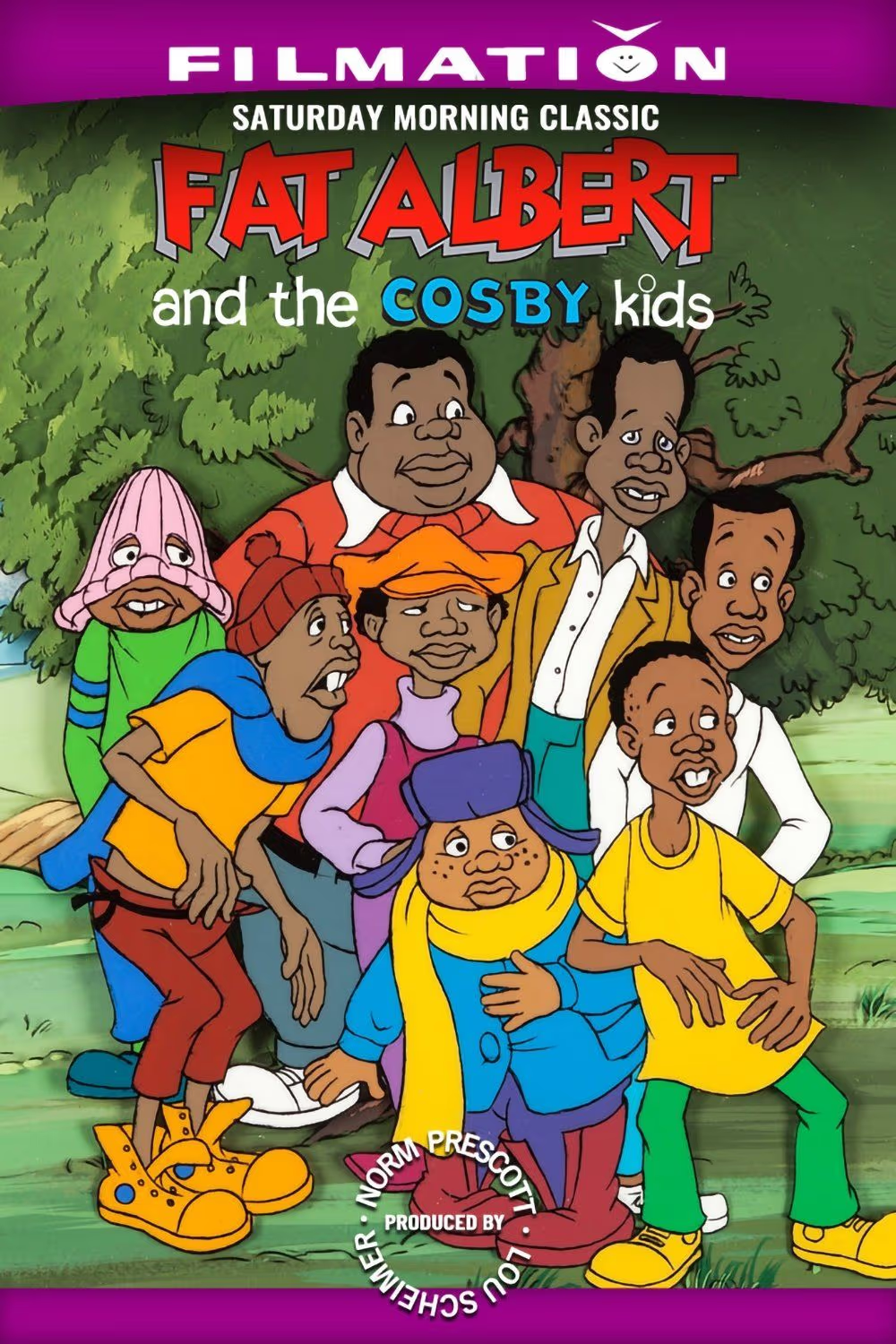
The Adventures of Fat Albert and the Cosby Kids (or Fat Albert) and Good Times: Black Again (or Good Times) share a number of commonalities. They’re both animated series that explore Black urban life. They both use comedy to address social realism. They both engage in Black storytelling. 

And, unlike many other animated series about African-Americans (e.g., The Boondocks; The Proud Family; The PJs), they both include a billiard episode. Fat Albert aired the episode “Double or Nothing” in which Rudy learns a valuable lesson about winning big when he is tricked into gambling by a pool shark. Good Times premiered with the episode “Meet the Evans of New”, in which Reggie Evans gambles in billiards so he can win enough money to pay the heating bill in his apartment.

But, those similarities pale in comparison to how wildly different these two series are. Let’s just say Fat Albert’s Philadelphia and Reggie Evan’s Chicago may as well be a million miles apart.

“Double or Nothing”

Fat Albert.2Fat Albert  is an educational animated television series created, produced, and hosted (with live action interstitials and bookends) by comedian Bill Cosby. The series ran from 1972 to 1985, long before Cosby became synonymous with celebrity sexual assault. (He was convicted in 2018.) The show was inspired by Cosby’s remembrances of growing up in Philadelphia. It also reflected the intersection of both Cosby’s penchant for observational comedy, with recollections of his childhood, and his educational training. (Cosby received his Doctorate in Education in 1976 and did his dissertation on integrating the visual media of Fat Albert into Elementary School Curriculum.)

In the “Double or Nothing” episode from the series’ final season, Rudy Davis, the smooth talking, cocksure member of Cosby’s Junkyard Gang, is befriended by Arnie, who admires  Rudy’s billiards skills and wants help improving his game. Eager to impress, Rudy gives Arnie some lessons and then takes him for some money. But, Rudy is too blind and greedy to recognize that Arnie is a pool shark.  Rudy quickly loses back the money, and then loses the Cosby Kids’ money, too, when he tries to go ‘double or nothing.’  Still convinced it’s only a streak of bad luck, Rudy is even prepared to wager his special watch, but fortunately Fat Albert intervenes, reveals the ploy, and sends Arnie scrambling.

Fat Albert.1The billiards storyline is pretty standard fare. What makes “Double or Nothing” interesting are the mini homilies Cosby delivers throughout the episode. He declares, “Rudy is not a very good loser. Of course, if he wants to keep on gambling, he better be, because losing is what gambling is all about.” He adds, “That’s the way gambling is. There’s no way to be a winner,” dismisses it as “for dopes,” and concludes that it is “not smart” but “downright stupid….” He leaves no wiggle room about the moral turpitude of gambling. Fat Albert is similarly decisive, saying,
“Gambling is for losers, and I’m not going to help you [Rudy] lose any more.”

The  “Double or Nothing” episode is available to watch for free with ads on DailyMotion.

“Meet the Evans of New”

Good Times.2You may remember meeting the original Evans family – James, Florida, Michael, Willona, and J.J (Mr. “Dy-no-mite!”) – when Good Times aired in the 1970s or reran in syndication. The show tackled complex and challenging issues about growing up in the Cabrini-Green housing projects of inner city Chicago.

Well, in 2024, an executive production team that included Norman Lear (who produced the original Good Times), Seth McFarlane (of Family Guy fame), and NBA phenom Steph Curry launched the animated Good Times: Back Again on Netflix, and it was a spectacular failure. Canceled after one season, the series was condemned by critics, audiences and multiple civil rights organizations as a “racist cartoon” that trolled in negative, crass and obscene portrayals of African-Americans.

“Meet the Evans of New” opens with the Evans family learning their heat has been turned off. After failing to raise the extra cash through his taxi cab driving day job, Reggie explains to his son Junior that to “take care of his family in a respectable way,” they must gamble in billiards. Using his grandfather’s cue stick, Reggie quickly beats most of the patrons, boasting, “Pool is in my genes and once I sink this 8-ball all your cash will be too [in my jeans].” He quickly amasses a small fortune, further schooling his son that pool halls are for “shit-talking”…it’s a place where men can “talk by themselves and can’t get into trouble.” But, before Reggie can sink the final shot against Minnesota Matt, who deigned to call him “the c-word…COWARD!,” he has to forfeit the game to rescue his youngest son.

Good Times.1Aside from presenting gambling at pool in a more virtuous light, this scene probably doesn’t offer the starkest contrast between Good Times and Fat Albert. But, if you thought that pool scene marked the apex of crudeness, the remaining 20 minutes will disabuse you of that notion. They include: Junior waking from a possible wet dream on the couch; Reggie standing naked in front of his daughter; Junior wishing his “Dad’s sudsy bits can go back to normal [from the shrinkage]”; chicken buckets being used as lamp shades; babies dealing crack; a trio of babies (Baby, Lil’ Baby, and Baby Baby) shooting guns at other other babies; Beverly phoning “Not Whitey, but the True Almighty” Black Jesus for favors; Beverly visibly lactating; Beverly using her lactating breasts as a makeshift GPS to locate their kidnapped child; Dalvin doing a “key bump of formula”; a white woman wishing she had bought a Cambodian baby (instead of a black one) for adoption because “those babies are way more grateful”; Dalvin seeing a woman in a revealing top and requesting some milk; and a full-blown attack on spam, “a pink racist meat designed in a lab by a pink racist.”

All 10 episodes of Good Times are available to stream on Netflix.

Snooker Man

Perhaps as a subconscious tribute to the late Rob Reiner, director of This Is Spinal Tap, the greatest mockumentary ever made, I am kicking off 2026 with a review of the 2024 UK film Snooker Man, which won’t be entering the pantheon of great mockumentaries any time soon.

Snooker ManThat’s not to say the premise isn’t clever:  Johnny “Snooker Man” Bonnar, the 17th-rated lookalike for the great world snooker champion Ronnie O’Sullivan, stumbles into an avocation in miniature snooker and pursues a path to challenge the reigning champion Wolfgang in the World Championship of Miniature Snooker (WCMS).

Humorously, the genesis of this original film concept began with Snooker Man director Pete Casserly winning a “best adult short film award” at the Dorking Film Festival in 2020. Casserly’s film was about someone trying to audition for a role as Rodney Trotter, the lead of a musical version of the British sitcom Only Fools and Horses. In Casserly’s film, the lead actor, Nick Hayles, is said to look like Bruce Campbell, the star of Sam Raimi’s famous cult film Evil Dead. While it’s a decent resemblance, Casserly’s mother said Hayles looked much more like Ronnie O’Sullivan. And, so the germs of the mockumentary Snooker Man were born.

Snooker Man starts on a high note. The opening credits pay tribute to the James Bond movie Skyfall with the fluid graphics, dissolving and reassembling motifs, balletic characters, and super-imposed silhouettes (of a snooker player!). The title song “Snooker Man,” sung by Nekane, also harkens to Adele’s “Skyfall” in musical tone, though hardly in lyrics (“The ladies want him | The gentlemen want to be him | He’s a snooker man”).

But, it’s not too long before you not only realize the film has nothing to do with James Bond, aside from featuring a Daniel Craig impersonator who acts out scenes from Casino Royale, but also that the rest of the movie is not nearly as clever.

Nick Hayles

The 17th-rated Ronnie O’Sullivan lookalike

First, we are introduced to Johnny Bonarr (Nick Hayles) and his pitiable career starring in terrible movies, such as The Girl With Two Masks; To Kill a Princess; and Chihuahua Man. (Making this even more twisted is these clips are from real movies created by Casserly, who shared in an interview that by inserting these clips, “I kind of made fun of how terrible they were as an apology to the actors who unfortunately had to take part in them!”)

Ronnie Photo

The real Rocket Ronnie O’Sullivan

Johnny made these films with Barry Keane (Stephen Sheridan), an unaccomplished director who unsuccessfully aims to double for British stage thespian Toby Jones. When that fails, Keane launches Prestige Lookalikes, the UK’s lowest-rated lookalike agency, and hires Johnny to double as Ronnie O’Sullivan. He’s the 17th-ranked lookalike, which everyone agrees is pretty pathetic, given he’s impersonating the world’s #1 rated snooker player.

Johnny’s deteriorating career takes an unsuspecting u-turn, when he needs to emulate The Rocket by shooting on a 36” snooker table. His performance, or rather the fact there is a film crew on the premises capturing his cue strokes, enrages  the sport’s reigning foul-mouthed champion, Wolfgang, who challenges him to a future match. Soon, there is a new miniature snooker wunderkind making waves, and his name is Snooker Man, a player even capable of running a 147 break in under four minutes.

Now, I’m more than happy to watch a competitive match of a miniaturized sport, especially one that I love as much as billiards. And, miniature sports are not as outlandish as one might think. Fun fact: there are real, professional world championships of miniature golf, miniature soccer (i.e., foosball), table hockey, and Subbuteo table football. And, as the director Casserley notes in an interview, there are also world championships for everything from cup stacking to Rubik’s Cube solving to air guitar playing. So, is miniature snooker really such a stretch? 

Snooker Mani image1

Notice something missing from that table?

But, match after match after match starts to get downright dull, a far cry from the “nonstop thrill ride of ball potting action” that the WCMS marketing promises. A rogue’s gallery of opponents, including The Ambassador and Hong Kong’s reigning champ Queenie, does little to enliven the atmosphere. And the final match, pitting Snooker Man against Wolfgang, is predictable, unenjoyable, and unforgivable for not even having the right number of balls on the snooker table.

The movie’s post-credits, which include Snooker Man embarrassingly performing his new K-pop single “Baegman Janga (Millionaire J)” that reached 287th in the Korean music charts, only cement the film’s downward creative spiral from its opening credits.

Snooker Man is available to watch on Amazon Prime Video. For a limited time, it is also currently streaming for free on YouTube.

Billiards Movies In Memoriam

As we prepare to close out 2025, we must pause to remember the many billiards movies that we lost – not necessarily this year, but during the 12 years that I’ve been blogging. These unrealized films had inspiration and potential, even if they never came to fruition. 

Every year, aspiring filmmakers strive to bring their visions and stories to the screen. But, the cinematic highway is fraught with challenges, from securing funding to navigating logistics, from uniting craftspeople to cutting through legal red tape. While it’s true that an estimated 10,000 movies are now produced each year, there are too many gems that never get made and perhaps never stood a chance.

We raise our cue sticks to those who hoped to inspire and entertain and to their films that never were. 

Ride the 9

Ride the 9Of all the billiards movies I hoped would get produced, Blake West and Jordan Marder’s Ride the 9 was my favorite. Murmurs and titillations about the movie first started in 2011; by 2014, when I interviewed West and Marder, it seemed like the movie was around the corner. A well-produced teaser video that highlighted the gritty New Orleans set locations, jaw-dropping trick shots courtesy of Florian “Venom” Kohler, and a killer soundtrack, all furthered the excitement. Marder also assured us that while the film is “not about pool, pool is integral to the story…it’s the glue.” Sadly, the team could not secure the necessary funding, and by 2017 the tweets and Facebook posts were done. 

The Fisher Queens

Fisher QueensFormer WPBA touring professional Kim Shaw teamed up with television director Julie Edwards in an attempt to tell the story of Mandy Fisher, Allison Fisher and Kelly Fisher, three unrelated UK snooker champions. According to the marketing, this documentary film would “not only provide a historical record of the rise of women’s professional billiards but will also provide an insight into the minds of three women who have shaped and dominated a sport traditionally viewed as predominantly male.” Unfortunately, an unsuccessful Kickstarter campaign sealed the film’s fate, and on May 1, 2015, it was announced on Facebook the documentary would not get made.

From Hustler to Champion

Seven months after the demise of The Fisher Queens, we also lost Philip Messina’s documentary-to-be, From Hustler to Champion, which promised to profile 20 of the best past and present pool players in the industry. Those “champions” included Shane Van Boening, Earl Strickland, Ewa Laurance, Efren Reyes, Allison Fisher, Karen Corr, and Johnny Archer, to name just a handful. The film would tell the “untold story of the extraordinary men and women who have transcended every obstacle to become legends.” Audiences would “experience these astonishing individuals—artists, wizards, road warriors, clinicians, entertainers and more—whose passion sets them on a path unlike any other in the sports world.” The quest to raise $55,000 on Kickstarter netted just 27% of their goal, though their concept video for the documentary is still available on their funding page.

Bred in Manila

Bred in ManilaOriginally from New York, and now living in the Philippines, Phil Giordano began working on the script for Bred in Manila (originally titled Supot) in 2016.  For the next three years, he did “countless hours of research, location scouting, interviews, late night anecdote-filled drinking sessions, script revisions, pitches, meetings, begging, crying, cheering, and overall filmmaking heartache” to tell the story of a female pool player who is trying to escape the world of illegal gambling in back alley pool halls. Years later, in 2022, I stumbled across an online poster for the film and reached out to Giordano. He shared that the film was “his biggest passion project,” but that it lost its funding and he hadn’t been able to find alternative financing. This tale however may have a happy ending. While I cannot yet confirm, Giordano’s current movie, Bilyarista, sounds like it may be a retitled Bred in Manila. The movie is about a girl living in the slums of Manila who “dreams of becoming a billiards World Champion, but when her father is killed, she is manipulated by Itoy, her hustler uncle, into playing in dangerous underground gambling matches in back-alley pool halls.”  

The Rematch

Rematch TheHaving released the piss-poor snooker film Perfect Break in 2020, director Len Evans embarked on a follow-up entitled The Rematch, with appearances by snooker household names Jimmy White and John Virgo. At one point, the movie had a poster, website, and fundraising campaign; however, all evidence of the film is now gone, and Evans’ profile on IMDB is equally devoid of mention of this former pet project.

Billiards Boy vs Dr. Pool

With its frivolous title and its story about an aspiring pool player named Billiards Boy who attempts to take down the legendary Dr Pool, this short film seemed intent on injecting some playfulness into the billiards film genre.  But, in 2020, the film’s co-producer, Jake Hourd, emailed me, explaining it was “a university project, and the writer/director decided he wasn’t going to finish it. He just wasn’t pleased with the outcome of the script and the footage so he scrapped it.” 

Billiardo

BilliardoNot to be confused with the identically-named Palestinian film Billiardo from 2016, the 2017 almost-film Billiardo from director Gabe Rodriguez was intended to be the story of a poor busboy who plays a fateful game of pool that may change his life. But, in 2020, I tracked down the writer/actor Ahmet Devran Dayanc, who cryptically shared with me, “the movie couldn’t be completed because of the director’s action.” 

Manitoba Sharks

When I wrote about Amanda Kindzierski in 2016 about her forthcoming documentary, Manitoba Sharks, it was hard not to get inspired. With $20,000 of funding from a pitch contest she had won, Kindzierski was committed to telling the “story of pool in Manitoba through the eyes of Aboriginal proprietors and players who are among the best in the world.” Manitoba Sharks was in post-production at the time of our conversation, so it’s sad the film apparently never found a distributor. Fortunately, as evidenced by her long list of projects on her website, Kindzierski has remained busy.

Potting Black

Potting BlackThe Fisher Queens was not only the film influenced by Mandy Fisher, an English former professional snooker player and a World Women’s Snooker Championship winner in 1984. A trio of third year filmmaking students at UWE Bristol also leaned into her story when they attempted to make Potting Black, a short film set in 1976 Britain about Pauline, a female snooker player in a game dominated by men. The director Marley Hamilton wrote, “This story is rich with historical influences and will take the audience on an emotional journey as they see Pauline stand up for herself and make a difference just as Mandy Fisher did.” While the film’s Crowdfunder page indicates it was successful in its fundraising efforts, all traces and mentions of the film disappeared from social media after early 2020.